Goryshin Archaeological Site: Remains of a Medieval Town
Site at a Glance
- Popularity
- Very Low
- Country
- Russia
- Primary era
- Medieval
- Eras represented
- Medieval
- Civilizations
- Grand Duchy of Lithuania
- Site type
- Military
- Remains
- Citadel
On this page6 sections
History
The Goryshin Archaeological Site, the remains of a medieval town, lies northeast of Loshakovo in Tver Oblast, Russia. Goryshin existed from the eleventh to the seventeenth century, when it was a frontier town caught between the shifting territories of Lithuania and Moscow.
Lithuanian and Moscow rule
During Lithuania’s eastward expansion, Goryshin belonged to the Grand Duchy of Lithuania. It was probably burned in 1335 by forces of Ivan Kalita, a prince of Moscow. In a 1371 charter to Philotheus, the senior bishop of Constantinople’s Eastern Orthodox Church, Lithuania’s grand duke Algirdas named Goryshin among his towns taken by Moscow forces during the Lithuanian-Moscow War of 1368–1372. A list compiled between 1375 and 1381 also classified it as Lithuanian.
Goryshin probably returned to the Principality of Moscow in 1381–1382. A treaty between Russia and Lithuania in 1449 confirmed Moscow’s possession of the town.
Administrative role and destruction
From the fifteenth century to the early seventeenth, Goryshin served as a pogost, a local ecclesiastical and administrative center, and as the center of Goryshin Volost, a local administrative district within Rzhev District. In 1581, near the end of the Livonian War, a conflict involving Russia and powers in the Baltic region, the town suffered during operations by a Polish-Lithuanian army led by Prince Radziwill.
During the Time of Troubles, a period of political crisis in Russia in the early seventeenth century, Polish forces burned Goryshin. The town was not rebuilt. It is recognized as a Russian cultural heritage site of federal significance.
Remains
Hilltop fort and settlement
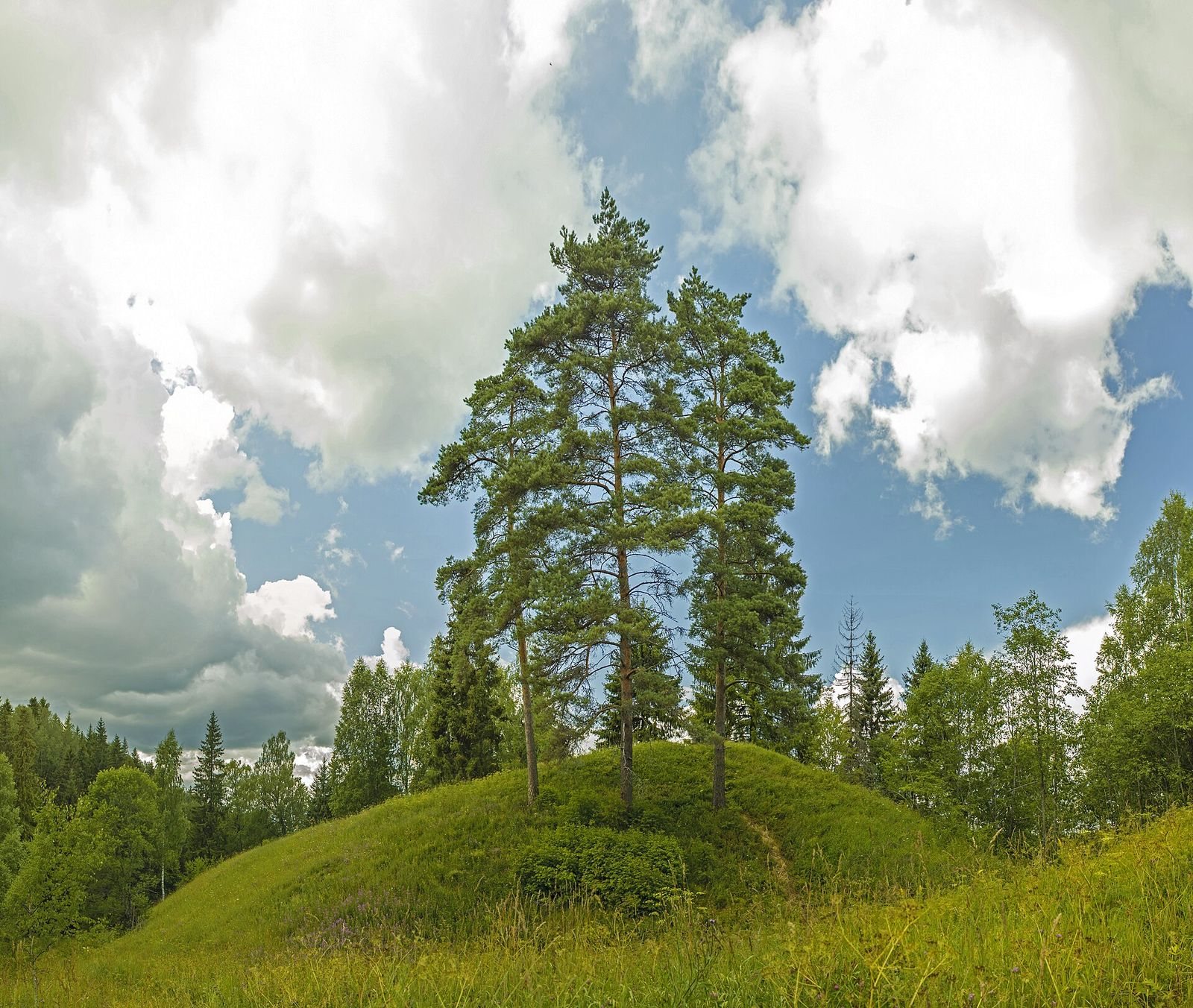
The site occupies a headland on the Volga’s right bank, northeast of Loshakovo. Ravines bound it to the west and south. The fortified area stands on the summit of a hill about 40 metres high, separated from the riverbank by a deep ravine. Its oval platform measures 50 by 20 metres, and traces of its artificial defences are poorly preserved. North of the fort lies an unfortified posad, a settlement associated with a fortified town.
The cultural layer is about one metre deep and contains burnt-stone fragments, animal bones, and pieces of Old Russian pottery dating from the eleventh to fourteenth centuries.
Churches of St Nicholas
A wooden Church of St Nicholas stood in Goryshin while the town served as a pogost and administrative center from the fifteenth to early seventeenth century. A stone Church of St Nicholas, built in 1783, adjoins the site on the east and is partly ruined.