Gongxian Grottoes: A Northern Wei Buddhist Cave-Temple Complex
Site at a Glance
- Popularity
- Medium
- Country
- China
- Primary era
- Medieval
- Eras represented
- Medieval
- Civilizations
- Tang
- Site type
- Religious
- Remains
- Temple
On this page17 sections
History
The Gongxian Grottoes are a Buddhist cave-temple complex in Gongyi, Henan, China, whose principal caves were carved in the early sixth century under the Northern Wei, a Chinese dynasty. Their sculptures preserve Northern Wei traditions while reflecting changes in Chinese Buddhist art, and their monumental cliff carvings have been interpreted as an early precedent for large Buddha figures carved into cliffs during the Tang dynasty.
Northern Wei foundation
Tradition credits Emperor Xiaowen, who ruled from 471 to 499, with founding the monastery associated with the grottoes. A Tang-era inscription connects the monastery with Xiaowen, but its wording has also been understood to mean that the institution began after his reign. Another inscription has been read as evidence that Emperor Xuanwu took part in excavating the caves. The caves themselves are generally assigned to the later Northern Wei, in the early sixth century. Their construction took place in stages, and the exact sequence and dates of individual caves remain uncertain.
The five principal caves appear to have been carefully planned. The complex is often interpreted as a royal Northern Wei foundation, perhaps a restricted temple not intended for ordinary worshippers; another interpretation sees it as an imperial precinct. Its patron is not known. Empress Dowager Ling, a senior ruler at the Northern Wei court, has been proposed, while another theory credits the Zheng family of Xingyang, whose members served as Northern Wei officials.
Changing patronage and Tang carving
After the Heyin Incident, a violent political crisis that contributed to Northern Wei’s decline, support for the grottoes shifted away from the imperial household toward private donors. New image niches were then added less systematically. By 528, the caves may no longer have been reserved exclusively for imperial use. In 531, lay worshippers carved a niche on the outer cliff, and dozens more were added under the Eastern Wei, Western Wei, and Northern Qi, successor Chinese dynasties.
Carving was especially extensive under the Northern Qi and Tang. Images associated with King Udayana, a ruler in Buddhist tradition linked with an early image of the Buddha, were made between 656 and 661. Sculptural work reached a peak in 666–668, when artists also repaired older Buddha figures. Across these successive phases, the grottoes became an important record of changing Chinese sculpture.
Monastery, later work, and conservation
A 662 inscription describes the monastery as fallen into disrepair and unoccupied. Its name changed over the centuries: it was called Jingtu, or Pure Land, Temple during the Tang and Song dynasties, Pure Land Chan Temple under the Ming, and Grotto Temple from the Qing period onward. Repairs took place under the Eastern Wei, Western Wei, Northern Qi, Tang, Song, Jin, Ming, and Qing, including during the Qing dynasty’s Yongzheng era.
Before the establishment of the People’s Republic of China, the grottoes suffered extensive theft. A bodhisattva removed from Cave 5 is now held at the Fogg Art Museum at Harvard University. Édouard Chavannes published 18 photographs of the caves, taken in 1907, in a work issued in Paris in 1909. In 1954, workers cleared accumulated silt from the caves and built a protective structure. Conservation from 1973 onward included bonding, repointing, and repairs, as well as a large drainage channel, expanded boundary walls, and other buildings. The grottoes became a National Key Cultural Relic Protection Unit in 1982.
Remains
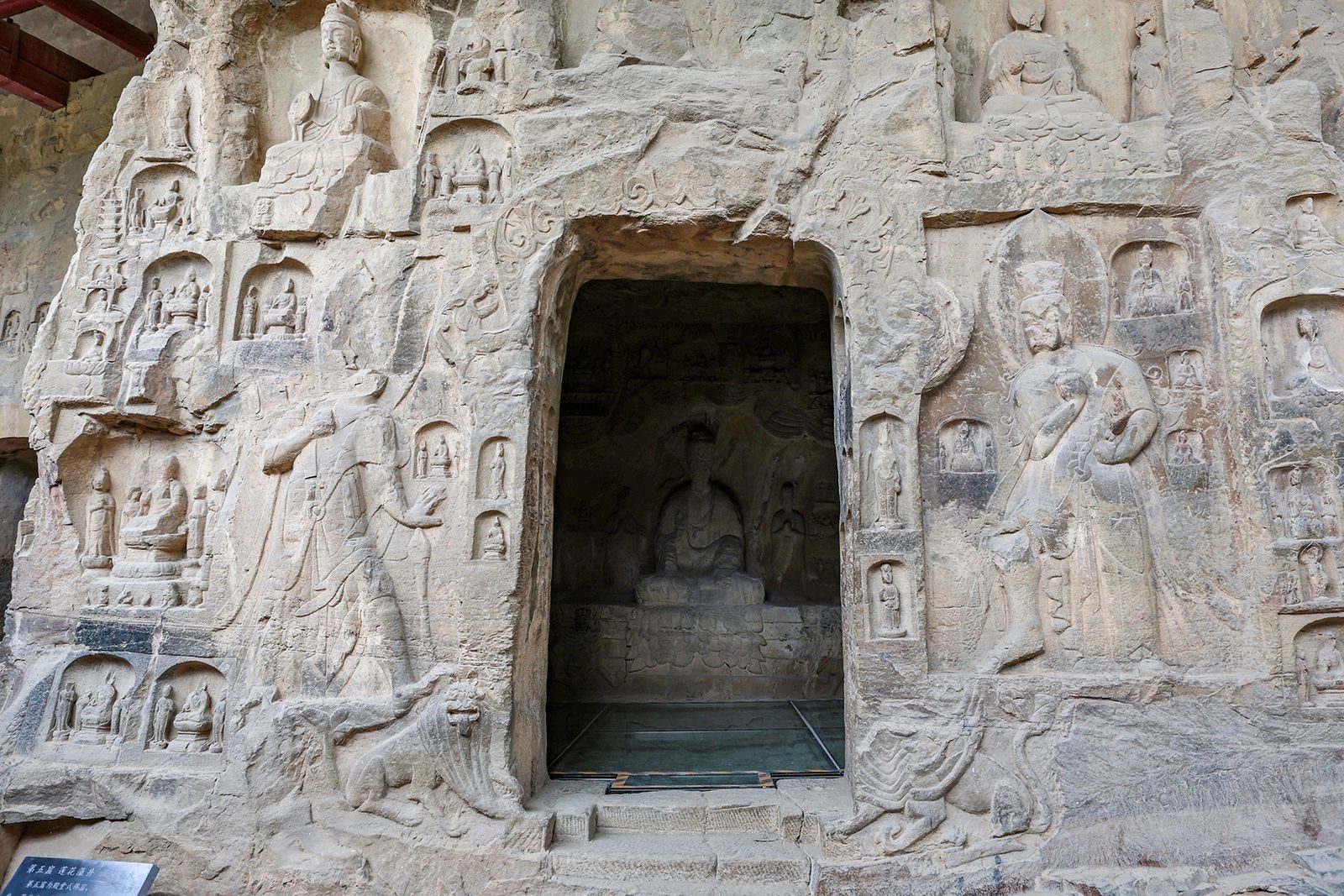
The grottoes lie in central Henan between Dali Mountain to the north and the Luo River to the south, about 44 kilometres east of old Luoyang. The complex has western, central, and eastern areas. Caves 1 and 2 occupy the western area; Caves 3–5 and the Thousand-Buddha Niche are in the east, with Northern Qi niches in the central area. The site includes five caves, three large cliff-carved statues, one Thousand-Buddha Niche, 328 image niches, about 7,743 Buddhist figures, and 256 inscribed steles and tablets. Inscriptions, Buddhist scripture texts, eulogies, and poetry are also carved in the complex.
The five caves
Cave 1
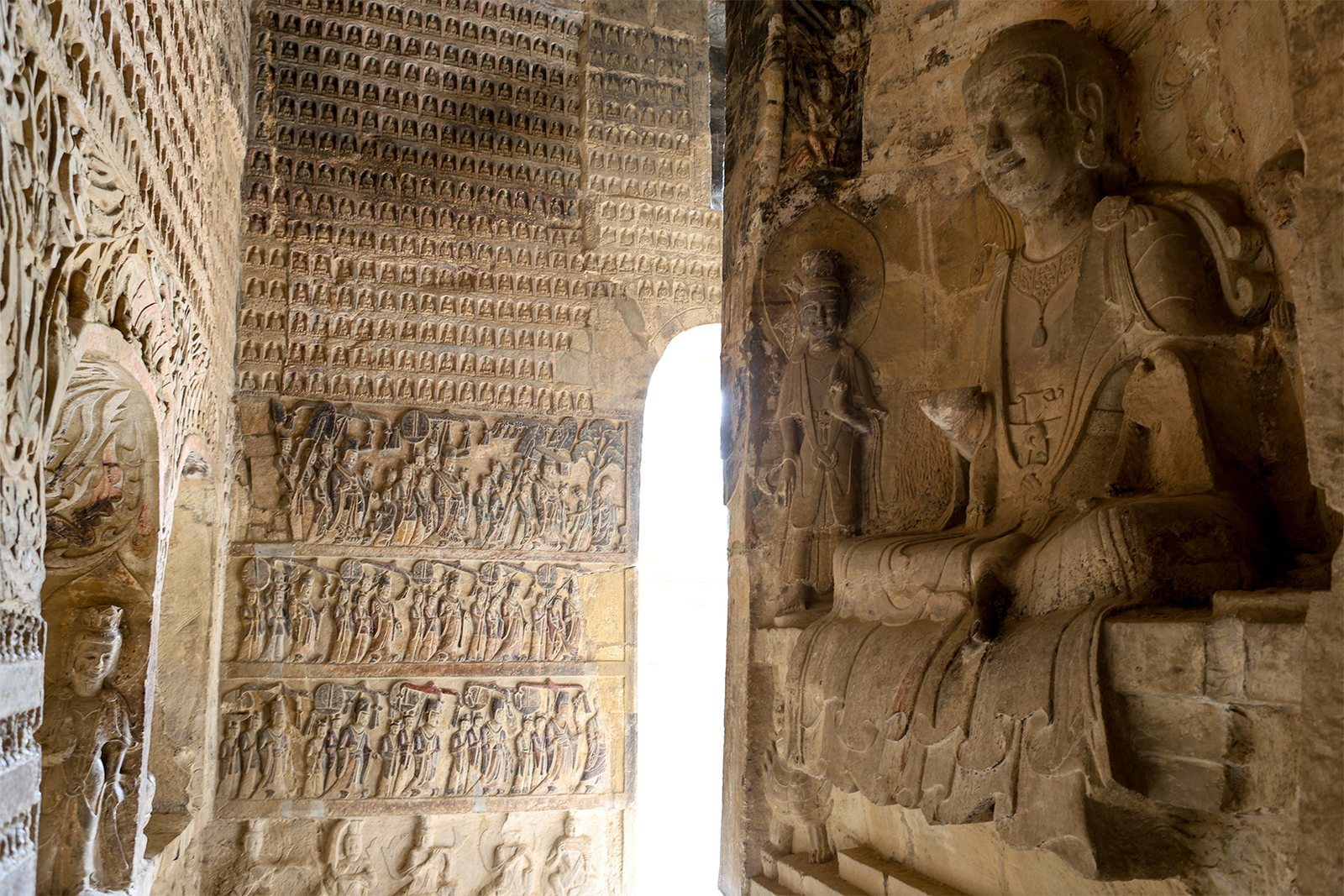
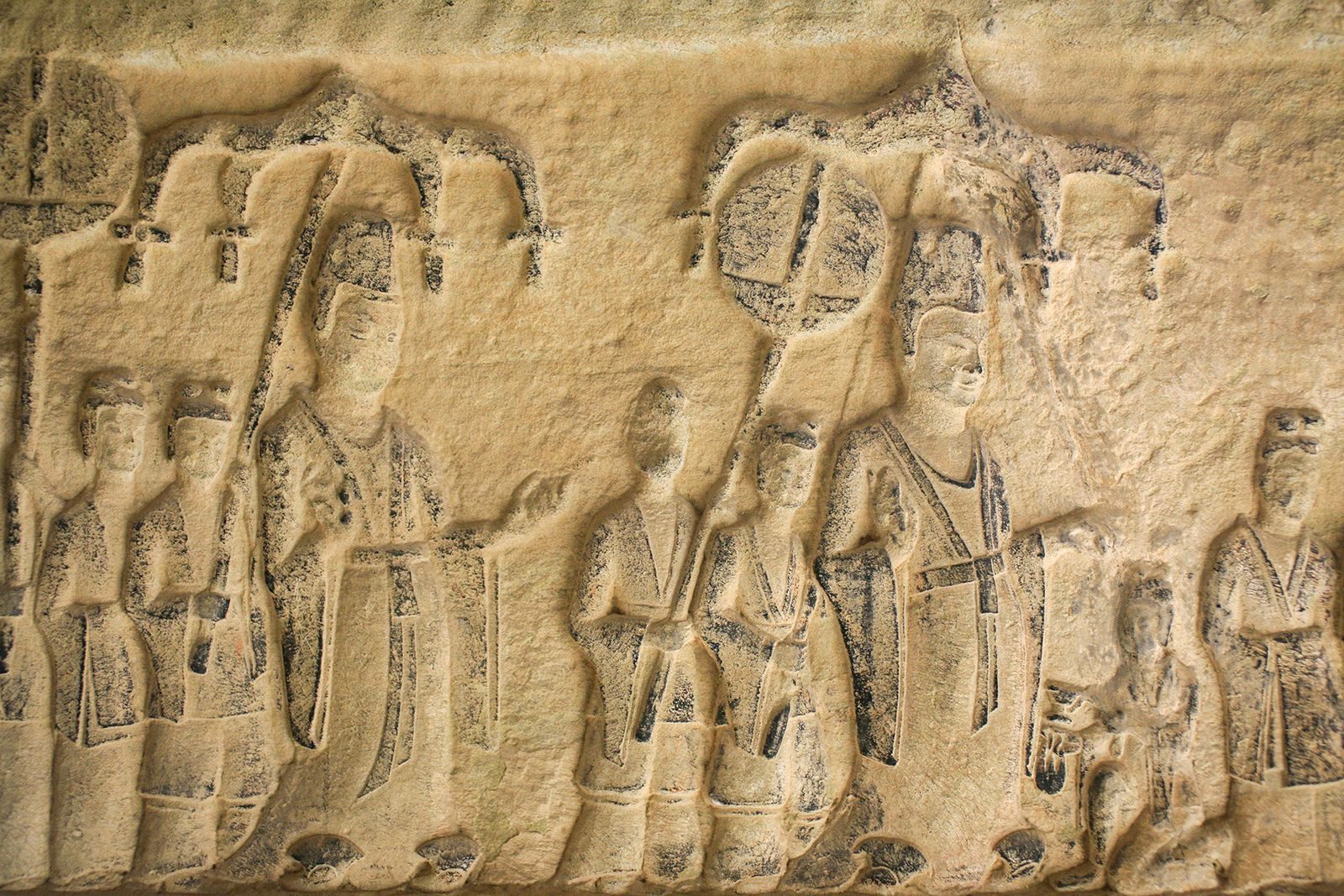
Cave 1 is about five metres deep and has a square chamber approximately six metres high. At its centre stands a square pillar, 2.8 metres on each side. Each of the pillar’s four faces has a large niche with a Buddha, two bodhisattvas, and two disciples; lions flank the Buddha’s seat. Four lotus-born figures, shown emerging from lotuses, are carved above the pillar, with another four where it meets the ceiling’s recessed panels. Each of the east, west, and north walls has four large niches. On the south wall, three tiers of imperial worship scenes sit below small-Buddha niches beside the entrance, with the emperor shown to the east and the empress to the west.
A square window sits over the entrance, with guardian figures on either side. Above the western guardian are two rows of arhats, people who have attained enlightenment, and a cliff-carved bodhisattva. A Buddha and bodhisattva above the eastern guardian are damaged. Farther east, a large cliff niche holds a standing Buddha 5.3 metres high with two bodhisattvas. The outside of the entrance is also carved with a Buddha and two bodhisattvas.
Cave 2
Cave 2 is unfinished, and its front wall has collapsed. It is about five metres deep and has a central pillar. Eleven niches remain inside: one on the east wall dates to the Eastern Wei, while ten are Tang-period carvings. Three niches are arranged vertically on the pillar’s south side. The lowest and largest dates to 661–663. Four niches occupy the pillar’s east side, including a larger upper niche dated to 667.
Cave 3
Cave 3 has a square plan, a ceiling divided into recessed panels, and a square central pillar with a large niche on each face. Every niche contains a Buddha, two bodhisattvas, and two disciples. Two small-Buddha niches flank the entrance on the south wall, with three tiers of worship scenes below them; the eastern scene is badly damaged. The east, west, and north walls each have a principal niche containing Buddhist figures.
Cave 4
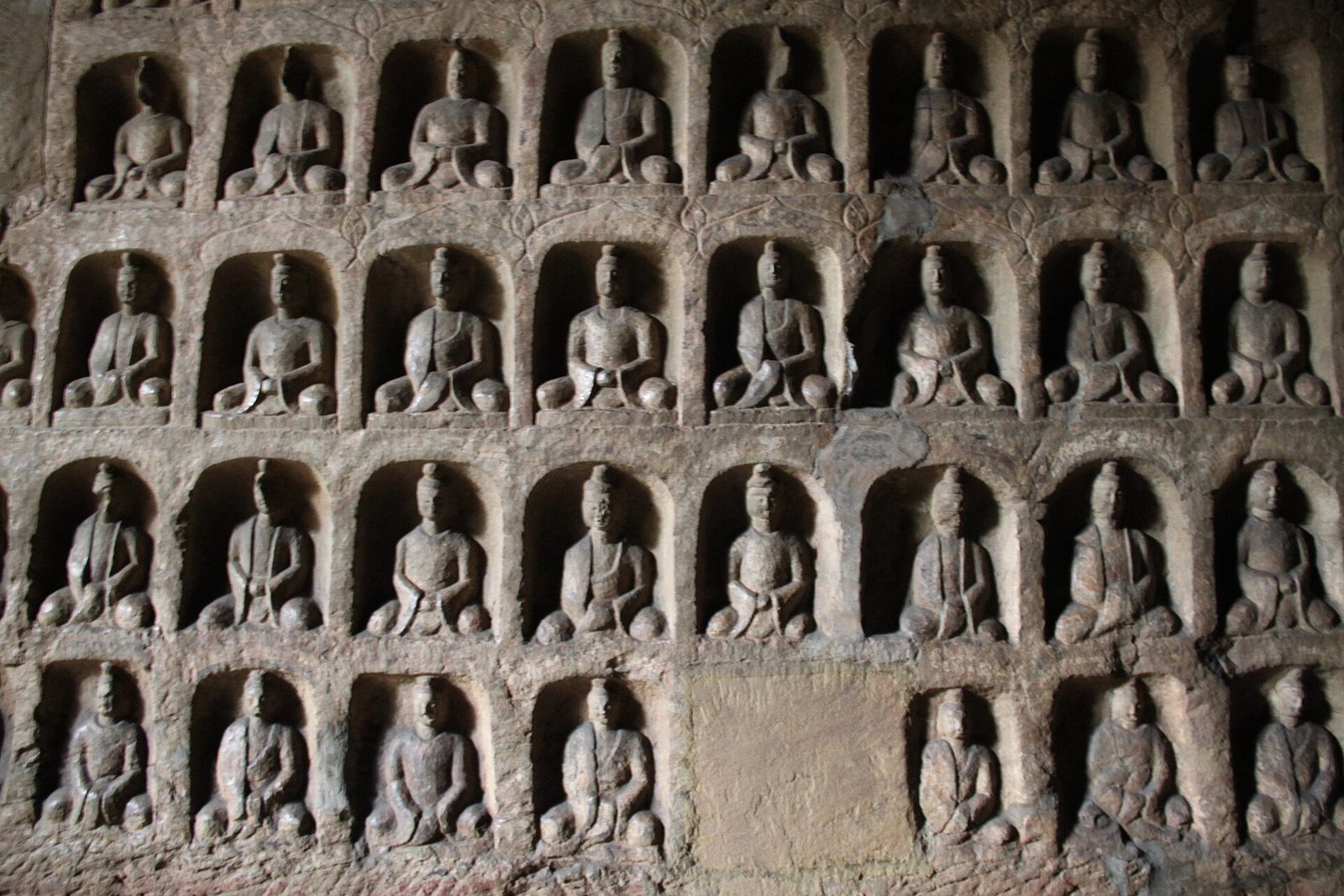
Cave 4 is square, with a central pillar bearing two tiers of niches on each face. The upper niches contain a Buddha, two bodhisattvas, and two disciples; the lower ones show a Buddha with two bodhisattvas. A hanging-curtain pattern runs around the upper walls. Below it, each of the east, west, and north walls has sixteen tiers of small-Buddha niches. Four more tiers stand on either side above the south-wall entrance. Beneath the small-Buddha niche east of the entrance are two tiers of imperial worship scenes. Each of the other three walls also has a principal niche with Buddhist figures.
Cave 5
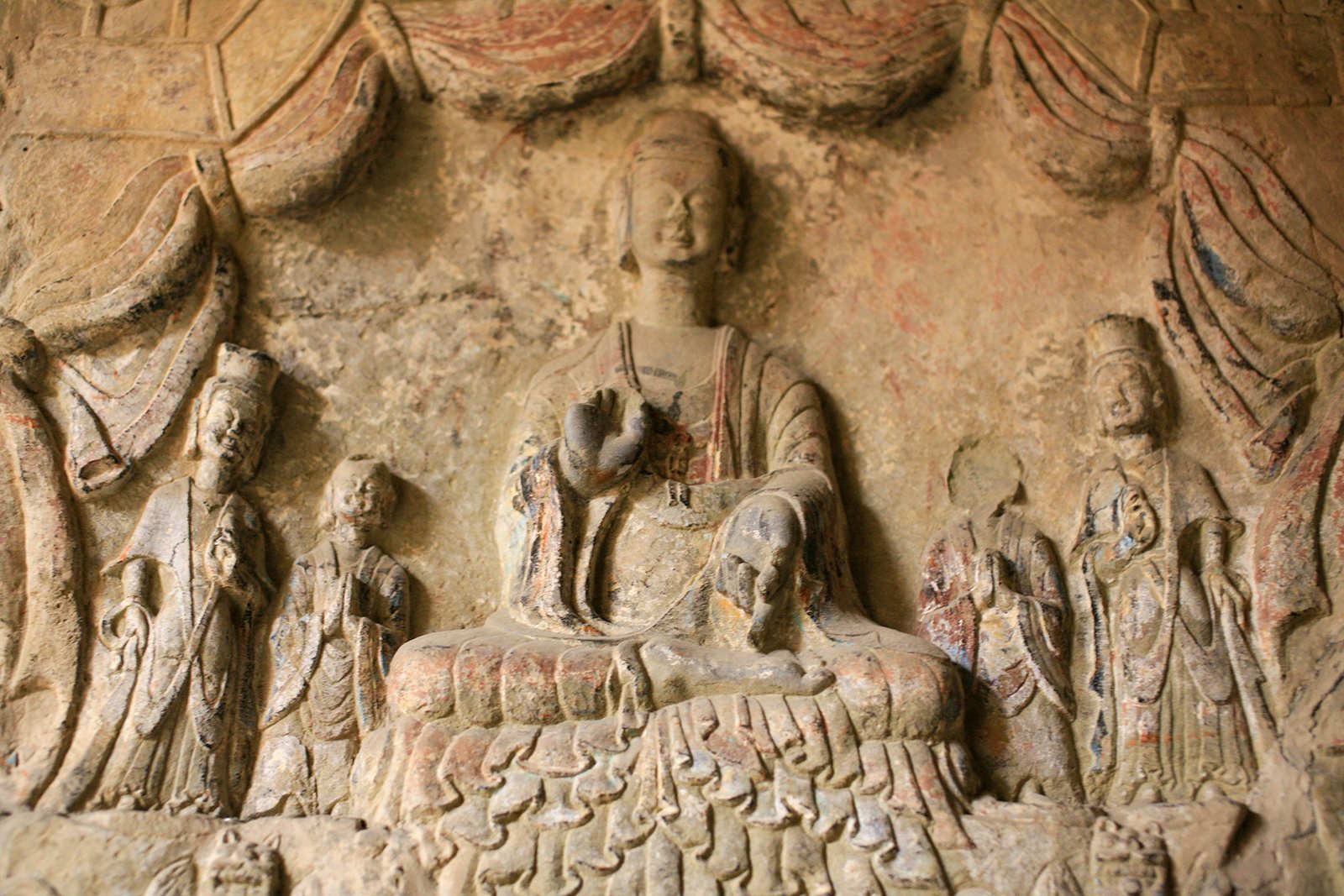
Cave 5 is nearly square, about three metres deep, and has no central pillar. Its ceiling features a lotus-shaped panel surrounded by six flying figures, with a lotus-born figure at each corner. The east, west, and north walls each have a niche containing a Buddha, two bodhisattvas, and two disciples. On the south wall, a standing Buddha rises from a lotus.
The eastern niche and cliff carvings
Thousand-Buddha Niche
At the eastern end of the complex, the Thousand-Buddha Niche dates to 666–668 and measures 1.5 metres high and 2.12 metres wide. A larger seated Buddha and an inscription occupy the niche, while its back and sides carry 1,000 small Buddha niches. Nine smaller niches outside it belong to the same period.
Carvings across the complex
Carved subjects include imperial worship scenes, musicians, dancers, guardian deities, mythical beasts, and figures of Vimalakirti, an enlightened lay figure in Mahayana Buddhism, and Manjushri, a bodhisattva associated with wisdom. The grottoes also depict the Buddha’s nirvana, his final passing, and a debate between Vimalakirti and Manjushri. Ceiling and floor carvings, along with images of musicians, divine kings, and beasts, remain in good condition.
Imagery and cave design
Buddhist imagery
The sculptures include seated Buddhas, cross-legged bodhisattvas, and two Buddhas seated together. Bodhisattvas are beings who seek buddhahood while working for the liberation of others. The many small Buddha niches surrounding larger images have been interpreted as representations of Buddhas in the ten directions, meaning the full expanse of the Buddhist cosmos. Considered together with the central pillars, this imagery has been understood to express the presence of Buddhas across past, present, and future. The exterior carvings have more than one interpretation: one sees them as a simplified version of the Three Buddhas theme in Longmen’s Binyang caves, while another views the complex as an ideal setting joining Buddhist art with popular beliefs. The Three Buddhas theme associates Buddhas with past, present, and future.
Central-pillar plan and sculptural style
A central-pillar cave has a pillar in the middle of the chamber, around which worshippers could walk. This is the principal cave type at Gongxian. Gongxian and Dunhuang use a square central pillar, unlike the central tower-shaped pillar at Yungang. The Gongxian design has been interpreted as a development from earlier Buddhist cave forms and as an influence on the later Xiangtangshan and Xumishan grottoes.
The carvings use fewer wind-swept poses, fluttering robes, and strongly modeled bodies than works popular in the late fifth century, and their robe lines are more simplified. These features have been read as signs of movement toward Sui and Tang artistic styles. Many of the exterior niches belong to periods after the Northern Wei, and some Tang carvings are regarded as particularly accomplished.