Garcia d’Ávila Tower House: A Fortified Colonial Estate in Bahia
Site at a Glance
- Country
- Brazil
- Primary era
- Early Modern
- Eras represented
- Early Modern
- Civilizations
- Portuguese
- Site type
- Military
- Remains
- Castle
On this page10 sections
History
Origins and construction
Garcia d’Ávila Tower House is a Portuguese colonial fortified complex at Praia do Forte, in Mata de São João, Bahia, Brazil. Tomé de Sousa, the first governor-general of Portuguese Brazil and the Crown’s chief colonial administrator, appointed his son Garcia de Sousa d’Ávila to build a coastal fortress. Work began in 1551 and was completed in 1624 under instructions issued by King John III of Portugal. With medieval characteristics, the complex became the centre of an inherited estate and a major centre of colonial military power.
The family’s origins were linked to Diogo Álvares Correia, known as Caramuru, and Catarina Álvares, a Tupinambá woman baptized in France as Catarina do Brasil. They were the first Christian couple in the Brazilian colony. Their descendants later became connected with Garcia d’Ávila’s family, which formed part of Bahia’s colonial aristocracy.
In the sixteenth century, the estate became a morgado, an inherited property intended to pass through a family line. Over more than two centuries, successive lords extended its holdings across more than 400 leagues of northeastern Brazil, an area roughly twice that of the captaincy of Piauí, a Portuguese colonial territory. Separate Ávila properties from Bahia to Maranhão covered about 800,000 square kilometres, approximately one tenth of present-day Brazil.
This expansion involved warfare against Indigenous peoples and their enslavement to work on sugar-cane plantations and mills, as well as in cattle raising. The estate also sought silver mines, but found only saltpeter mines. Its expeditions helped spread cattle raising through the region and were associated with the movement of goods along the Bahia Road, which supplied Minas Gerais. The growth of cattle work also helped shape the regional vaqueiro, or cattle herder, whose leather clothing protected against thorny vegetation.
Warfare and territorial expansion
During the Dutch invasions of Brazil from 1630 to 1654, part of the conflict between Dutch and Portuguese colonial powers, Garcia d’Ávila’s grandson Francisco Dias de Ávila Caramuru supplied men and provisions for the Portuguese defense. After the Portuguese defeat at the Battle of Mata Redonda in January 1636, the Tower House temporarily sheltered Giovanni di San Felice, Count of Bagnoli, who took command of Portuguese forces.
In the second half of the seventeenth century, Francisco Dias de Ávila II extended the family’s territory into the interior of Pernambuco after subduing the Cariris, an Indigenous people of Brazil. In 1704, at Governor-General Rodrigo da Costa’s request, Garcia de Ávila Pereira paid for the Fort of Tatuapara, intended to replace the already vanished Forte da Praia. He commanded three auxiliary companies assigned to guard the coast between the Real and Vermelho rivers. The fort’s artillery was probably completed around 1710 or 1711; the fort itself has since disappeared.
Independence, abandonment, and preservation
From 1798, the lords of the Tower House took part in the struggles for Brazilian independence. When Garcia de Ávila Pereira de Aragão died without heirs in 1805, the Tower entail passed to the Pires de Carvalho e Albuquerque family. During the 1822–1823 war, the complex served as a base for the Liberation Army of Cachoeira and supplied armed Cariri detachments equipped with bows and clubs. Joaquim Pires de Carvalho e Albuquerque became Viscount of Pirajá, Francisco Elesbão Pires de Carvalho e Albuquerque Baron of Jaguaripe, and Antônio Joaquim Pires de Carvalho e Albuquerque Viscount of the Tower of Garcia d’Ávila. Members of the family also received noble titles from Emperors Pedro I and Pedro II.
The independence war depleted the family’s resources, and the abolition of hereditary entails in Brazil from 1835 further weakened the estate. The Tower House was gradually abandoned. An Inquisition denunciation accused Garcia d’Ávila Pereira Aragão of torturing enslaved people and committing heresy against the Catholic faith. The accusation was not pursued, though it described alleged torture methods and equipment and people living at the sugar estate.
Brazil’s National Institute of Historic and Artistic Heritage listed the Tower House and the Chapel of Our Lady of the Conception as historic structures in 1938. In the 1980s, the Institute of Geography and History of Bahia prepared a restoration plan and submitted it to the regional heritage directorate. The property’s private ownership led to the establishment of the Garcia d’Ávila Foundation, with aims that included protecting and restoring the listed building and developing a cultural centre and historical museum.
Remains
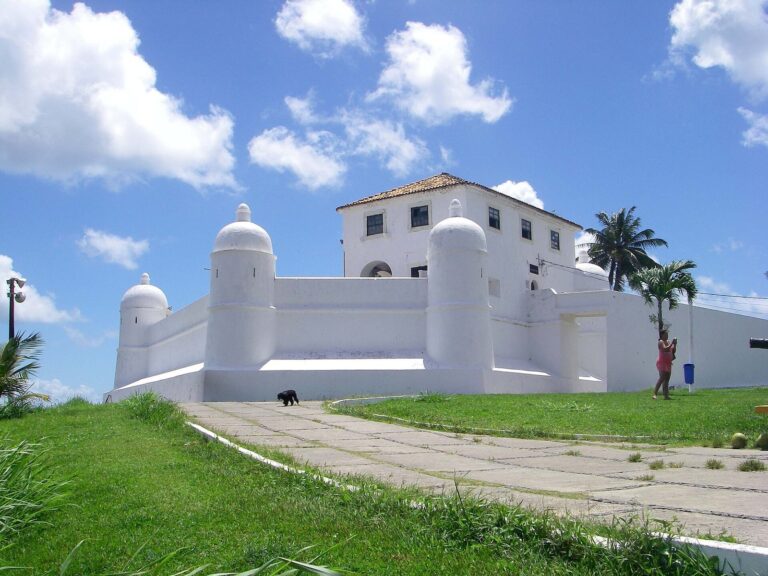
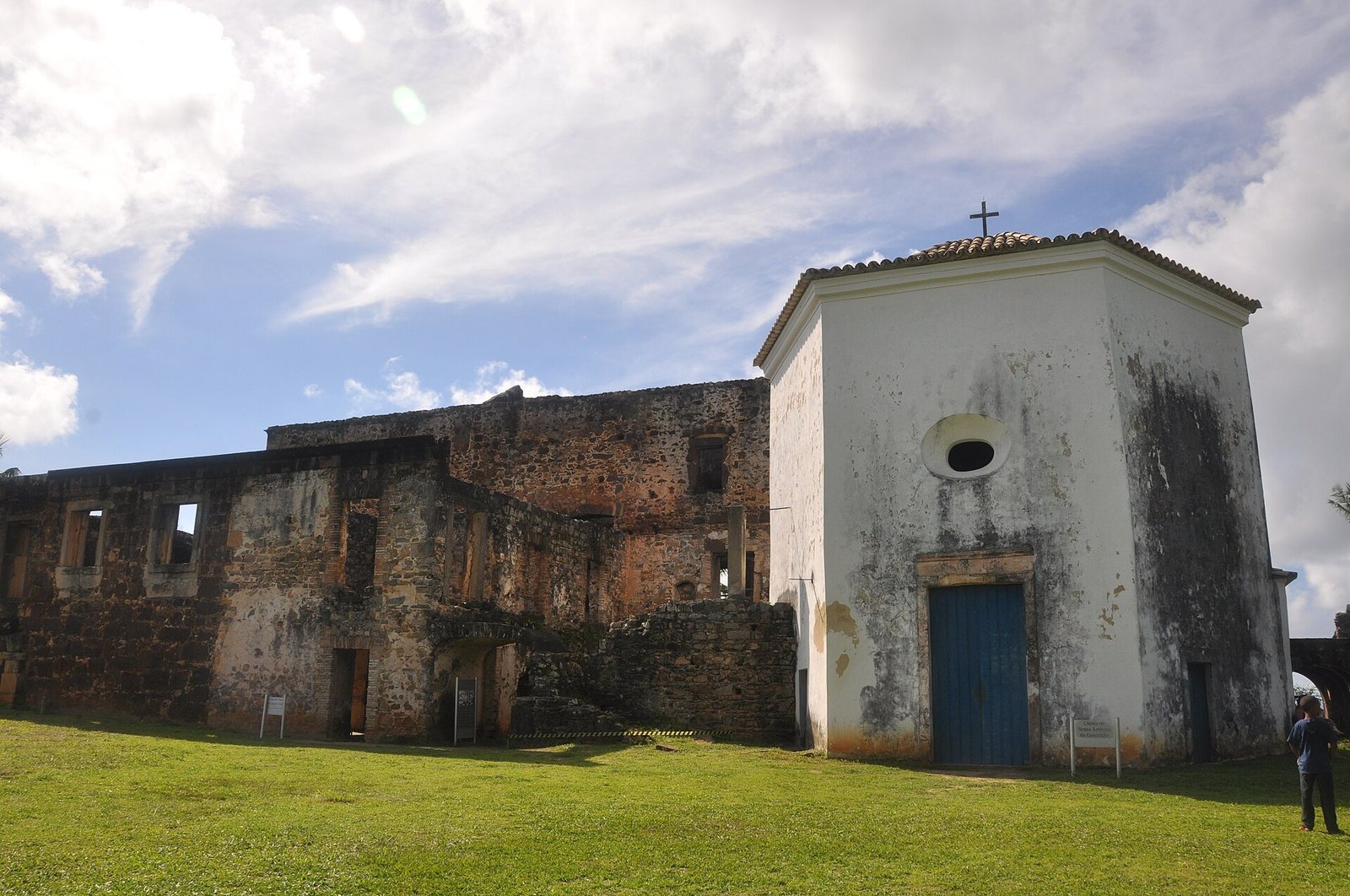
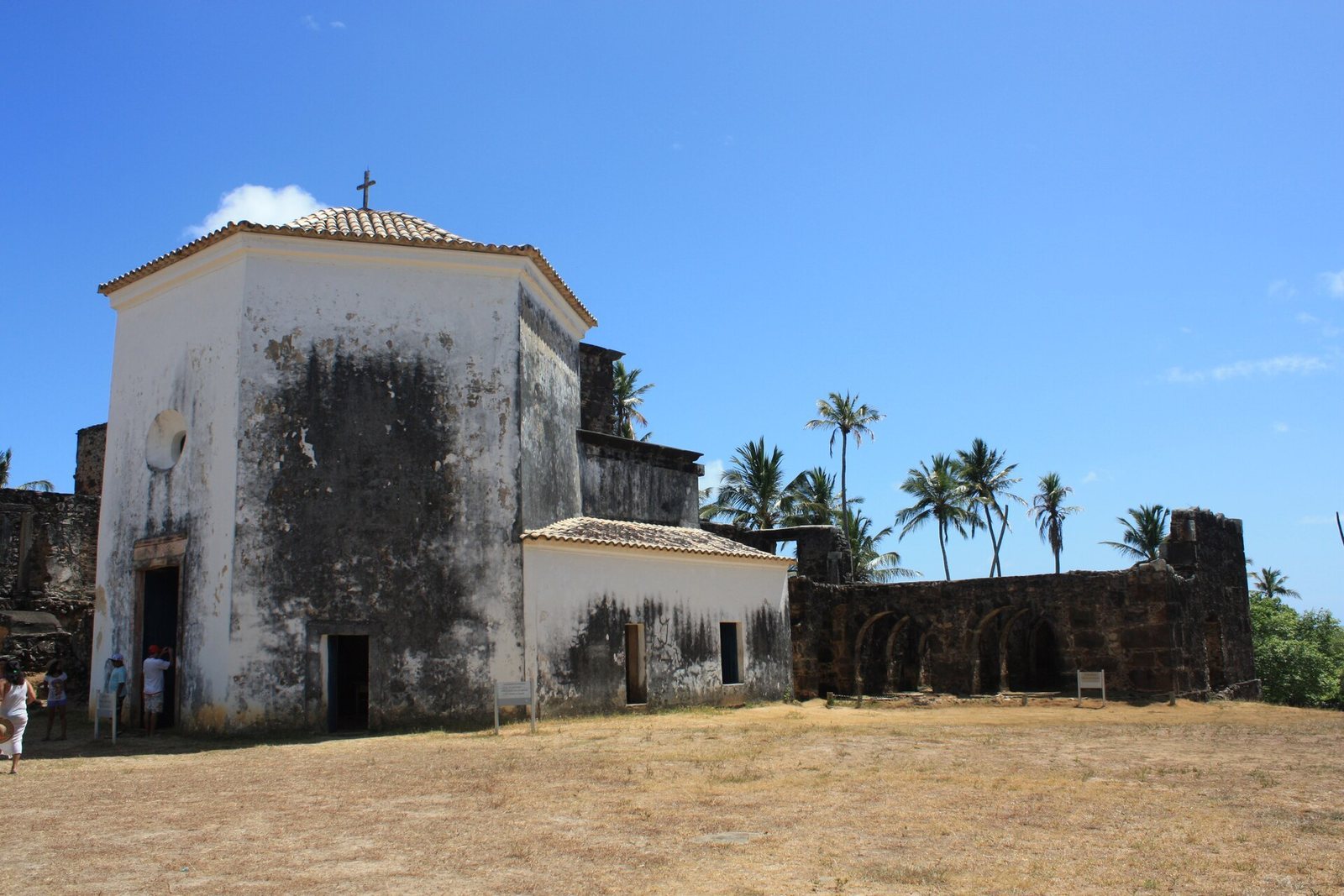
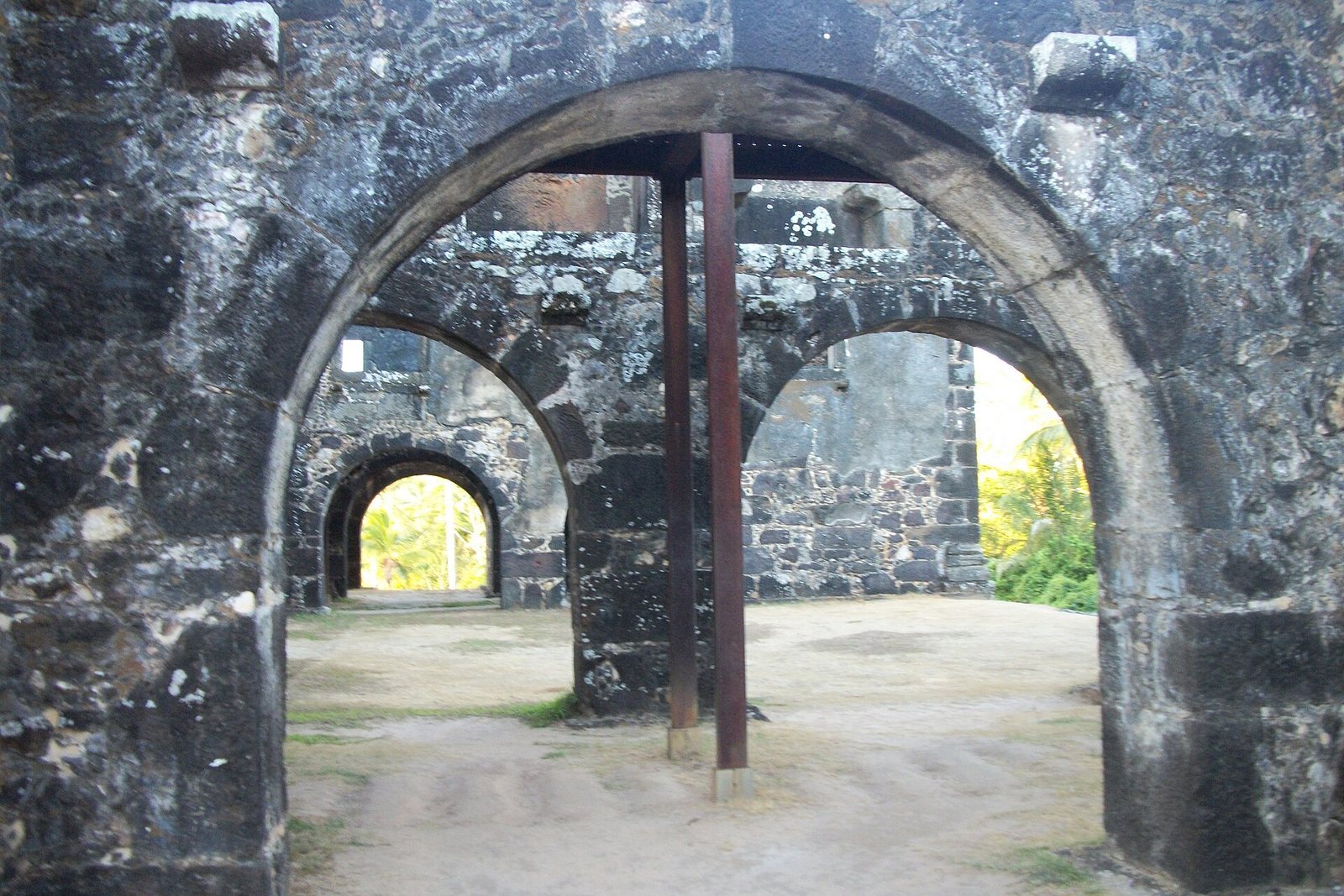
The complex stands on a hill at Praia do Forte, about 1,200 metres from a small natural harbour on the Atlantic coast, with a view of the ocean. Now in ruins, it combined residences, defensive works, a chapel, and a lookout bastion, a projecting defensive position. The original structure was called the Plain Tower of Saint Peter; the larger complex is also known as the Castle of Garcia d’Ávila.
Buildings and defenses
Chapel tower and adjoining rooms
The earliest structure, corresponding to the chapel, was a hexagonal tower with brick walls and a vaulted interior. Rooms beside it had domed ceilings and vaults formed by intersecting arches.
Stone fortification and courtyard
A later building phase added a stone fortification arranged symmetrically around an arms courtyard, an open space within the defended complex. Builders used stone and lime mortar, and a double staircase led to the first floor. In the early eighteenth century, the castle was enlarged in stone.
Lookout and warning signals
The complex also watched the coast and the interior. Fires were lit on special occasions, while smoke and torch signals conveyed coded warnings of approaching enemy ships toward Salvador through a chain of Jesuit villages and other small settlements.
Early depictions
Views by Portuguese cartographer João Teixeira Albernaz the Elder, associated with Bay of All Saints (1612) and The Book That Gives an Account of the State of Brazil (about 1616), show the building isolated on a mound. It appears as a small tower with three storeys, a notched upper wall, and narrow openings for arrows.