Fortress of Barbalho: A Fort Defending Salvador, Brazil
Site at a Glance
- Country
- Brazil
- Primary era
- Early Modern
- Eras represented
- Early Modern, Modern
- Civilizations
- Portuguese
- Site type
- Military
- Remains
- Fort
On this page8 sections
History
The Fortress of Barbalho, also known as the Fort of Our Lady of Mount Carmel, is a fort in Brazil that defended Salvador’s northern land approach. Its alternative name refers to Our Lady of Mount Carmel, a Catholic title for the Virgin Mary. The fort began as a redoubt during the second Dutch invasion of Brazil, a conflict that lasted from 1630 to 1654, and developed into part of the defenses of Salvador, then the capital of the Portuguese colonial territory called the State of Brazil.
From redoubt to fortified defense
In 1638, Captain Luís Barbalho Bezerra ordered a redoubt built at the site because he feared another Dutch attack on the Santo Antônio trenches. Under Governor-General Alexandre de Sousa Freire, the redoubt was rebuilt to an improved design using stone-and-lime masonry. An inscription gives 25 August 1712 as the completion date for this phase.
The fort’s defenses were enlarged under Viceroy Pedro Antônio de Noronha Albuquerque e Sousa as part of a 1714 plan for Salvador’s fortifications by French engineer Jean Massé. King João V had sent Massé to Brazil in 1712 to inspect and repair fortifications after French privateers attacked Rio de Janeiro in 1710 and 1711. Work continued under Viceroy Vasco Fernandes César de Meneses, but was interrupted when Captain-Engineer João Teixeira, responsible for works at Barbalho and the Fort of Morro de São Paulo, died. The fort was completed in 1736 under Viceroy André de Melo e Castro, Count of Galveias. An inscription states that João V ordered its construction and that it was completed under the Count. Together with the Fort of Santo Antônio beyond Carmo, Barbalho guarded Salvador’s northern land approach.
Independence and political unrest
During the Brazilian War of Independence (1822–1823), Portuguese troops under Brigadier Inácio Luís Madeira de Melo withdrew from Salvador. On 2 July 1823, Barbalho became the first fortification in the city to raise the Brazilian flag. The fort had also been used as Salvador’s public prison since 1828, by order of provincial president José Egídio Gordilho de Barbuda; the Imperial Government formally approved this use in 1845.
In 1831, soldiers mutinied and demonstrators gathered at the fort to demand the dismissal of General João Chrisostomo Callado, Commander of Arms. Provincial president Luís Paulo de Araújo Bastos granted the dismissal on 4 April. The fort’s command later joined the Sabinada, a 1837–1838 revolt in Bahia against imperial authority, and resisted imperial forces in 1838. After the fort fell, about 200 rebels were detained there.
Prison, infirmary, and military use
Repairs took place in 1853, and from 1855 the fort served as an infirmary for cholera patients from the São Lázaro lazaretto, a quarantine institution for people with infectious diseases. Emperor Pedro II visited in 1859. During the Christie Affair, a diplomatic dispute between Brazil and Britain in the 1860s, an 1863 report judged the fort unsuitable for defense and noted its use as a civil prison. Further repairs were made in 1886, when the fort was used to isolate smallpox patients.
Barbalho served as an artillery barracks from 1892 to 1920. It housed the 5th Position Artillery Battalion in 1904 and the 4th Position Artillery Battalion from 1915. On 10 January 1912, during President Hermes da Fonseca’s Policy of Salvations, a political intervention policy, the fort joined the forts of São Marcelo and São Pedro in bombarding Salvador. The Government Palace, municipal hall, São João Theatre, and Public Library were hit; the library burned, destroying important documents from Bahia’s Public Archive. In 1958, the fort housed the 4th Guard Company and 6th Police Company of the 6th Military Region. It has been protected under Brazil’s national historic and artistic heritage system since 1957 and is used as a Military Police barracks.
Remains
Bastioned plan and interior
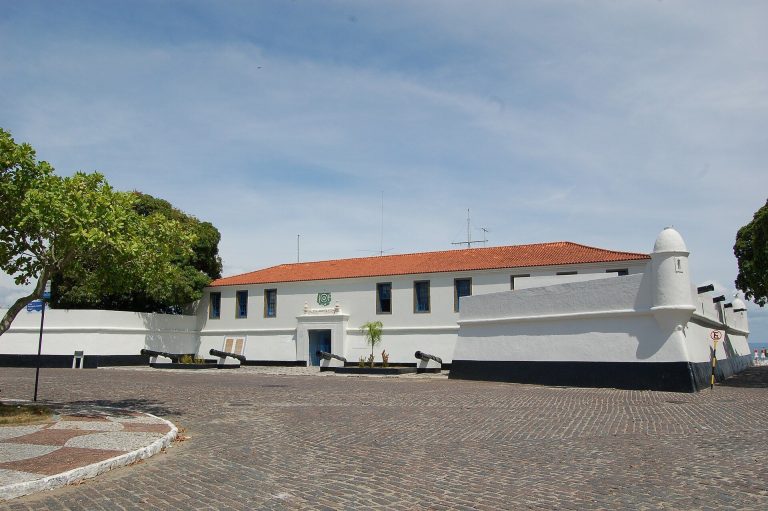
The fort has a regular quadrangular plan, with three pentagonal bastions and one circular bastion at the corners. A bastion is a projecting defensive work that helps protect a fort’s walls. A plan and façade made by José António Caldas around 1764 show ramps leading from the central terreplein, the level interior platform, to the bastions. Service buildings stood around this platform, sheltered by the walls. They included troop barracks and an equipment store. Beside the access ramp was the guardhouse, with the commander’s house above it.
Entrance and inscriptions
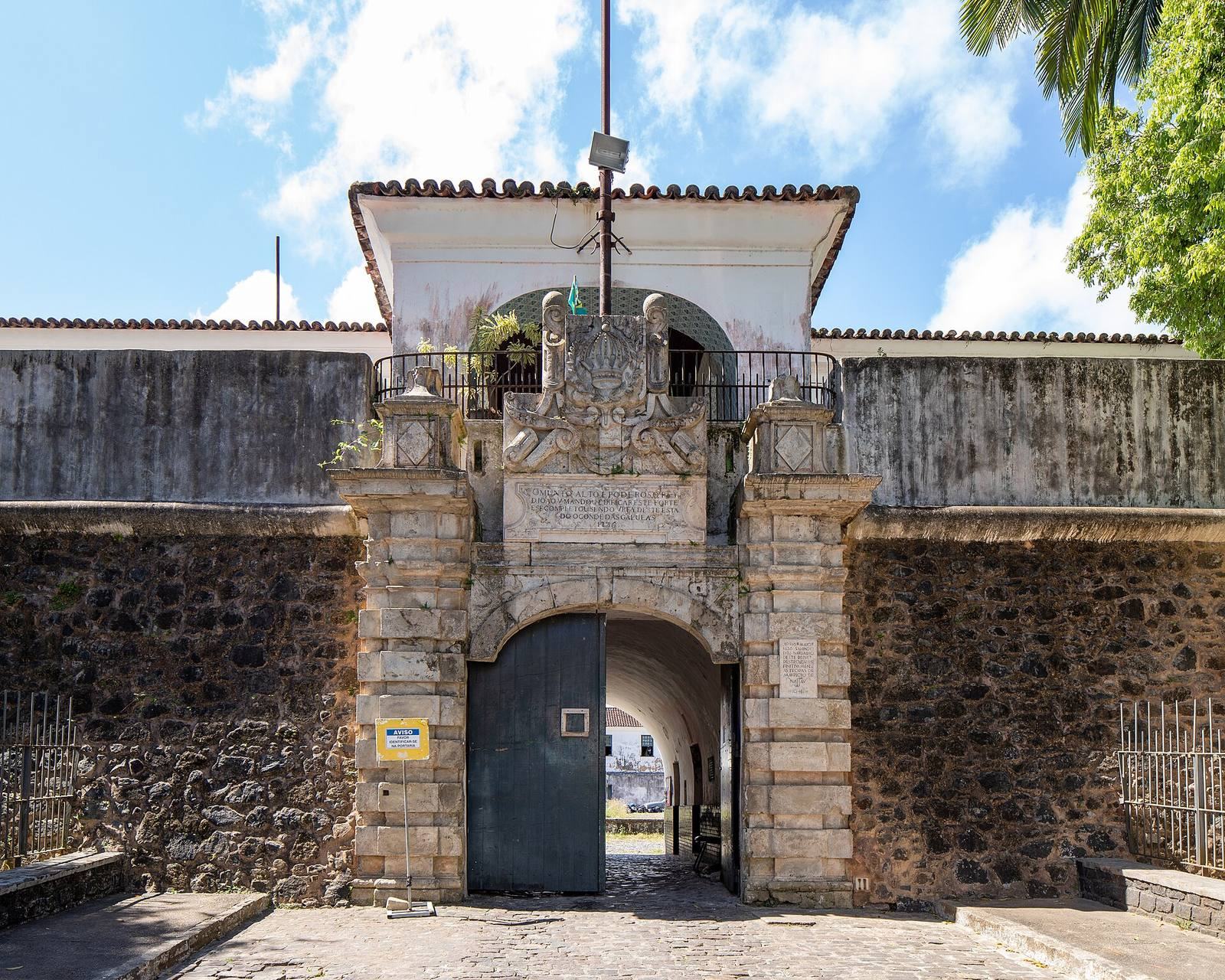
The entrance portal has a gallery-like form that was probably added during nineteenth-century alterations, and the gate is topped by the arms of the Empire. Two inscriptions above the entrance record the fort’s construction phases, including its completion in 1712 and its completion under the Count of Galveias in 1736. A separate inscription installed by the Geographic and Historical Institute of Bahia in 1938 commemorates Luís Barbalho Bezerra’s involvement in the conflict.
Artillery
The fort is believed to have held fifteen iron cannon in the mid-eighteenth century: six 24-pounders, three 18-pounders, three 10-pounders, and three 6-pounders. Its reported staff at that time consisted of a captain and three soldiers. In 1915, the fort received a 75-millimeter Krupp L/28 cannon.