Friars Carse: A Historic Estate and Country-House Hotel in Dumfriesshire


Site at a Glance
- Rating
- 4.4
- Popularity
- Low
- Country
- United Kingdom
- Primary era
- Modern
- External website
- Open
- Eras represented
- Medieval, Early Modern, Modern
- Civilizations
- British, Kingdom of Scotland
- Site type
- Domestic
- Remains
- Castle
On this page19 sections
History
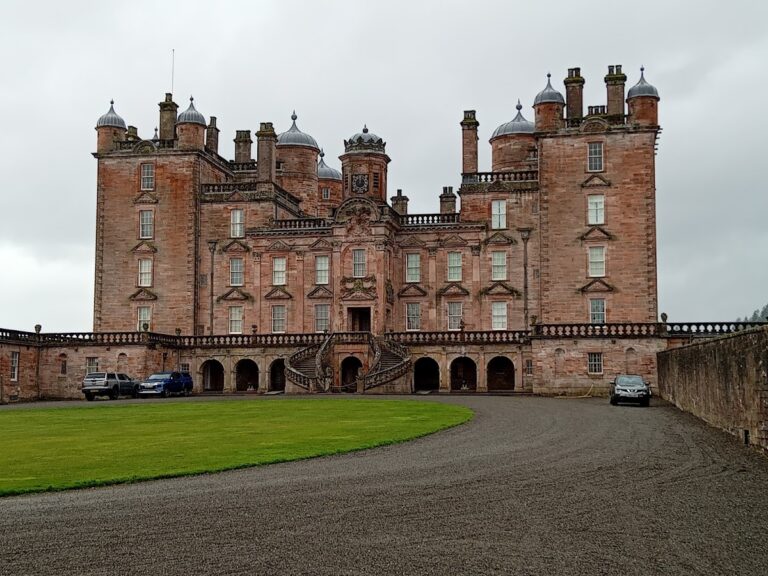
Friars Carse is a historic estate and mansion in the United Kingdom, at Auldgirth in Dumfriesshire, near the River Nith. Its origins reach back to a thirteenth-century monastic settlement associated with the Cistercian monks of Melrose Abbey, while the present country house was built in 1873 in the Scots Baronial style around an earlier mansion. The estate is especially associated with Robert Burns, who lived nearby at Ellisland Farm and formed an important, though ultimately troubled, friendship with Robert Riddell of Friars Carse.
Melrose Abbey and the medieval estate
The name Friars Carse derives from the nearby monastic settlement and was formerly written as “Carse of the Friars.” Around 1215, Affrica, daughter of Edgar, granted the lands of Carse to Melrose Abbey, holding them under King William the Lion. Cistercian communities commonly managed agricultural estates, mills, fishponds, and other working installations, and the place-name Grange Mill may preserve a reference to an outlying monastic holding belonging to the abbey.
In 1536, Abbot Andrew granted the lands of Freirkers and Grange Mill, together with associated milling rights, to John Kirkpatrick of Ellisland. Thomas Kirkpatrick and Janet Gordon held the property in 1565. After the Reformation, the estate passed through the Laird of Elliesland, a junior branch of the Kirkpatricks of Closeburn. A fortified Scottish residence known as Freerscarss was recorded by Timothy Pont on his map of Nithsdale around 1595.
Ownership before the Riddells
The lands had earlier belonged to the Red Comyn in the fourteenth century. After Comyn’s murder, they eventually passed to King Robert the Bruce. During the early seventeenth century the estate was held for a time by the Stirlings, then passed through Jean Stirling’s marriage to John Maxwell of Templand and subsequently to the Maxwell family.
John Irving, a merchant, had acquired the property before 1647. It later passed through the Maxwells of Tynwald and the Barncleugh family before reaching the Riddells through the Stirling, Maxwell, and Barncleugh lines in transactions associated with 1737 and 1784. William Riddell, the son of a Nova Scotia baronet from Roxburghshire, acquired the Friars Carse lands. His family’s Glenriddell estate had come through Walter Riddell of Newhouse’s marriage to his cousin Anne, whose family had held it since the Reformation and the secularisation of Melrose Abbey’s lands.
The Riddell mansion and Robert Burns
In 1771, Robert Riddell demolished the older ruinous buildings to make way for a new mansion. The house, generally identified as the Georgian mansion of Glenriddell, was built between 1771 and 1773. Riddell, who died in 1794, was a friend and patron of Robert Burns, and Friars Carse became an important setting in the poet’s life and work.
Burns lived at nearby Ellisland Farm from 1788 to 1791. Patrick Miller of Dalswinton probably introduced him to Captain Robert Riddell and Riddell’s wife, Elizabeth Kennedy of Manchester. In September 1788, Burns composed The Day Returns as a tribute to Robert and Elizabeth Riddell. In April 1791 he completed a collection of poems and songs for Riddell’s library, now known as the Glenriddell Manuscripts. The volume was later returned to Burns.
Burns and Riddell founded the Monkland Friendly Society at Dunscore. Riddell became president and Burns secretary, while the society maintained a 150-volume library and met every fourth Saturday. Their friendship ended after a drunken incident at Friars Carse in December 1783, traditionally called the “Rape of the Sabines.” Burns was expelled from the house, and Elizabeth Riddell never forgave him. The affair may also have damaged Burns’s reputation with his superiors in Edinburgh.
Another episode at the estate inspired The Whistle. On 16 October in either 1789 or 1790, three lairds competed to remain capable of blowing an inherited ebony whistle while drinking claret. Alexander Fergusson of Craigdarroch won after consuming more than eight bottles. Sir Robert Laurie collapsed, while Robert Riddell withdrew to bed. McMurdo of Drumlanrig, chamberlain to the Duke of Buccleuch, judged the contest with two neighbours as witnesses.
Tradition connected the ebony whistle with a Danish courtier serving either Prince George of Denmark or Anne of Denmark. Burns borrowed it after the contest and later arranged another drinking competition at the New Inn in Sanquhar. The winner of that contest is uncertain, and the whistle was reportedly accompanied by a Scandinavian drinking horn.
Changes of ownership in the nineteenth century
After Robert Riddell’s death, his widow refused to allow the estate to pass to his brother-in-law Walter Riddell under Robert’s will. The property was sold outside the family. Walter Riddell had made a fortune overseas and was married to the poet Maria Banks Woodley; he named his replacement estate in her honour.
Captain Smith later bought Glenriddell and sold it in 1809 to Provost John Crichton of Sanquhar, who acted for his brother, Dr James Crichton. Crichton had made his fortune through the East India Company’s China trade and had lived in Canton. He occupied the house in 1812, restored the name Friars Carse, and died there in 1823. His widow, Elizabeth Grierson, remained at the estate until her death in 1862.
Elizabeth Grierson’s bequest of £100,000 helped establish the Crichton Royal Hospital in Dumfries in memory of her husband. The identity of the hospital’s founder is uncertain, since its foundation is also attributed to Dr James Crichton himself. Before her death, Elizabeth Grierson sold the estate to Thomas Nelson of Carlisle, who was said to have been an engineer involved in the construction of the Forth Bridge. Nelson substantially enlarged the mansion, retained the old Whistle Room, and added Masonic symbols to the Hermitage in recognition of Burns’s interest in Freemasonry.
Institutional use and the hotel
In 1895, the trustees of the Crichton Royal Institution acquired Friars Carse and about 189 hectares of estate land. The mansion became a convalescent home connected with the treatment of people with mental illness. It served as a summer residence for selected paying patients, including aristocrats and members of the royal family, while non-paying patients were also accommodated and employed as servants. The institution sold the property in 1908 for £21,150.
After a period under the ownership of Charles Wedderburn Dickson, who extended the mansion again, his widow sold the estate to Bryn Asaph Ltd., an organisation for Post Office staff. The house then became a convalescent and holiday guest home commemorating Post Office employees who died in the two world wars. The Post Office Fellowship of Remembrance owned the estate in 2012. The mansion has operated as a country-house hotel since 1938, and two cottages near the former stables were converted into guest accommodation.
Burns, antiquarian activity, and local traditions
Burns used the Hermitage for writing poetry after receiving a key to its gate from Ellisland. He wrote verses for its window in memory of Robert Riddell. The original window was removed and sold for five guineas after 1835; it is now preserved at the Ellisland Farm museum. Manuscripts of The Whistle and Lines Written in the Hermitage were formerly held at Friars Carse.
The antiquary, artist, and author Francis Grose stayed at Friars Carse for several months while documenting local antiquities for The Antiquities of Scotland, published in 1797. His friendship and artistic collaboration with Burns contributed to the composition of Tam o’ Shanter. Annie Laurie, the subject of the song, died at Friars Carse on 5 April 1764 at the age of 81. Her burial place is uncertain, although Craigdarroch has been suggested.
Robert Riddell found a one-ounce gold ring set with a pale-blue stone near Friars Carse in May 1791. His antiquarian interests also led him to assemble stones from local sites, including Lag Castle and Morton Castle. A possible Roman encampment attributed to the Roman general Gnaeus Julius Agricola lies north of Friars Carse, while a suspected monastic site near the putting green and a mill on the Mains Burn at Carse Mains form part of the estate’s wider archaeological interest.
Historic Environment Scotland lists the former stables, including Beech Cottage, and the Hermitage as Category B listed buildings. This category protects historic buildings considered of regional or more-than-local importance under Scotland’s listed-building system. The former stables designation dates from 26 June 1986; the principal mansion is not listed.
Remains
Friars Carse occupies an estate beside the River Nith, with the mansion set among about 18.2 hectares of parkland, woodland, and pasture. The surviving buildings combine earlier tower-house fabric and later country-house additions. Red sandstone, courtyard planning, towers, crow-stepped gables, and carved or reused stones reflect the estate’s changing functions from medieval holding to landed residence and later institutional and hotel use.
The mansion and service buildings
The principal mansion
The present mansion is a Scots Baronial country house built in 1873 around an earlier building and extended between 1905 and 1909. It is constructed of dressed red sandstone. Its principal southeast range has a broad, complex frontage and includes a round tower with a rectangular second stage corbelled above it. An armorial panel dated 1598 was inserted into the entrance-tower range in 1909.
Inside, the house contains a panelled entrance hall, a wood-panelled snooker room, and an elegant staircase. The earlier residence developed from a sixteenth-century tower with a cap-house, a structure built above or beside the main tower, and a prominent parapet. During the seventeenth and eighteenth centuries, residential lodgings with crow-stepped gables were added around a courtyard.
The former stables and Beech Cottage
The former stables and Beech Cottage date mainly from the early nineteenth century. Their principal southeast range was remodelled around 1873 and given a tall, two-stage tower. Four single-storey ranges form a quadrangular courtyard, with a passage placed centrally beneath the tower. The group also includes a gabled dovecot.
An earlier monastic refectory survived into the eighteenth century. It was described as having walls about 2.4 metres thick and an open fireplace approximately 3.6 metres wide before it was demolished to make way for the mansion.
Water features and archaeological landscape
Carse Loch
Carse Loch, close to the mansion, was formerly the monks’ fishpond. Its artificial crannog, an island or platform built partly over water with timber piles and planks, provided a hiding place for valuables during English raids and other periods of warfare. When the loch was drained, a dugout canoe and other finds were recovered.
The river and estate woodland
The River Nith runs close to the mansion. Along its right bank, the estate’s fishing beat extends for about 2,300 metres and includes pools used for fly-fishing, spinning, and worm fishing for salmon, sea trout, and greyling. Woodlands line the riverbank, with old pedunculate oaks, fungi associated with ancient oaks such as beefsteak fungus, and notable old sycamores.
The 1855 Ordnance Survey map records several elements of the wider landscape, including an old summerhouse, the suspected monastic site near the putting green, Oak Knowe near the stables, Deadman’s Hole on the opposite bank of the Nith, Black Pool upstream of the hotel, and a small lochan near Penflowing Bridge. It also marks a mill on the Mains Burn at Carse Mains, together with a statue and seat at the beginning of the path to the Hermitage.
Crosses and Riddell’s stone collection
The ninth- or tenth-century cross
A ninth- or tenth-century cross stands on a modern base in the grounds. It is the only surviving piece of Captain Robert Riddell’s former collection of stones, which once stood along the driveway. The collection also included a cross with a basin, sundials, and later baptismal fonts. Those other objects are now in Dumfries Museum.
The Laugh Moor cross
The Laugh Moor cross stands on the old putting green and is thought to have originated as a ninth-century village cross from Morton Castle. It follows the form of a Celtic cross, although its ring and arms are broken away, and it was later reused as a horizontal gravestone. A pair of shears carved on one side may indicate that the person commemorated was a woman.
The cross rests on a later square sandstone base bearing a carved cross and the words “Laugh Moor” on its front. Its upper face carries the inscription “Ora Pro Anima Comerchie De Laugh,” meaning “Pray for the soul of De Laugh, foully murdered.” When Robert Riddell found the cross, it was being used as a gatepost, a former use indicated by a niche cut into its rear.
Templewood
Robert Riddell created an imitation Bronze Age stone circle called Templewood from weathered stones. It consisted of 38 stones, of which all but three were standing. One fallen stone lay at the centre and another immediately west of the circle.
The Hermitage
The original Hermitage was a small summerhouse, described as an “ivied cot,” built by Captain Robert Riddell in a secluded part of the estate a few fields from Ellisland. It measured approximately 3.19 by 2.43 metres and contained one window and an open fireplace. The word “BURNS” was carved above the lintel.
After Robert Riddell’s death, the building was neglected. By 1803 it was being used for livestock, and in 1810 it was described as derelict, with straw covering the floor, cattle damaging the surrounding trees, and window glass missing. By around 1870, only part of its east gable remained. A watercolour of the original Hermitage places it near the River Nith, some distance from the present building.
Thomas Nelson built a replacement Hermitage on the same site in 1874 in a different style. It has also been described as a refaced structure dating from around 1790. In 1879, it contained a representation of a monk lying on his back at the entrance, along with a chair and a small table. The replacement was restored in 2009 and provided with an interpretation board.
Burns’s verses were copied onto a window of the Hermitage, although the window was later removed to the mansion and the present windows no longer carry the inscription. A second window formerly bore verses commemorating Robert Riddell.