Lochmaben Castle: A Medieval Royal Stronghold in Scotland


Site at a Glance
- Rating
- 4
- Popularity
- Low
- Country
- United Kingdom
- Primary era
- Medieval
- External website
- Open
- Eras represented
- Medieval, Early Modern
- Civilizations
- English, Kingdom of Scotland
- Site type
- Military
- Remains
- Castle
On this page10 sections
History
Lochmaben Castle is a ruined medieval castle in Lochmaben, United Kingdom, in the historic Lordship or Barony of Annandale. It replaced a motte-and-bailey castle built by the Bruce family, Lords of Annandale, around 1160–1166, and the present stronghold was established beside Lochmaben Loch by Edward I of England in 1298 during the Wars of Scottish Independence, the conflicts in which Scotland resisted English attempts to establish control over the kingdom.
Bruce Foundations and English Control
The earlier Bruce castle stood south of the present site. After Edward I took it in 1298, he established a new position among woodland and marshes beside the loch. This location controlled routes through Annandale between Cumberland, Galloway, and Lothian. Edward’s first castle on the new site was a peel, a lightly built fortified enclosure formed from earthworks and a timber palisade. A more substantial castle followed around 1300, while much of the principal stone construction belongs to the late fourteenth century.
Robert the Brus, father of Robert the Bruce, tried and failed to capture the castle in 1299. Scottish forces burned it in 1301, and Robert the Bruce briefly held it in 1306 before it was recaptured by the future Edward II of England. The English took Lochmaben again in 1333, retaining it for approximately fifty years.
Capture, Destruction, and Crown Ownership
Archibald Douglas, Lord of Galloway, captured Lochmaben Castle from the English after a nine-day siege on 4 February 1384. The Earls of March and Douglas assisted him, and Douglas razed the castle to the ground. The castle and the barony subsequently passed to the Earls of March.
When the tenth Earl of March was forfeited and later reinstated, Lochmaben Castle and the Lordship or Barony of Annandale were excluded from the restoration. By July 1455, both were in the possession of Alexander Stewart, Duke of Albany. After his death in 1485, they were annexed to the Crown by an Act of Parliament dated 1 October 1487.
Rebuilding and Sixteenth-Century Conflict
During the reign of James IV, the castle was rebuilt or extensively repaired between 1488 and 1513. A mason called Gluffar built a hall in 1504, using locally sourced timber for its roof. James IV visited Lochmaben on 23 August that year and played cards with Lord Dacre, an English nobleman and border official.
Robert Lauder of The Bass became Captain and Keeper of Lochmaben Castle on 16 January 1509 for three years. He received a further seven-year appointment in March 1512. In 1605, the office was held by Sir William Cranstoun of that Ilk, later the first Lord Cranstoun.
James V was at Lochmaben in November 1542 in connection with the Battle of Solway Moss, an Anglo-Scottish battle in which the Scottish army was defeated by English forces near the Solway region. From Burnswark Hill, he watched fires being lit by the Scottish army, then returned to Stirling Castle after learning of the defeat.
During the Wars of the Rough Wooing, the mid-sixteenth-century conflicts linked to Henry VIII of England’s attempt to force a marriage alliance between his son Edward and Mary, Queen of Scots, Regent Arran besieged Lochmaben in November 1545. Lord Maxwell had allowed English forces to garrison his castles. James Crawford brought artillery from Edinburgh Castle, and Arran rewarded three gunners with drinksilver, a monetary payment made to artillerymen or other military personnel.
Mary, Queen of Scots, and the Later Sieges
Mary, Queen of Scots, and Lord Darnley visited Lochmaben in October 1565, after the Chaseabout Raid. Mary was Scotland’s monarch from 1542 to 1567, and Darnley was her second husband. On 23 June 1568, the castle surrendered to an army sent by Regent Moray against Mary’s supporters. A garrison commanded by James Douglas of Drumlanrig was installed, but supporters of Lord Maxwell who had been concealed in the castle overpowered Douglas’s men the following day.
Lord Maxwell held Lochmaben in 1588 while seeking to overthrow the Protestant monarchy. James VI besieged the castle with English assistance, and gunpowder was sent from Edinburgh. The keeper, David Maxwell, and five other men were hanged despite William Stewart of Monkton’s efforts to negotiate a surrender. One royal soldier was shot in the leg.
In June 1592, Francis Stewart, fifth Earl of Bothwell, was said to have infiltrated and captured the castle while disguised as a woman during an uprising against James VI. Crown control was soon restored. The castle remained politically and militarily important until after the beginning of the seventeenth century, when it underwent its last siege and was gradually abandoned. James allocated £1,600 sterling for repairs in 1624, but the work apparently was not carried out, and the castle was no longer in use by the seventeenth century.
Protection and Literary Afterlife
Lochmaben Castle received protected-monument status on 30 April 1937. The ruin is now a Scheduled Monument managed by Historic Environment Scotland, while the Earl of Mansfield remains the hereditary keeper of Bruce’s Castle of Lochmaben. The castle also appears in Jane Porter’s 1810 historical novel The Scottish Chiefs.
Remains
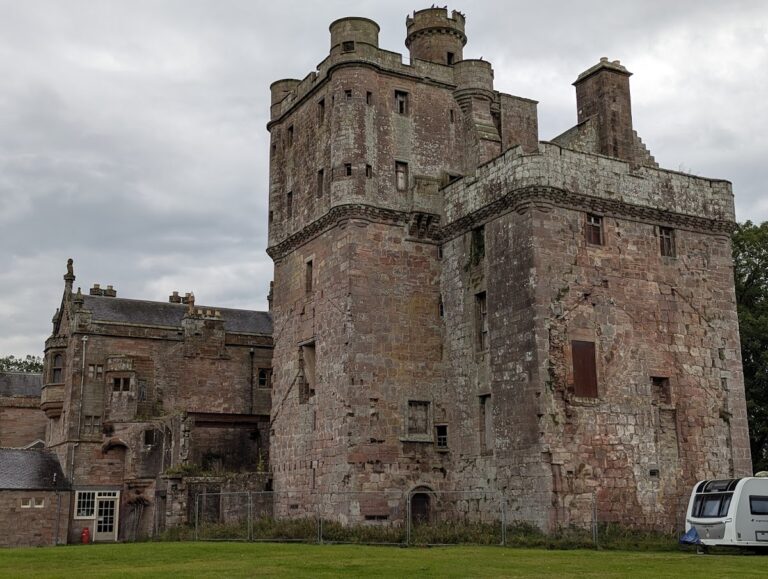
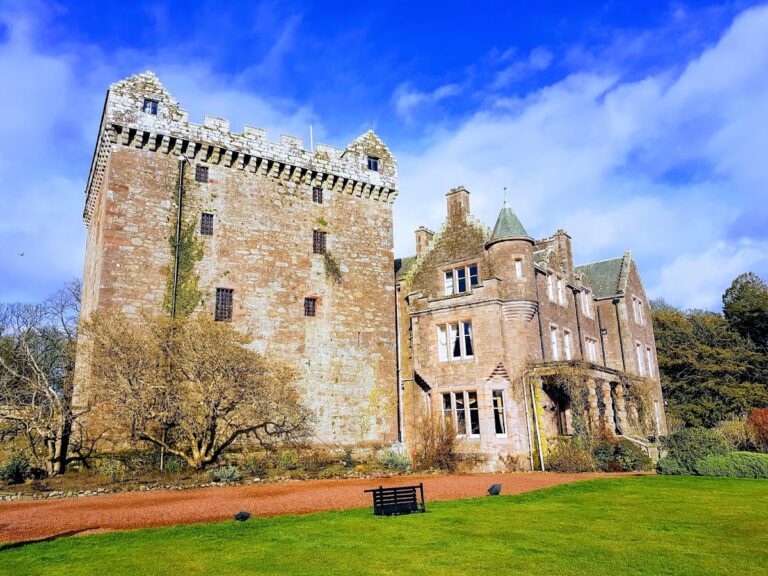
Lochmaben Castle occupies slightly raised ground at the southern end of Castle Loch. The lowland stone castle was built largely in rubble masonry, and its surviving defences demonstrate the strength of the structure developed under Edward I. The original enclosure measured approximately 170 metres from east to west and 90 metres from north to south.
Courtyards and Defences
The surviving remains include parts of the inner courtyard, the large front section, the deep ditch crossed by the drawbridge, and the walls of the wings. A channel separated the inner and outer courtyards. It remains visible and was originally connected with Lochmaben Loch at both ends, forming part of the castle’s defensive arrangement.
Earthworks and the Early Peel
Extensive earthworks surround the castle. Among them is a rectangular peel, the enclosed area protected by the timber palisade of Edward I’s first castle on the site. These earthworks preserve the form of the earlier, more lightly constructed phase alongside the later stone stronghold.
Surviving Hall and Masonry
The hall built by Gluffar in 1504 formed part of the castle’s later rebuilding. Its roof used timber obtained locally. Lochmaben Castle is now a ruin, and the surviving masonry is unstable, so the remains can be viewed only from the exterior.