Freiberg Cathedral: A Late Gothic Church and Wettin Burial Chapel in Germany


Site at a Glance
- Rating
- 4.6
- Popularity
- Low
- Country
- Germany
- Primary era
- Medieval
- External website
- Open
- Eras represented
- Medieval, Early Modern, Modern
- Civilizations
- Electorate of Saxony, German, Holy Roman Empire, Margraviate of Meissen
- Site type
- Religious
- Remains
- Church
On this page24 sections
History
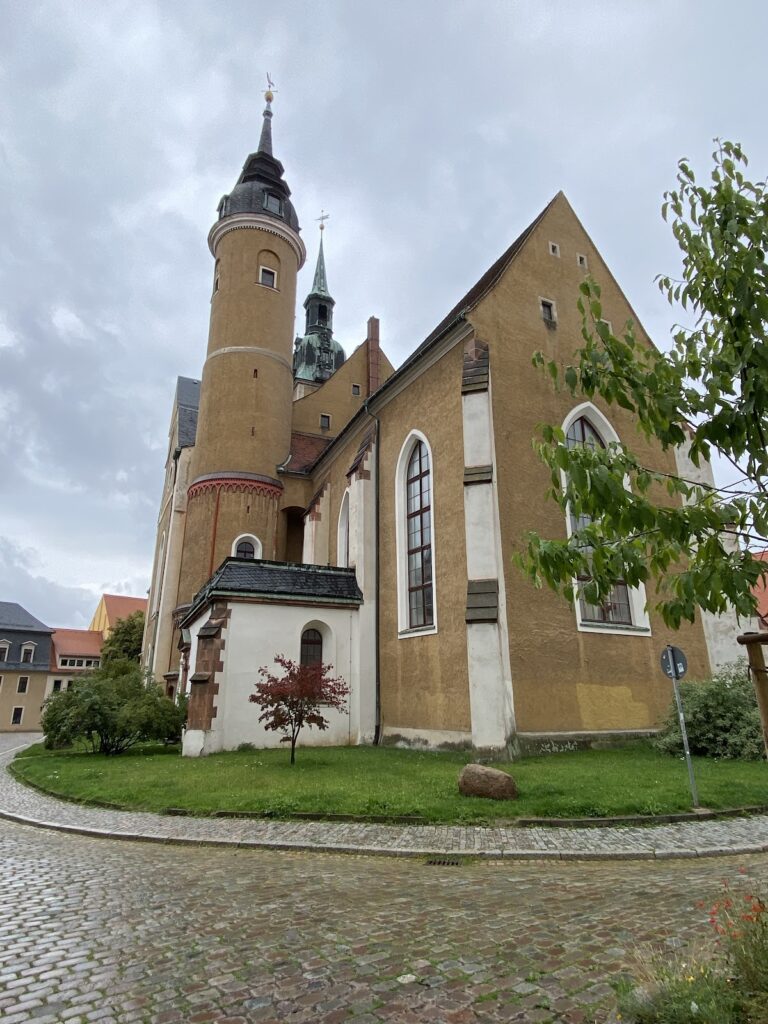
Freiberg Cathedral, formally Dom St. Marien, is a historic church in Freiberg, Germany, whose present building is a late Gothic hall church developed from a Romanesque parish church. The church stands at the Untermarkt and is commonly called a cathedral, although it was never the seat of a bishop. Before the Reformation, it served as a collegiate church.
Romanesque foundation and early additions
Freiberg was expanding rapidly around 1180 because of silver mining when the Romanesque Basilica of Our Lady was built on this site as a parish church. Two important works were added during the following decades. The late Romanesque Triumph Cross group dates from around 1225, while the Golden Gate was probably completed around 1230.
In 1480, Pope Sixtus IV raised the parish church to collegiate status. A collegiate church was served by a community of clergy rather than functioning as a bishop’s seat. This institution lasted until the Reformation in Saxony, the sixteenth-century religious movement that divided Western Christianity and produced Protestant churches. The collegiate foundation was dissolved 57 years after its creation, and by 1537 the church had become Evangelical-Lutheran.
Fire and late Gothic rebuilding
A major town fire in 1484 almost completely destroyed the Romanesque church. The Triumph Cross group, the Golden Gate, and parts of the choir survived. A new late Gothic hall church was then constructed on the same site under the master builders J. and B. Falkenwalt. The rebuilt church was consecrated in 1512.
The new building preserved selected elements of its predecessor while establishing a different architectural form. Its irregular west building, chapels, galleries, and unequal towers developed within existing or required ground plans. This produced a complex late Gothic structure rather than a fully symmetrical design.
Wettin funerary chapel
Between 1589 and 1595, the choir was transformed into a funerary chapel for the Wettin dynasty under Giovanni Maria Nosseni. The Wettins were a German princely dynasty that ruled Saxony for centuries and included both electoral and ducal branches. Elector Augustus of Saxony commissioned the conversion.
The choir became the burial place of 38 members of the Saxon ruling family between 1541 and 1696. They included eight electors, two dukes, ten women, and eighteen children. Burial practices ended after Augustus the Strong converted to Roman Catholicism. Among those buried or reburied in the princely chapel were Maurice, Augustus, Christian I, Christian II, Johann Georg I, Johann Georg II, Johann Georg III, and Johann Georg IV, all electors of Saxony, as well as Henry, Duke of Saxony, Katharina of Mecklenburg, and Sidonie of Saxony.
The burials also included members of the ruling families, among them Sophie of Brandenburg, Hedwig of Denmark, Sibylla Elisabeth of Württemberg, Magdalena Sibylle of Prussia, Magdalena Sibylle of Brandenburg-Bayreuth, Anna Sophie and Wilhelmine Ernestine of Denmark, and Eleonore of Saxony-Eisenach. Children and other relatives included Albrecht, Eleonore, Alexander, Magnus, Joachim, Hektor, Marie, Amalie, Anna, August, Adolf, and Friedrich of Saxony; Anna Sabina, Elisabeth, August, and Dorothea of Saxony; Christian Albrecht and Heinrich of Saxony; Sibylla Marie of Saxony; Sophie Hedwig of Schleswig-Holstein-Sonderburg-Glücksburg; Johann Philipp and Moritz of Saxe-Zeitz; and Zofia Agnieszka Radziwiłł.
The tomb of Anna Sophie of Denmark and her sister Wilhelmine Ernestine was made by Balthasar Permoser between 1703 and 1712 for Lichtenburg at Prettin. It was transferred to Freiberg in 1811. Coffins of members of the Wettin family that had been kept in Dresden’s Sophienkirche were moved to the cathedral’s princely crypt after that church was destroyed in 1950.
Modern alterations and continued use
An early twentieth-century proposal to add towers and improve the facades led to an architectural competition in 1905. Paul Wallot chaired the jury. Otto Kohtz proposed twin towers, while Bruno Schmitz designed a dominant broad western tower. The First World War brought the plans to an end and helped preserve the cathedral’s fragmentary late Gothic character.
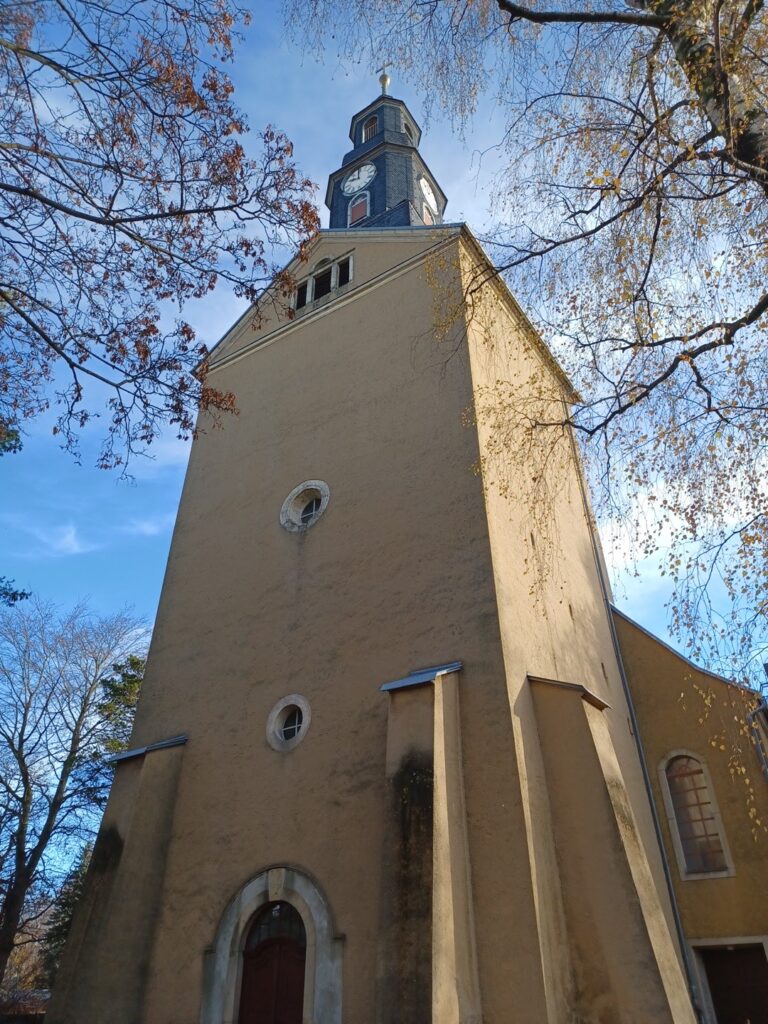
The low northwest tower follows the line of the northern aisle. The southwest tower projects south of the aisle line and was modestly raised in 1931 according to plans by Otto Rometsch. Freiberg’s municipal administration carried out a complete restoration in 1971, when the late Gothic vault paintings were extensively restored and supplemented.
The cathedral remains in use for worship by the Evangelical-Lutheran Cathedral Congregation of Freiberg. Since the 1960s, the congregation has maintained a partnership with the cathedral congregation in Verden an der Aller. Its continued religious use and its major works of art, including the Golden Gate, the Tulip Pulpit, Silbermann’s organs, and the Wettin burial chapel, have made it one of the richly furnished churches of Saxony.
Remains
Late Gothic building
Freiberg Cathedral is a three-aisled, six-bay late Gothic hall church. Its exterior is irregular, with two unequal towers and a large roof covered in slate. The roof has a strong effect on the townscape around the Untermarkt. At the west end it is hipped, while the great gable above the nave rises over the choir and is articulated with blind arcading and a roof turret.
The nave contains inward-projecting buttresses, elaborate net vaults, and slender fluted octagonal piers. A late Gothic gallery with a tracery parapet runs around the church at mid-height, producing balcony-like projections around the pier responds. The high pointed-arch windows are divided horizontally by this gallery. Their tracery includes cross-arch forms and fish-bladder motifs in the lower sections. Steeply rising vault springers give the interior a marked vertical emphasis, and a colored heavenly opening occupies the center of the central vault.
West building and chapels
The west building, adjoining cloisters, and chapels are asymmetrical because their forms follow existing or required ground plans. The entrance hall and the two-aisled Anne Chapel show how late Gothic builders used imaginative vaulting within irregular spaces. The Anne Chapel has a twisted-rib vault related to late Gothic forms from Upper Saxony and Bohemia. Its sandstone Monhaupt Madonna dates from 1513. Franz Maidburg is the probable maker, and the statue has stylistic parallels with Tilman Riemenschneider’s double Madonna of around 1512 in Würzburg Cathedral.
Golden Gate
Portal structure and survival
The Golden Gate is a late Romanesque portal with a semicircular arch on the south side of the cathedral. It is made from Grillenburg sandstone from the Tharandt Forest, whose material was deposited in a shallow Cretaceous sea. Sculptures and richly ornamented columns alternate across the jambs. The portal was probably first used as the western entrance of the Romanesque church. After the fire of 1484, its architecture and sculpture were carefully dismantled and incorporated into the Gothic building as the new southern entrance.
The portal’s surfaces originally carried rich polychrome decoration. It is regarded as the first complete German statue portal and as a major work of thirteenth-century German art. A protective vestibule built around it in 1902 and 1903 by the Dresden architects Schilling and Graebner combines Gothic forms with contemporary Art Nouveau design.
Imagery and sculpture
The tympanum shows the enthroned Virgin Mary with the adoring Three Magi, an angel, and Joseph. Old Testament figures occupy the jambs, while four archivolt zones present scenes connected with salvation and the Last Judgment. On the left jamb are Daniel, the Queen of Sheba, Solomon, and John the Baptist. The right jamb contains John the Evangelist, David, Bathsheba, and Aaron. The iconographic program was probably conveyed by the Cistercians of Altzella.
Wettin choir and funerary furnishings
Choir form and burial monuments
The single-aisled choir ends in a five-eighths polygon. Its elaborate tracery, curved roof, and obelisk-shaped roof turret largely reflect its conversion into the Wettin burial chapel in the sixteenth century. During that work, the original buttresses were reshaped as Ionic pilasters with capitals and obelisk finials.
The choir floor contains 29 finely made brass grave slabs, including the slab of Duchess Katharina, cast by Wolfgang Hilliger’s Freiberg foundry. Other slabs have also been provisionally attributed to Hilliger and members of his family. The choir walls are densely covered with Wettin epitaphs and sculptures. Its ceiling combines painting and stucco sculpture in the style of Italian Mannerism, a late Renaissance style known for elongated forms and elaborate combinations of painting, sculpture, and architectural ornament.
Musical angels and the Moritz Monument
Thirty-four musical angels stand on the uppermost cornice of the epitaph architecture. Their hands hold real Renaissance instruments or highly accurate replicas. The instruments were examined in Leipzig and reconstructed, providing models for reproducing the characteristic sound of a Renaissance orchestra.
The choir also contains the imposing Moritz Monument, dedicated to Maurice, Elector of Saxony. His service to the emperor secured the electoral dignity for Saxony. Beside the monument stands a figure of Maurice wearing the armor associated with the Battle of Sievershausen.
Coffins and princely galleries
The north chapel contains eleven tin coffins of electors and their wives. Additional tin coffins are kept in a crypt beneath the south chapel, formerly the All Saints Chapel. Two princely galleries were inserted beneath the northern gallery arches at the beginning of the eighteenth century to a design by Matthäus Daniel Pöppelmann. Their ornament is Baroque, but the galleries remain subordinate to the Gothic interior.
Epitaphs, altarpiece, and sculpture
Numerous epitaphs, chiefly in the entrance hall, preserve the memory of Freiberg’s religious and ruling communities. They include Andreas Lorenz’s high-Renaissance epitaph for Johannes von Schönberg; Barbara Schönlebe’s 1599 epitaph; richly Mannerist wooden monuments to the Holewein couple and Wolf Heinrich von Brand; the epitaph of W. Meurers; and a bronze-and-wood monument to Nikolaus and Sigmund Horn. Painted epitaphs commemorate Gabriel Breiting and Theodor Siegel. A high-Baroque work in alabaster and marble for Agnes and Abraham von Schönberg was made by Heinrich Böhme the Younger, while Heinrich Schmidt’s epitaph includes an inscription and allegorical figures. Seventeen portraits of pastors are also preserved.
A small portable altarpiece was needed because the choir served as a burial place. Donated in 1560, its painting shows Christ instituting the Eucharist and Lutheran communion in both kinds. The work resembles paintings by Lucas Cranach the Younger but probably did not come from his workshop. The carved wooden frame has black and gold decoration, twisted columns, and a broken pediment, and was probably produced in a Freiberg master’s workshop. Its silver crucifix was made by the goldsmith David Winkler.
Pulpits and medieval devotional images
Tulip Pulpit
The free-standing Tulip Pulpit, probably made between 1505 and 1510, stands beside the Miners’ Pulpit in the central nave. It is carved from Hilbersdorf porphyry tuff, a volcanic stone, and is supported neither by a wall nor by a pier apart from iron anchors. Four stems lift the pulpit from the floor like a flower calyx. Ropes bind the stems twice to an inner shaft, with singing angels between the bindings.
The pulpit basket presents the four Church Fathers as Augustine the bishop, Gregory the pope, Ambrose the archbishop, and Jerome the cardinal. A richly dressed reclining man surrounded by lions appears at the base, while a miner or mining assistant supports the spiral staircase from a forked tree trunk. These figures may represent the donor, Daniel as patron of miners, and a self-portrait of the sculptor, although the interpretations remain uncertain.
A suspended wooden soundboard is crowned by a Madonna playing with the Christ Child. The pulpit’s chalice form and grape clusters allude to the Eucharist, while its broader imagery has been interpreted as the tree of the new paradise. Art-historical literature attributes the work to Master H. W., probably Hans Witten of Cologne, but both the identification and the attribution have repeatedly been questioned.
Miners’ Pulpit
The Miners’ Pulpit was made of sandstone and donated in 1638 by Freiberg mayor Jonas Schönlebe and his wife. The basket shows the kneeling donors before an alabaster crucifix. A miner in working dress supports the staircase, and a mining foreman supports the basket. Reliefs of the Passion cover the staircase and basket. The soundboard is crowned by the risen Christ with a victory banner, while the pulpit door shows Jonah being vomited from the whale, an allusion to the donor’s name.
Medieval sculpture
The late Romanesque Triumph Cross group, dating from around 1225, stands in the choir arch. It originally belonged to the rood screen, a medieval partition separating the choir from the nave, and consists of Christ crucified, the mourning Virgin Mary, and Saint John. Mary stands on a serpent and John on a wolf-like creature gnawing an apple, probably alluding to the Fall overcome through Christ’s death. Other original rood-screen figures are lost, and the surviving fragments do not permit a reliable reconstruction.
A Vesper image from around 1430 also survived the fire. It depicts the sorrowful Virgin holding Christ’s body and uses late Gothic realism, including natural hair for Christ. A later cycle of carved and polychromed wooden apostles stands on the nave piers and pier responds. It was produced by the workshop of the Master of the Freiberg Cathedral Apostles, who may have been Philipp Koch. The same workshop made figures of Christ with the Wise and Foolish Virgins, as well as Saint Christopher and Saint Wolfgang, for altars that no longer survive.
Organs and bells
Great organ
Gottfried Silbermann built the great organ between 1710 and 1714. It was his first large organ and the largest instrument he built personally. The instrument has 44 registers, three manuals, a pedal, mechanical key and stop actions, and 2,674 pipes. A register is an individual stop or sound group, while manuals are keyboards and the pedal is operated by the feet.
Johann Kuhnau, cantor of Leipzig’s St. Thomas Church, recommended the young Silbermann for the commission. Elias Lindner designed the case with Corinthian pilasters and rich acanthus ornament. Kuhnau and Gottfried Ernst Bestel examined the organ on 13 and 14 August 1714, and it was dedicated on 19 August. Silbermann made minor changes to the Oberwerk in 1738, and the Qvintadehn 8-foot stop was renewed in 1933.
Jehmlich restored the instrument in 1981 to 1983 under Kristian Wegscheider. Its modified meantone tuning, a historical system designed to favor pure major thirds, was later moderated toward well temperament. The organ has a pitch of A = 476.3 Hz and includes the couplers III/II and I/II and stop valves. Its design combines French and German influences, including French-style reeds with German foundation stops, Quintadehn stops, and conical reed stops.
Defective roof framing caused excessive pressure above the western structure, producing serious cracks in the vault over the organ and loosening its ribs. Jehmlich conserved and modernized the organ from November 2009 to June 2010, working on its interior, bellows, case, pipes, windchests, and stops.
Choir organ and bells
The smaller Silbermann organ was built in 1718 and 1719 for Freiberg’s St. John’s Church. After that church became structurally unsafe, it was dismantled in 1938, repaired by the Eule firm, and installed in the cathedral in January 1939 as a choir organ. It has one manual, a pedal, and fourteen registers. Alterations and repairs in 1857 included conversion to equal temperament, installation of a pedal coupler and new pedal keyboard, and replacement of its bellows. Jehmlich inspected and repaired it in 1996 and 1997.
The bell ensemble consists of six bells, four cast by Oswald Hilliger’s Freiberg foundry. The Great Susanne weighs five tons and is regarded as one of the most important bells of its period in Germany. A second Hilliger bell was recast by C. Albert Bierling of Dresden in 1896 after cracking. The smallest bell replaced a 1512 bell by Oswald Hilliger that was requisitioned for armaments during the Second World War and never returned from the Hamburg bell cemetery. The present peal combines two conventional bells with four cymbal bells, creating an unusual ensemble within Saxony’s bell tradition.
Cloister baptismal font
The cloister contains a Romanesque stone baptismal font approximately 800 years old. It was transferred from the church at Hirschfeld, about 15 kilometers away. Katharina von Bora, Martin Luther’s wife, is traditionally said to have been baptized in the font.