St. Reinoldi: Dortmund’s Medieval City and Council Church


Site at a Glance
- Rating
- 4.5
- Popularity
- Medium
- Country
- Germany
- Primary era
- Medieval
- External website
- Open
- Eras represented
- Medieval, Early Modern, Modern
- Civilizations
- Holy Roman Empire
- Site type
- Religious
- Remains
- Church
On this page18 sections
History
St. Reinoldi is a Lutheran Protestant church in central Dortmund, Germany, whose present form took shape during the thirteenth century in late Romanesque and early Gothic phases. By its foundation date, it is the oldest surviving church in Dortmund’s historic centre. Dedicated to Reinold, the medieval Christian saint traditionally associated with knightly identity, the church remained under his patronage until the Reformation, the sixteenth-century movement that divided Western Christianity and established Protestant churches.
Early churches and medieval rebuilding
Dortmund chroniclers proposed that a church already stood at this location in the ninth century, where the Hellweg met the historic road between Cologne and Bremen. The earliest predecessor confirmed by archaeology was an Ottonian palatine church. The Ottonian period belonged to the Saxon dynasty that ruled the German kingdom during the tenth and early eleventh centuries, while a palatine church was associated with a royal or imperial palace complex. This building had a single nave, a transept, and a semicircular apse.
Military disturbances around 1060 destroyed the Ottonian church. It was rebuilt with an external crypt, probably to accommodate relics of Reinold that were brought to Dortmund around 1065. The church dedicated to the saint was probably destroyed again during fighting in 1113 to 1115. A further rebuilding followed, but a city fire in 1231 to 1232 destroyed the building for a third time. Archaeological investigations found related fire traces along the north side of the present church.
Reconstruction began between 1233 and 1235. The surviving transept belongs to this phase, while the nave was added after a change of plan and completed around 1260. The church that emerged during the thirteenth century is broadly dated to 1250 to 1270. In the Middle Ages, it became Dortmund’s city and council church, the spiritual centre of the Free Imperial City, and its principal parish church. A Free Imperial City enjoyed substantial self-government under the emperor rather than being ruled by a territorial prince. St. Reinoldi’s furnishings and ceremonial arrangement expressed this civic and imperial status.
Civic authority and the late medieval church
The legal right to appoint the parish priest initially belonged to the dean of the Cologne collegiate church of St. Maria ad Gradus. Proceedings from 1262 to 1290 ended with a compromise under which the Cologne chapter could appoint only a Dortmund citizen. From 1421, the city council appears to have exercised the patronage right, meaning the legal power to appoint or nominate a parish priest, although the circumstances of the change are not known.
Dortmund successfully defended its autonomy during the Great Feud, a conflict fought from 29 May 1388 to 8 November 1389. The city’s defence was followed by increased economic strength, and the resulting prosperity helped generate substantial donations to St. Reinoldi. These gifts supported the construction and furnishing of the large council choir between 1421 and 1450. The late Gothic choir replaced the earlier Romanesque choir, and a sacristy was added in 1446.
The tower was renewed from 1443 and reached 112 metres when completed in 1454. Its height earned it the designation “Miracle of Westphalia.” The spire was renewed in 1519, and copper roofing was completed on 24 June 1520. A sphere placed at the summit on 27 July raised the apex by about seven metres.
St. Reinoldi’s Catholic period ended when Dortmund’s pastors and congregations formally confirmed their adoption of Lutheranism there in 1562. The church is now Protestant within the Evangelical Church of Westphalia, whose regional church forms part of the Evangelical Church in Germany.
Collapse, war, and reconstruction
An earthquake damaged the tower in 1640, and it collapsed in 1661. A new foundation was laid around 1662, and the replacement tower was completed in 1701 with a Baroque crown. Eight of the church’s eleven bells were lost in the collapse. Four nineteenth-century bronze bells that were still in the church in 1917 were later melted down for arms production during the First World War. The congregation also surrendered the church’s copper roof covering and organ façade pipes for the same purpose.
After the First World War, a war memorial chapel was built in the north-western part of the church in 1926. Allied bombing severely damaged St. Reinoldi, and the fourth major air raid on Dortmund destroyed the church on 6 October 1944, leaving parts of its walls and remnants of the tower. Reconstruction began in 1950 and lasted six years. The rebuilt church was inaugurated on 3 June 1956. Its interior was finished with exposed masonry rather than plaster, while the tower retained a Baroque silhouette but received a taller octagon and a slimmer, higher Baroque-style hood.
Modern use and conservation
In 2006, a two-storey glass extension was constructed south-west of the tower on the foundations of the destroyed war memorial chapel. Designed by Architekten Schröder Schulte-Ladbeck after an architectural competition, it incorporates an opening into the historic church and houses the Reinoldiforum of the Evangelical City Church of Dortmund. On 1 January 2007, the formerly independent Reinoldi congregation merged with the Apostel, Heliand, and Melanchthon congregations to form the Evangelische Kirchengemeinde St. Reinoldi Dortmund.
Renovation of the tower, exterior façade, and roof began in 2008. The Stiftung St. Reinoldi and the initiative Rettet Reinoldi were established to support the church’s long-term maintenance. St. Reinoldi is entered as a protected architectural monument on the monument list of the City of Dortmund.
Remains
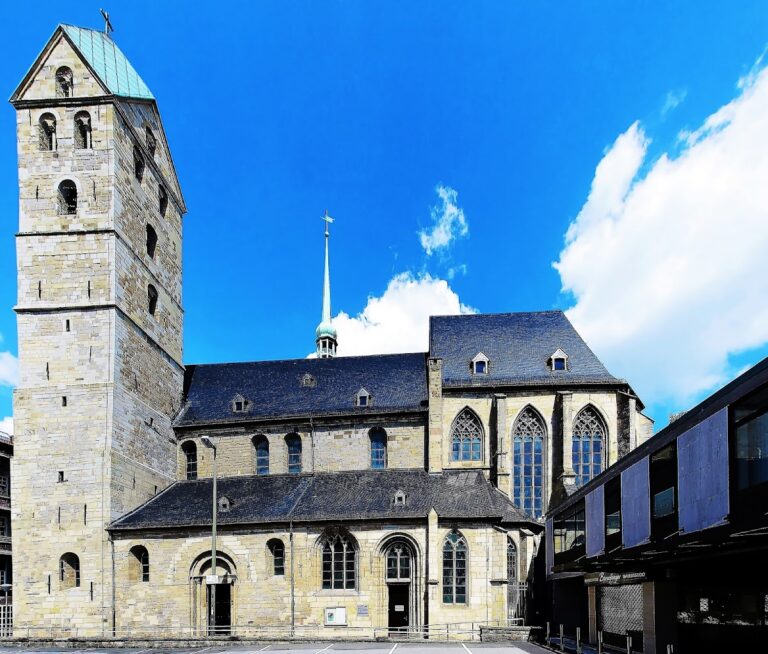
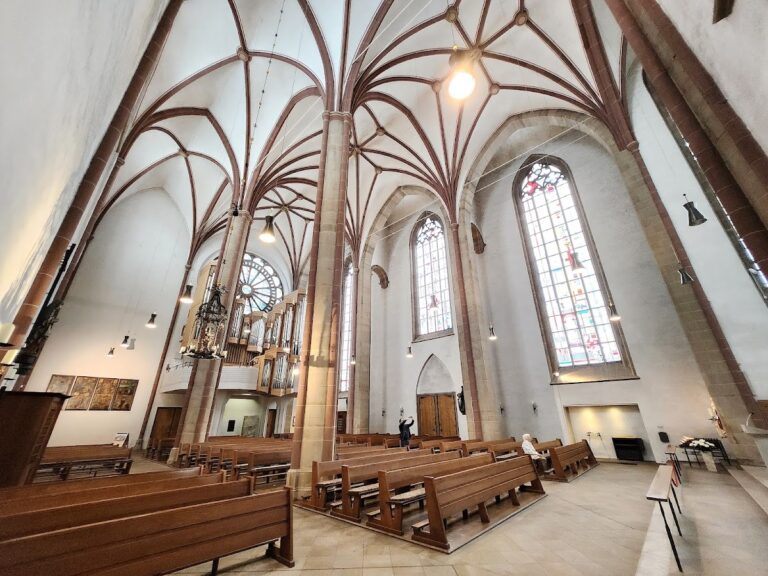
St. Reinoldi is a three-bay basilica with three aisles, built principally of brick. Its surviving fabric brings together a late Romanesque transept, an early Gothic nave, a late Gothic choir, and a west tower with Romanesque-inspired decoration and a Baroque crown. The architect is unknown. The nave originally extended two bays farther west than it does today. After the Gothic tower collapsed in 1661, the nave was shortened by two bays and the present tower was erected in front of it.
Transept, nave, choir, and tower
Transept and nave
The transept, the cross arm of the church, is the oldest surviving part of the present building. It was erected shortly before the middle of the thirteenth century and belongs to the rebuilding that began between 1233 and 1235. The early Gothic nave was added after the original plan changed and was completed around 1260. Its three-aisled basilican arrangement forms the main longitudinal body of the church.
Late Gothic choir
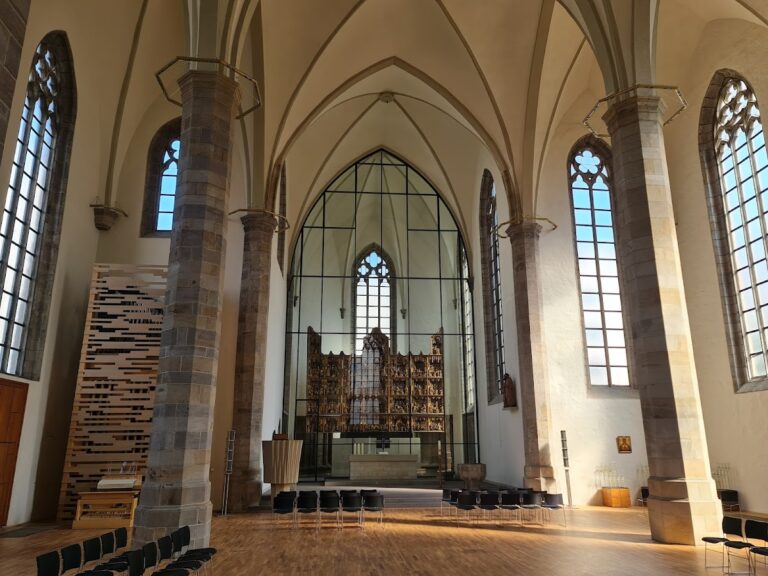
The choir, the eastern liturgical area reserved principally for clergy and ceremonial use, was built between 1421 and 1450 in place of the Romanesque choir. Its construction created the setting for the medieval council furnishings, the reliquary of Reinold, the high altar, and other works that remain associated with the church’s civic and religious functions. The sacristy was added in 1446.
West tower
The west tower rises 104 metres, with a stated height of approximately 104.65 metres. Its bell tower can be climbed to a first platform at about 60 metres. An eagle-shaped metal weather vane crowns the structure. The eagle is Dortmund’s heraldic animal, and the vane bears the inscriptions “885 Tremonia” and “1954 Dortmund.” These refer to the city’s traditional foundation year and Latin name and to the completion of the tower’s post-war reconstruction.
Choir furnishings and sculpture
Reinold and Charlemagne
At the junction of the nave and choir, wooden sculptures of Reinold and Charlemagne stand beneath Dortmund’s eagle emblem, whose form recalls the eagle of the Holy Roman Empire. The council stalls are positioned before Reinold’s reliquary, joining civic authority with religious devotion in the arrangement of the interior.
The larger-than-life wooden figure of Reinold stands on the north side of the choir entrance beneath a wooden canopy. Made during the first half of the fourteenth century, it presents the saint as a knight on a column-like pedestal decorated with an eagle and lions. The wooden exterior was restored several times during the nineteenth and twentieth centuries and is thought originally to have been painted. The sculpture is also interpreted as a Roland statue.
On the opposite side of the choir is a wooden sculpture of Charlemagne from the middle of the fifteenth century. The emperor wears a crown, armour, and an elaborate cloak and holds an orb and sceptre.
Council stalls and reliquary
The choir stalls along the north and south walls were made in 1462 by the woodcarver Hermann Brabender. They provide 42 seats for members of the medieval city council during Mass. Their outer carvings depict Reinold, the emperor, Mary, Jesus, and the saints Pantaleon, Quirinus of Neuss, and Anthony the Hermit.
A reliquary shrine placed beside the council stalls in 1456 housed the relics of Reinold and other saints until the seventeenth century. A reliquary is a container or shrine for the bodily remains or other relics of a saint. A sacrament house stands opposite the shrine. The original relics themselves have not survived.
Altar, lectern, and other sculptures
The high-altar retable dates from 1420 and was made in Belgium by the artist known as the Master of Hakendover. A retable is an ornamental altar structure decorated with painted or carved religious scenes. This one portrays episodes from the lives of Jesus and Mary, with Christ’s Crucifixion in the central section, and is now kept permanently open.
An eagle lectern imported from Belgium during the first half of the fifteenth century was used for reading the Gospel. Its eagle represents John the Evangelist and also serves as Dortmund’s heraldic animal. It grips a defeated serpent in its claws and supports a sphere-topped column resting on small lion figures. A wooden sculpture of Mary from the middle of the fifteenth century stands above the sacristy door, while twelve sculptures of the Apostles are placed in front of the windows.
Font, organs, and bells
Bronze baptismal font
The bronze baptismal font dates from 1469 and now stands in the choir. It may originally have been located in the western part of the church. Six side supports resting on lions were lost during the Second World War. Three Middle Low German inscriptions encircle the font. Two contain maxims, while the inscription at the base records that the Dortmund citizen and bell founder Johann Winnenbrock cast it in 1469. Winnenbrock also cast at least one former St. Reinoldi bell.
Organ tradition
The 1909 Walcker organ, installed at the initiative of pastor Gottfried Traub, had five manuals, a pedal, and 105 stops. A stop is an independently controllable set of organ pipes, while a manual is a keyboard played by the hands and a pedalboard is played by the feet. The instrument was inaugurated during a Bach festival attended by Albert Schweitzer, who played works by Johann Sebastian Bach. It became a major example of the Alsatian-New-German organ reform and was played from 1925 by the composer and organist Gerard Bunk. The organ was destroyed during the Second World War, although two recordings made on 4 April 1931 survive.
A new Walcker organ built in Ludwigsburg was installed in 1958. Planned substantially by Gerard Bunk and inaugurated by him, it had 72 stops, four manuals, a pedal, and electro-pneumatic action, which transmits the organist’s control through electrical and pneumatic mechanisms. Its electrical components were renewed and a new console with a setter system was installed in 1996.
Orgelbau Mühleisen replaced the 1958 organ with a two-part installation. The choir organ, placed in 2019 above the southern side entrance beneath the rose window, has 11 ranks, mostly housed in a swell box, and is played from a mobile electronic console with four manuals. Its multiplex system can derive up to three apparently separate stops from a single rank. The Mühleisen main organ entered service on 20 March 2022. It has 54 stops across four manual divisions and a pedal, with ten auxiliary ranks providing a further 22 stops and transmissions. Several ranks from the 1958 Walcker organ were incorporated, and the main organ can also be played from the choir organ’s mobile console.
Bells
After the tower collapse, a four-bell cast-steel peal was installed. Its bells were named Luther, Hindenburg, Kaiser, and Reinoldus, and each carried a religious, political, or biblical inscription. The Kaiserglocke cracked after being struck during a bombing raid. It was placed beside the church’s south wall after the Second World War, where it commemorates the destruction of the church and the earlier peal.
The present installation consists of six cast-steel bells made by the Bochumer Verein foundry in 1954. They were dedicated and first rung during the Christmas Eve service on 24 December 1954. The Dreifaltigkeitsglocke is the largest ringable cast-steel bell in Westphalia, and the peal is the second-largest cast-steel peal in the world, after that of the collegiate church in Neustadt an der Weinstraße.
St. Reinoldi remains an important centre of church music and is the workplace of the long-established Dortmund Bach Choir.