Stadtkirche Brand-Erbisdorf: An Early Gothic Evangelical Lutheran Church in Germany


Site at a Glance
- Rating
- 3.9
- Popularity
- Very Low
- Country
- Germany
- Primary era
- Medieval
- External website
- Open
- Eras represented
- Medieval, Early Modern, Modern
- Civilizations
- German, Holy Roman Empire
- Site type
- Religious
- Remains
- Church
On this page12 sections
History
Stadtkirche Brand-Erbisdorf is an Evangelical Lutheran church in Germany, built as an early Gothic hall church around 1300. It belongs to the Brand-Erbisdorf congregation, the Freiberg Church District, and the Evangelical Lutheran State Church of Saxony.
Medieval church and later enlargement
The church began as a Gothic hall church, a design in which the main worship space and adjoining areas have broadly similar heights, creating a unified interior. Its later history changed both its appearance and arrangement. Melchior Gerber built the west tower in 1598, and a fire in 1624 was followed by alterations that transformed the building into a large gallery hall.
The church’s four bells were destroyed by a fire in 1835. Replacement bells were later melted down for war materiel in 1917, during the First World War. Steel bells were installed in 1921 and were still in use in the early twenty-first century.
Nineteenth- and twentieth-century changes
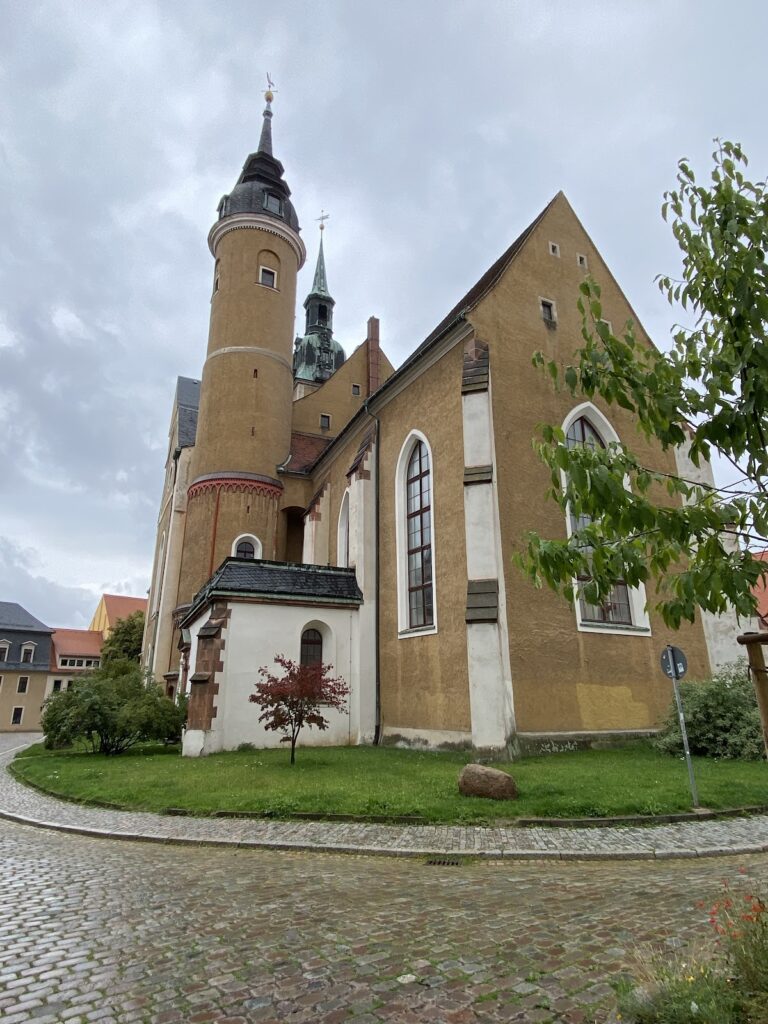
The exterior of the hall and tower was remodelled in 1836, while the chancel, the part of the church surrounding the main altar, was remodelled in 1930. Interior restoration took place in 1870, 1892, 1968, and 1993–1994. The tower was renewed in 1979–1980, and the exterior was restored between 1988 and 1993.
The organ
Adam Gottfried Oehme built the organ between 1772 and 1774. He was the youngest pupil of Gottfried Silbermann, a prominent eighteenth-century German organ builder. The instrument has 21 stops, or sets of pipes with distinct tones, distributed across two manuals and a pedal.
Karl Traugott Stöckel cleaned and overhauled the organ in 1878, replacing the Sesquialtera and Mixture stops in the Oberwerk, the upper manual division. The front pipes were surrendered for military purposes in 1917 and renewed by Jehmlich Organ Builders of Dresden in 1924. Hermann Eule Organ Builders of Bautzen repaired and cleaned the organ in 1953, removing Stöckel’s replacement stops and reinstating the original ones. Jehmlich restored the instrument again in 1994.
Remains
Exterior and interior arrangement
Stadtkirche Brand-Erbisdorf is a rendered building with a three-sided termination and buttresses. A round-arched western main portal made of sandstone provides entry. The windows have different forms, reflecting the church’s long construction and alteration history.
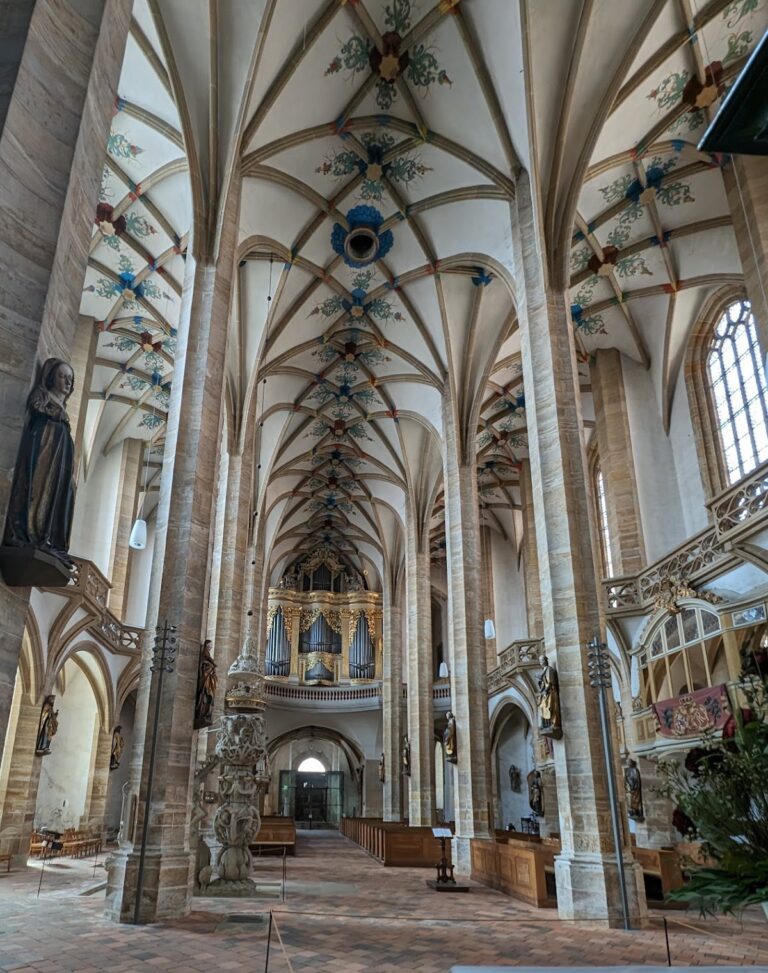
Inside, a flat ceiling and wooden galleries on three sides create the large gallery-hall arrangement produced by the post-medieval alterations. A chancel with a straight-ended niche was inserted into the Gothic choir without altering the choir’s exterior walls. The Gothic windows remain part of the earlier structure, although they are not visible from inside.
Paintings, portals, and furnishings
Wall paintings and stonework
Figural wall paintings survive on the southern wall of the hall. The lower painting is probably Gothic in date. The southern sacristy doorway has a polychrome, round-arched sandstone surround. In the tower hall, an ornamental keystone from the former church portal is preserved; it is dated 1580.
Altar and pulpit
The modern altar incorporates a small altar cross marked 1774 and a larger cross from 1930. The former pulpit altar, made by Franz Ditterich the Elder in 1603, was dismantled. Its four polychrome figures of the Evangelists, Matthew, Mark, Luke, and John, are incorporated into the modern pulpit.
Other parts of the former altar are preserved in the sacristy. They include a predella, the lower section of an altar, with a Last Supper scene, two wings depicting the Annunciation and the Nativity, and seated figures representing Moses and John the Evangelist. The altar’s upper section is mounted to the left of the choir, above the gallery entrance.
Fonts and baptismal objects
The simple baptismal font dates from 1929. A tin baptismal basin from 1516 was transferred from the church in the St. Michaelis district. Its basin depression is elaborately engraved with the Creation of Eve. Another baptismal font, made of cast iron, dates from 1880.
Sculpture and commemorative monuments
A life-size sandstone figure of a miner was probably formerly a figure supporting the pulpit. Made around 1585 by the Freiberg sculptor Samuel Lorentz, it has carefully rendered surface textures. Wooden epitaphs, commemorative monuments for the dead, and portraits of pastors from the seventeenth and eighteenth centuries also form part of the furnishings.
An epitaph for Georg Hermann and his wife Christina stands on the southern wall of the entrance hall and dates to around 1686. A circular portrait of the couple appears above an oval Crucifixion scene. Rich ornamental and floral carving frames the composition, while inscription panels flank it. Two crowned miners and a coat of arms appear above the main arrangement.
Organ
The organ’s 21 stops are arranged across two manuals and a pedal. Its front pipes, renewed in 1924 after the original pipes were surrendered for wartime use, form part of the instrument’s later physical history. The original Sesquialtera and Mixture stops of the Oberwerk were restored in 1953.