St. Petri (Freiberg): A Historic Church and Municipal Tower Complex


Site at a Glance
- Rating
- 4.5
- Popularity
- Low
- Country
- Germany
- Primary era
- Early Modern
- External website
- Open
- Eras represented
- Medieval, Early Modern, Modern
- Civilizations
- Holy Roman Empire
- Site type
- Religious
- Remains
- Basilica
On this page15 sections
History
St. Petri (Freiberg) is a church in Germany, erected around 1200 as a late Romanesque basilica, a church organized around a central nave with lower side aisles. Built in the upper town, it initially served as Freiberg’s principal church and occupied an important position in the city’s religious life.
Medieval church and civic towers
The church’s three towers grew into a complex with a status distinct from that of the congregation. The nearly square Petriturm, the round Hahnenturm, and the Fauler Turm all retain Romanesque masonry in their foundations. The medieval legal position of the Petriturm is unknown, but members of Freiberg’s guilds, known as Zirkler, probably carried out fire and enemy watch from the tower from the second half of the thirteenth century onward.
The city financed and maintained the towers in exchange for rights to use them. After the Reformation reached Freiberg in 1537, the parish churches came under municipal control in 1541 and their property was incorporated into the city’s ecclesiastical revenue system. The three Petri towers, however, were assigned to the aedificium publicum, the municipal category for public buildings. This arrangement separated their administration and use from that of the church itself.
The Petriturm received a copper covering in 1526–1527, probably at municipal expense. In 1535, George Hausmann was associated with the tower and apparently held the profitable rights connected with the city musicians’ fire-watch service. The Petriturm, Fauler Turm, and Hahnenturm remained within the aedificium publicum through the seventeenth and eighteenth centuries. For the Petriturm, this relationship continued into the 1880s.
Baroque reconstruction
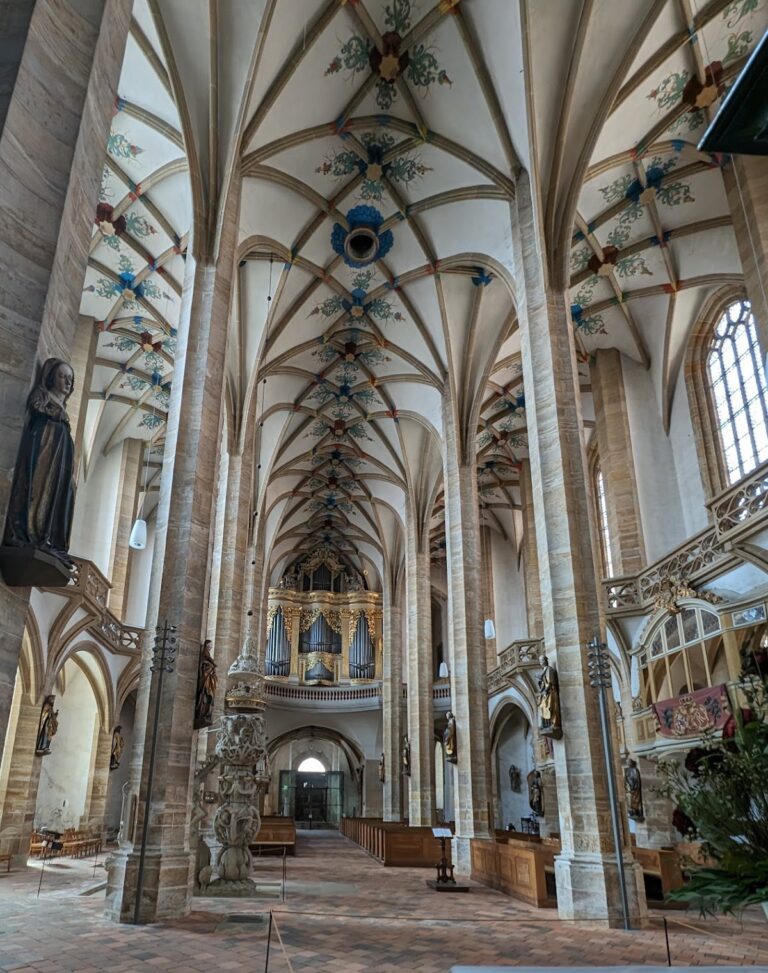
A major reconstruction in 1734 gave St. Petri its Baroque character, the style associated with much seventeenth- and eighteenth-century church rebuilding and decoration. The work included a sandstone pulpit and baptismal font from the workshop of Christian Feige the Elder. Johann Gottfried Silbermann’s organ was installed and inaugurated on Reformation Day in 1735.
The principal tower received its hood in 1730–1731. The Hahnenturm followed in 1749, when the municipal master carpenter J. G. Ohndorff built its round tower. The Fauler Turm was constructed later as the third and final tower. The tower interior followed an arrangement established in 1733 and set out to scale in a 1730 design by Johann Gottlieb Ohndorff. It included living accommodation for a tower-keeper family until the twentieth century.
Municipal ownership dispute and twentieth-century change
The separate status of the tower became contentious in the modern period. The church and Petriturm were insured separately in 1858, after which the city council claimed municipal ownership. In 1888, the church council rejected the demand to recognize that ownership and also refused a proposal under which the city would assume maintenance in return for rent. The church and tower subsequently occupied two separate plots, while the city retained usage rights for a time.
Carl-August Nepp, the last Freiberg tower keeper, left the Petriturm on July 1, 1905. The city could then dispense with the tower for fire watch and the manual striking of the hours. The structure at the top of the tower deteriorated and swayed dangerously, requiring renewal in 1920. Negotiations between city and church authorities continued until 1927 without agreement, while the church council rejected a proposed monthly rent because of the tower’s structural defects.
Further repairs to the decayed tower pinnacle were required in 1940–1941. The work was incorporated into Nazi propaganda. Although the lower cupola was also treated, the repairs did not complete all the work that was needed. In the mid-1970s, St. Petri was converted into a community center. Friedrich Press redesigned the interior, which then served largely as exhibition space. An East German church-building program supported the work with funding from the Protestant Church in Germany.
In 1996, the city of Freiberg relinquished its rights to the Petriturm and the property associated with it, including the hour-and-storm bell and the miners’ bell. The church also contains former burial places of notable figures, although later alterations destroyed the original graves. Three related gravestones were moved beside the north chapel. They commemorate Hans Carl von Carlowitz, a mining administrator whose writings are associated with the early history of sustainability, and Wolfgang Hilliger, a prominent Freiberg founder of bells and cannon.
Remains
St. Petri stands on Petriplatz at the highest point of Freiberg’s inner city, slightly west of the Obermarkt. The Petriturm rises from the highest point of the historic town center, approximately 405 meters above sea level. The church’s three towers have markedly different forms, while their foundations preserve Romanesque masonry. Together they express the complex’s long development from a medieval basilica into a Baroque church with civic watch and bell functions.
Towers and tower interior
Petriturm
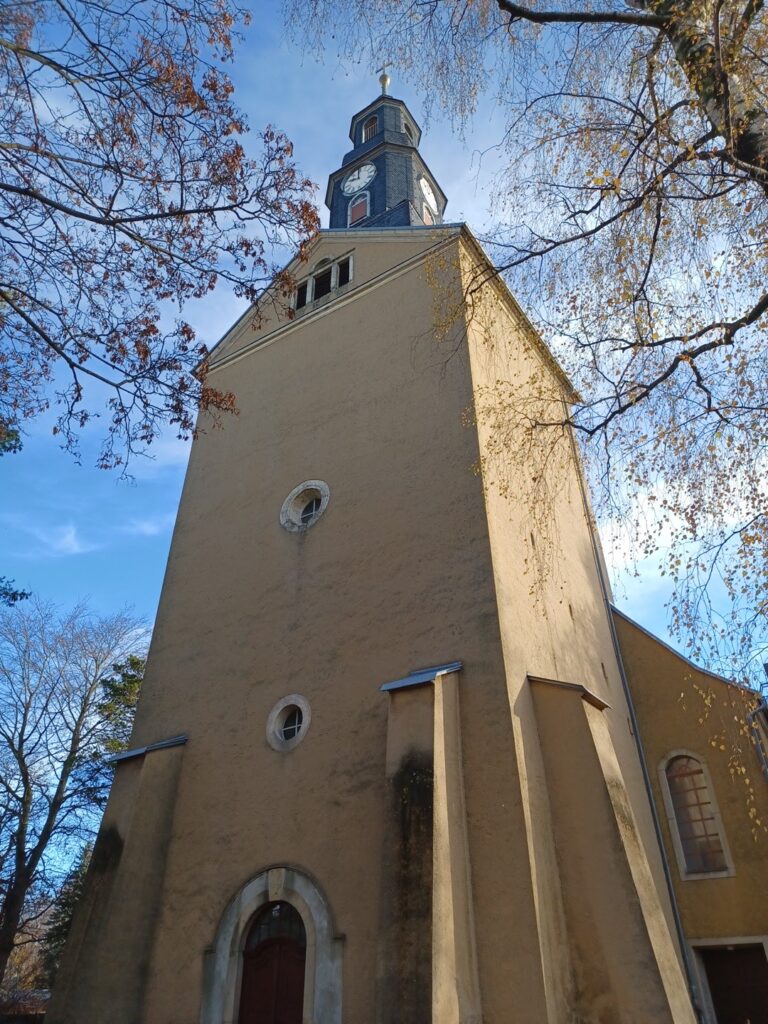
The almost square Petriturm is the city’s highest landmark and reaches into the wider landscape of the Eastern Ore Mountains. Its sides measure between 8 and 9 meters. Rubble-stone masonry rises nearly 42 meters, followed by a lower cupola slightly under 11 meters high, a lantern of more than 5 meters, an upper cupola about 12 meters high, and a gilded finial measuring 6 cubits from the lower end of the tower orb. The tower reaches 71 meters to the weather vane and 74.10 meters from the ground cornice to the top of the finial.
The interior retains the arrangement established in 1733. A timber bell-frame structure begins about 34 meters above ground. In 1730, Johann Gottlieb Ohndorff submitted two models of the construction to the city council and directed the tower’s construction alone, contrary to the council’s original decision. In 1732, the council approved an iron external platform for the city musicians, who used it to sound public signals. The platform still provides a view over almost the entire historic center.
Hahnenturm
The Hahnenturm is the complex’s round tower. Its foundations include Romanesque masonry, and the tower itself was built in 1749 by the municipal master carpenter J. G. Ohndorff. It forms one of the three distinct vertical elements that survive as part of the church’s architectural composition.
Fauler Turm
The Fauler Turm was built later than the Petriturm and Hahnenturm, becoming the third and final tower of the group. Its bell chamber contains two substantial bells. The Great Bell weighs 3,850 kilograms and was cast by Oswald Hilliger in 1487. The Small Bell weighs 1,940 kilograms and was made by his grandson Wolf Hilger.
Church interior and furnishings
Apse and Baroque furnishings
The apse receives light through several tall, colorless windows. A modern crucifix by Friedrich Press hangs centrally between two of them, with a plain, low altar table in front. The early eighteenth-century Baroque refitting supplied the church’s baptismal font and sandstone pulpit, both produced in Christian Feige the Elder’s workshop.
Silbermann organ
The gallery contains the largest two-manual organ built by Freiberg organ builder Gottfried Silbermann. It has 32 stops and 1,784 pipes distributed across two manuals and a pedal. Originally tuned in choir pitch, an older and relatively high standard used for church music, it was retuned to equal temperament in 1855.
Jehmlich rebuilt the instrument in 1898, or possibly in 1896, adding a third manual with pneumatic chests, which are organ windchests operated by compressed air rather than direct mechanical linkage. The late nineteenth-century rebuilding lowered the pitch to approximately 435 hertz. Jehmlich carried out further work in 1937. In 1959, the firm removed the echo division added during the nineteenth century, substantially reworked the pipework, and replaced the cores of eight stops, greatly changing the instrument’s sound.
Kristian Wegscheider and Jehmlich reconstructed the organ in 2006–2007. It is now tuned to 462.5 hertz in Neidhardt II temperament, “for a small town,” from 1732. Its couplers include a slider coupler between the first and second manuals and a bass valve coupling the first manual to the pedal. An additional register is a bell.
Bells and civic signals
Storm-and-hour bell
The lantern of the Petriturm contains the storm-and-hour bell cast in Dresden by Michael Weinhold in 1730. Known as the Saigerschelle, it sounds the hours and half-hours. It formerly also warned of fire or enemy danger, linking the tower’s bells with its civic watch functions.
Miners’ bell
The miners’ bell hangs above the hour bell. The bell cast in 1874 was replaced by a copy, while the original is displayed in Freiberg’s City and Mining Museum. The current bell rings at noon and 5:00 p.m. on days other than Sundays and feast days, approximately five minutes after the hour bell. Both the current bell and the original carry an inscription whose meaning is: “Arise, arise; I call you to the mine, I who stand above. Whenever you descend into the depths, remember the heights.”