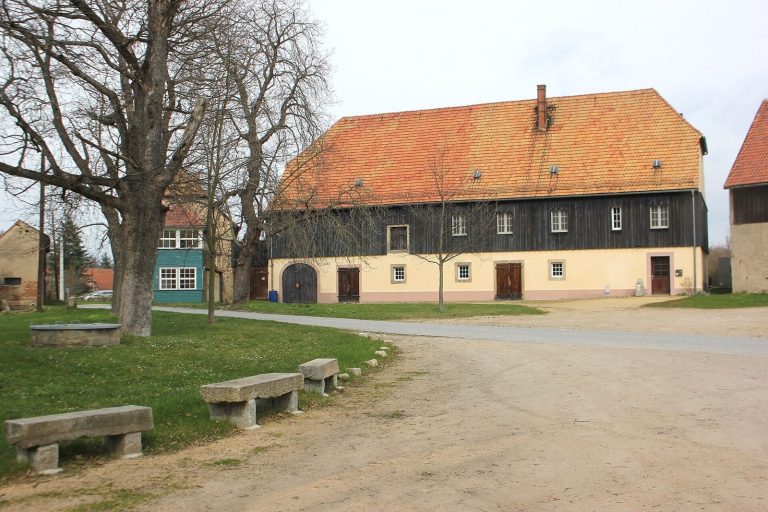
Löbau Franciscan Monastery: A Medieval Religious House in Germany
Site at a Glance
- Popularity
- Very Low
- Country
- Germany
- Primary era
- Modern
- Eras represented
- Medieval, Modern
- Civilizations
- Holy Roman Empire, Kingdom of Bohemia, Kingdom of Saxony
- Site type
- Religious
- Remains
- Monastery
On this page8 sections
History
The Löbau Franciscan Monastery was a Catholic friary in the eastern part of the old town of Löbau, Germany. Franciscans, formally the Order of Friars Minor, established the house in the early fourteenth century, although its precise foundation date and founder are unknown. Dedicated to the Holy Cross, it belonged to the Saxon Franciscan Province and served a modest community that also hosted annual assemblies of Upper Lusatian towns.
Foundation and political setting
Budissin, later known as Upper Lusatia, had been a dependent territory of the Kingdom of Bohemia since 1156. Brandenburg margraves took territorial control between 1253 and 1262 and divided the region into the Bautzen and Görlitz bailiwicks, or administrative districts. Löbau lay in the Bautzen district, just west of its boundary, and probably came under the territorial ruler’s direct authority while Brandenburg held the region. Its description as a royal town first appears in 1320. After the Ascanian dynasty ended in 1319/20, Emperor Louis IV invested John of Bohemia with Budissin. Henry I of Jawor had taken possession of the Görlitz territory, which came under the Bohemian king’s direct control in 1329.
Estimates place the monastery’s foundation around 1300 or sometime after 1320. The later date is considered plausible because Franciscans tended to establish houses in towns under royal or territorial rule. A secure written reference comes from 1336, when the town council recorded a grant of woodland near Kunewald to the convent. A Franciscan necrology’s claim that the monastery was founded and consecrated in that year is mistaken. Bishop Withego of Meissen consecrated its church, though the date is unknown. In 1513 the council called itself the monastery’s founder, a claim that cannot be confirmed.
The Franciscans belonged to the Saxon Province, while the convent’s regional grouping, or custody, is less certain. Records from around 1340, 1390, and 1418 place it in the Brandenburg custody, but a list from 1484 assigns it to the Goldberg custody. Lists from the period contain errors, and jurisdiction in this border region was contested. Löbau’s position in Upper Lusatia supports the Goldberg affiliation, with which the monastery is generally identified.
Community and civic life
The 1336 record names Hermann of Liegnitz as guardian, the local superior of the Franciscan house. This indicates that the convent had developed beyond its initial, less independent phase. In 1382 Heinrich of Radeberg became protector and holder of the convent’s rights to the woodland. He was to receive an annual measure of salt, and the friars were to provide hospitality for him and his horse when he came to Löbau. In 1513 Heinrich Schley gave up the related protective rights in exchange for three marks from the convent.
The community remained small. One estimate puts its usual number at eight friars or fewer; another allows for about ten, and perhaps twelve around 1500, possibly including students. The house hosted annual gatherings of Upper Lusatian towns. Around 1500 it also had a center for study by members of the order, where Valentinus Viberger served as a reader. On 20 June 1419, guardian Franciscus Piper arranged in Erfurt for an authenticated copy of a papal bull issued by Pope Martin IV in 1283. The document authorized Franciscans to appoint people outside the order to represent their worldly interests.
Town officials and private donors helped support the friars. In 1459 the town accounts noted a payment to the guardian for a citizen’s annual memorial service. A dispute with the council over two gardens arose in the middle of the fifteenth century. Peter Richter’s widow gave the friars a garden outside the Zittau Gate in 1482, and they probably acquired a nearby mill the following year. The council supplied cloth for religious garments and shoes. In 1504 the master craftsman Philipp Gortier promised an annual barrel of herring, to be given to poor people if the friars stopped observing their reform.
A procession for the Feast of the Finding of the Cross, described in 1521, presented episodes from biblical history and the life of Jesus. Its scenes included the Annunciation and the stable at Bethlehem, Jesus with the twelve apostles on the Mount of Olives, and events beneath the Cross involving John, Mary, Mary Magdalene, and Veronica. The procession also included Mary mourning her son and the Resurrection, with angels and the three women.
Reform, conflict, and fire
In 1429 a fire, blamed on an arsonist sympathetic to the Hussites, almost entirely burned Löbau. The Hussites, followers of the religious reform movement associated with the Bohemian preacher Jan Hus, captured the town in 1431. Around 1490 the monastery entered a reform movement and was probably placed under the supervision of an official charged with overseeing reform. An early effort to impose stricter observance may not have lasted. In 1503 the Görlitz council successfully opposed a proposed return to the visitor’s authority, fearing the effect on its own Franciscan house.
A reform under the Martinian Constitutions, Franciscan rules allowing less strict observance than the stricter Observant reform, was completed shortly before 24 June 1504. The Löbau council said the friars had previously set a poor example and that discipline and worship had declined, but now followed their rule and the new constitutions. Löbau and Lauban were returned to the Goldberg custodian. In 1513 a separate dispute arose with the clergy of St Nicholas parish church after the shoemakers’ journeymen moved their religious activities to the monastery church, reducing parish income. On 12 October, territorial governor Christoph von Wartenberg ordered that masses and offerings return to the parish church as before.
In 1517 the Franciscan Order divided into Observants, who followed stricter discipline, and Conventuals, the other branch of the order. The Saxon Province chose the Observants and divided into the stricter Province of the Holy Cross and the Province of St John the Baptist, which followed the Martinian Constitutions. Löbau was assigned to the latter in 1518. In 1523 the province split into Lower and Upper Saxon provinces, with Upper Lusatia included in the Upper Saxon province. Its provincial, Petrus Fantinus, visited the region that year and urged the friars to remain Catholic; they agreed by a handshake. The Goldberg custody was dissolved in 1523, and Löbau joined the new Görlitz custody. Reformation ideas nevertheless reached the convent: in 1527 a monk from Pirna noted its involvement with Lutheran practices, a Protestant tradition associated with Martin Luther.
On the evening of 3 April 1519, a fire in Löbau largely destroyed the monastery, apparently sparing only the church choir. The small community struggled to rebuild. In 1531 guardian Andreas Arnold acknowledged a debt to a glazier from Görlitz for work on the monastery’s windows, probably connected with the reconstruction. As townspeople adopted the Reformation, donations fell and few novices joined. In 1534 the friars sold some of the church’s smaller treasures to support themselves.
Decline and transfer to the town
On 24 August 1534 guardian Andreas Arnold transferred a 100-mark endowment, established by Caspar Graulich for memorial masses, to the town council. In return, the council was to provide the convent annually with two quarter-measures of wine for the mass. Graulich had stipulated that the capital should pass to the town if the convent dissolved. The friars exchanged their large garden with the town in 1538 for compensation. A dispute followed in 1553, after the town sold the garden and blocked access to the smaller one. A settlement reached with Jakob Schwederich, custodian of the Meissen custody, again provided compensation.
The last known convent record is a receipt from guardian Bartholomäus Lebelin to the town magistrate in 1558 for payments of herring and wine. In 1559 Emperor Ferdinand I ordered repairs to Franciscan houses in Bautzen, Löbau, and Zittau that had been abandoned or were close to abandonment. The Löbau friars were also ordered to provide two or three sets of vestments to Marienthal convent. Hans von Schlieben delivered the garments to Abbess Magdalena vom Berge in 1560. An Upper Lusatian assembly reported on 15 January 1564 that no friars remained at Löbau, so the convent probably ended between 1560 and 1564. Dietmann gives 5 October 1570 as the death date of the last friar, who had previously become a priest.
On 19 January 1564, Maximilian II, then King of Bohemia, stopped in Löbau and was asked to give the vacant monastery to the town for a school. After Ferdinand I died that year, Maximilian directed the Bohemian Chamber to transfer it, but did not promise financial aid. On 28 May 1565 Hans von Schlieben transferred the former monastery to the town for a municipally run school, by order of Archduke Ferdinand II, Maximilian’s brother. The grant included the woodland near Kunewald and a small barn outside the Zittau Gate, as well as 250 gulden for repairs and classrooms.
Remains
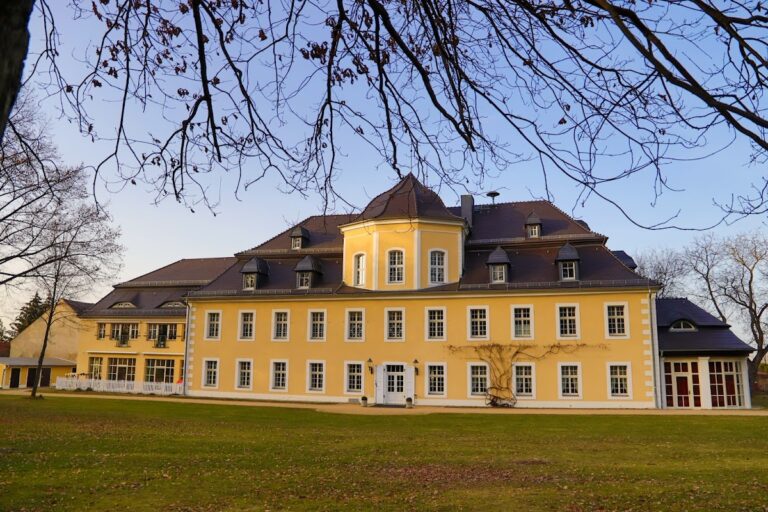
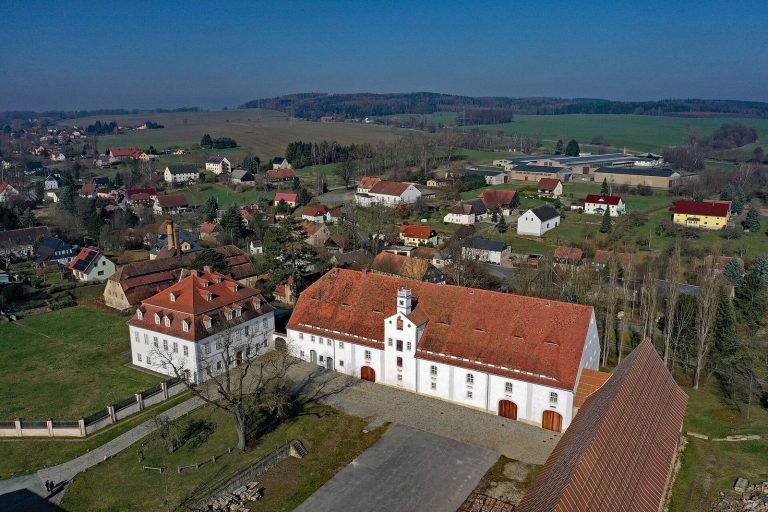
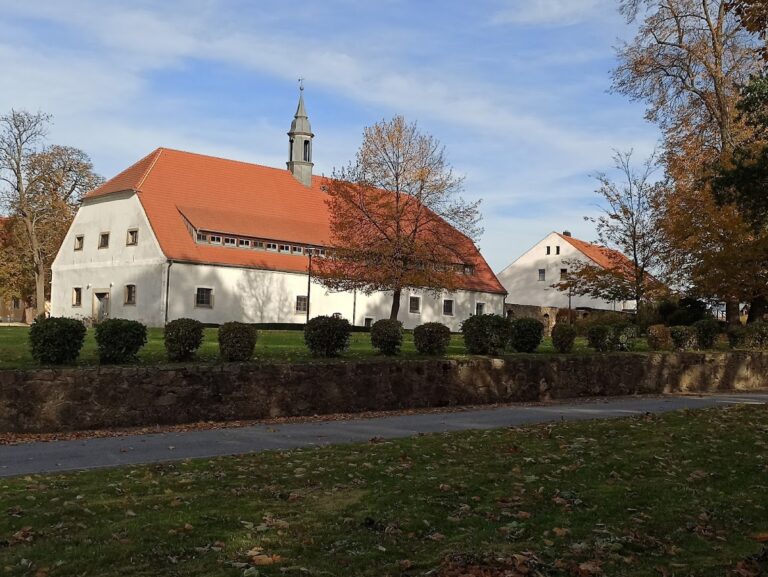
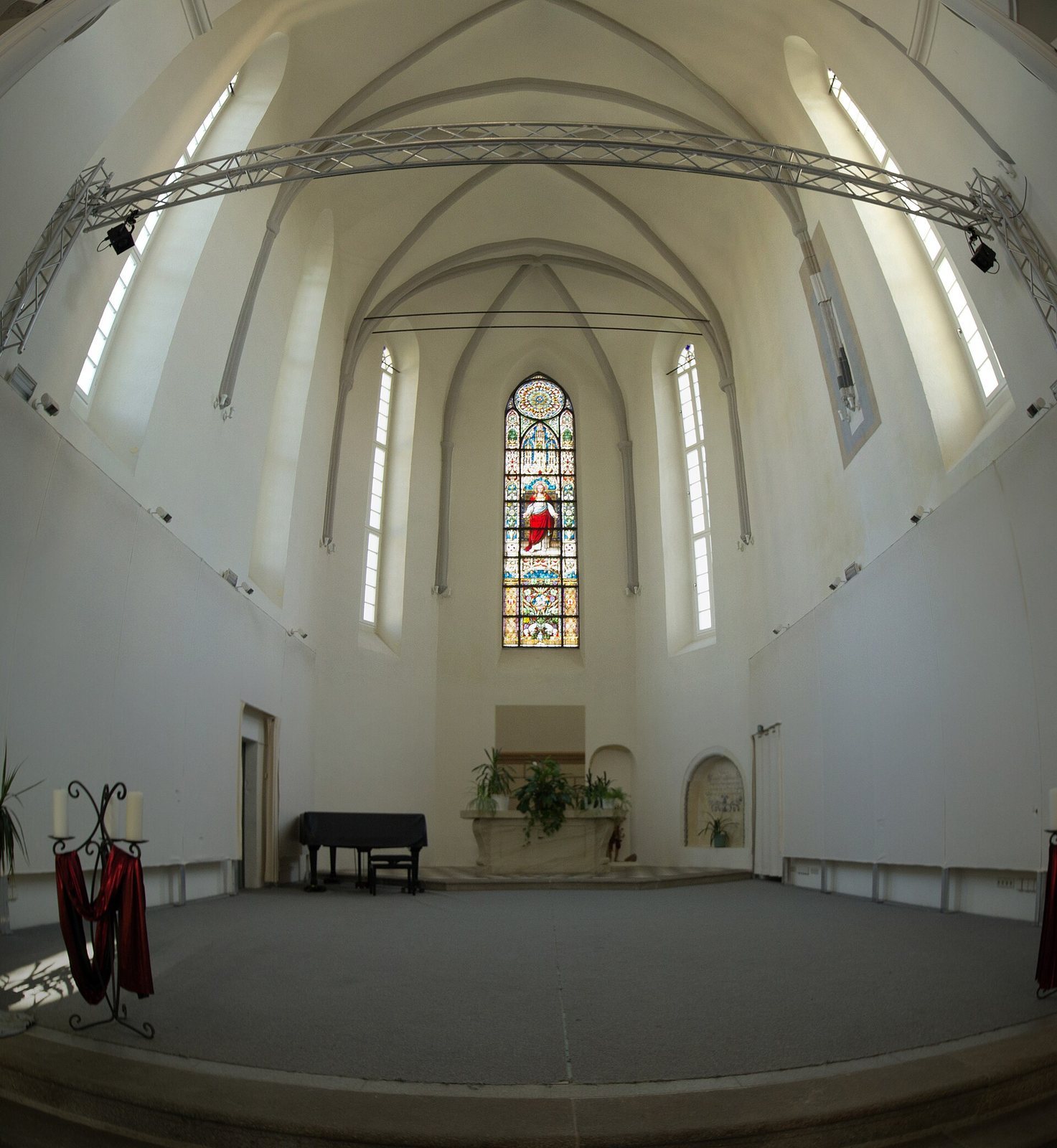
The monastery occupied the eastern part of Löbau’s old town, close to the town wall, and some of its buildings were incorporated into the wall. The former convent church remains as a secularized building used by the city as a cultural center.
Former monastery church
After 1570 the church served the predominantly Sorbian-speaking populations of Oelsa and Altlöbau. A major renovation in 1666/67 gave it the name Johanniskirche. The building burned in 1678 and was rebuilt. Its present appearance dates from a remodeling in 1840 in the Neo-Gothic style, a revival of medieval Gothic design. Renovation in 1995 accompanied its conversion into a municipal cultural center.
Liturgical objects
A royal commission inventoried the convent’s liturgical treasures on 6 December 1544. The objects included a gilded silver monstrance, a vessel for displaying the consecrated host; three gilded silver chalices with plates used during the Eucharist; and a silver cross containing a relic of the Cross and other relics. The monstrance was sealed, together with the parish church’s treasure, in a small vault in the wall of the church sacristy, the room used to prepare for services and keep religious objects. The chalices and cross were left to the convent’s last friars, along with religious garments without silver decoration.