Mornas Fortress: A Rhône Valley Stronghold in France


Site at a Glance
- Rating
- 4.6
- Popularity
- Medium
- Country
- France
- Primary era
- Medieval
- External website
- Open
- Eras represented
- Medieval
- Civilizations
- Papal States
- Site type
- Military
- Remains
- Castle
On this page9 sections
History
Ancient stronghold above the Rhône
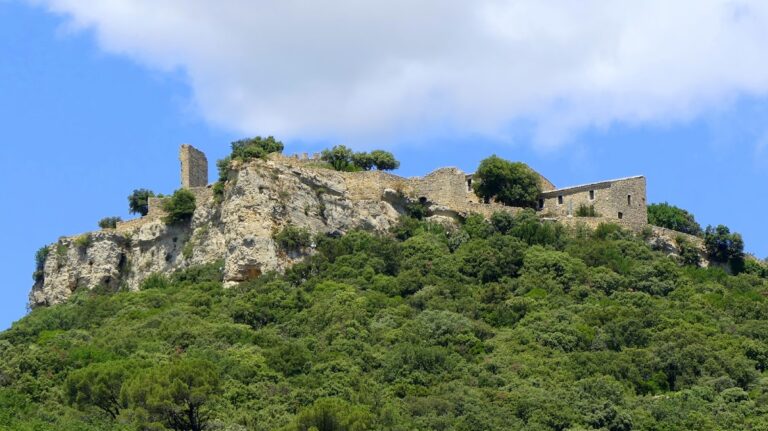
Mornas Fortress is a medieval stronghold in France above the village of Mornas, on a rocky height overlooking the Rhône. Its overall construction period extends from the eleventh to the fourteenth century, and its position continued an ancient defensive tradition. The rock offered a place to observe river traffic and helped travelers avoid more hazardous land routes. In antiquity, the Rhône may also have formed a boundary between Gallic territories.
The site was associated with the Battle of Vindalium, which Livy placed at the foot of the city of Aeria. In his account, the allied Salyan Gauls fought Roman forces summoned by the people of Massalia, the ancient Greek settlement at modern Marseille. After the Roman victory, towers were built around the battlefield to hold the weapons taken from the defeated forces.
In 118, Rome established the Roman Province, a Roman-administered territory in southern Gaul, to protect Massalia and secure a land route to Spain. The ancient oppidum, a fortified settlement or hilltop stronghold, at Mornas was dismantled, and its cisterns were filled so that it could not become a rebellious base. The Romans founded Arausio, modern Orange, established a legion there, and reorganized the surrounding land into a regular grid. These changes removed earlier boundary markers and were followed by several centuries of peace and prosperity.
Medieval castrum and contested lordship
Mornas first appears in written records in the ninth century under the name Rupea Morenata. Control passed successively to the Abbey of Aniane, the Archbishopric of Arles, and the Counts of Toulouse. A settlement developed below the cliff, while a castrum, a fortified medieval settlement or military stronghold, is recorded at Mornas in 1088. It continued the defensive use of the ancient height, with the earliest medieval fortifications probably made of wood.
The stronghold’s position made it a point of conflict between the Counts of Toulouse and the Archbishops of Arles. During the Albigensian Crusade in 1209, a thirteenth-century campaign against Cathar communities and their supporters in southern France, Raymond VI, Count of Toulouse, was forced to surrender several strongholds, including Mornas, to the Church. Mornas later returned to the Archbishop of Arles before being retaken by the count.
Papal authority and military use
The Treaty of Paris of 1229 transferred the comital possessions east of the Rhône to the French king, except for the Comtat Venaissin, a papal territory in Provence. Mornas therefore came under papal authority. The pope entrusted administration of the county to the French king until 1274, when Pope Gregory X resumed direct administration.
The fortress was placed under the tutelage of the Knights of Saint John of Jerusalem, a military religious order that governed and defended fortified sites. The cost of maintaining Mornas proved too high, and the order returned it in 1305. Major works followed in the fourteenth and sixteenth centuries. During the Hundred Years’ War, the stronghold played an important defensive role, particularly against routiers, armed bands of mercenaries and soldiers active during wartime disorder. These troubles ended toward the close of the fourteenth century.
Wars of Religion and abandonment
Conflict returned during the Wars of Religion, the sixteenth-century struggles between Catholic and Protestant forces in France. Neglected by the Church and poorly maintained, Mornas was seized in 1562 by Protestant troops led by Montbrun, a commander serving under the Protestant nobleman Baron des Adrets. Refugees and members of the garrison were thrown from the cliff. In the years that followed, Catholic and Huguenot forces, French Protestants associated mainly with the Reformed tradition, repeatedly took control of Mornas.
The conflicts ended near the close of the sixteenth century. Mornas then lost its defensive role and fell into abandonment and obscurity. It had remained important from antiquity until the French Revolution, after which the fortress deteriorated into ruins. The remains were rediscovered during the last third of the nineteenth century. Restoration began in the late 1970s under the auspices of the Amis de Mornas heritage-conservation association, which has carried out numerous renovations. The ruins were listed as a historic monument in France in 1927.
Remains
Promontory and fortress plan
Mornas Fortress occupies a rocky promontory on the left bank of the Rhône, directly above the village and the surrounding area. The escarpment forms a natural observation point and a strategic barrier over the Rhône valley. The fortress has a trapezoidal plan. Its long side faces west toward the river, while the northern part of the cliff contains the main fortified area.
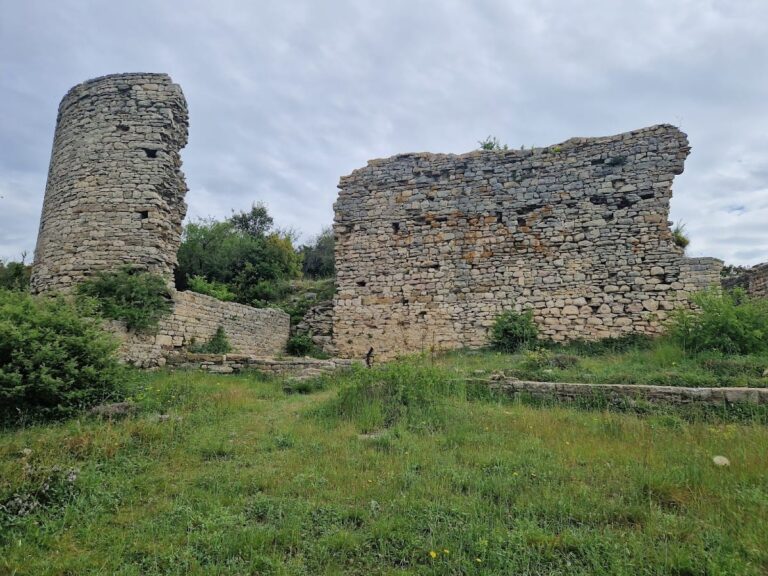
The buildings present a relatively homogeneous architectural character, making it difficult to assign secure individual dates to every structure. The surviving complex belongs broadly to construction carried out between the eleventh and fourteenth centuries. The medieval defenses follow the line of the ancient fortified settlement, while the southeastern tower and other structures form part of the wider fortress complex.
Entrance defenses
Barbican and chicane
The entrance is protected by a fourteenth-century barbican, an outer defensive work guarding the approach, and a fourteenth-century chicane, an angled passage intended to slow attackers and expose them to defense. A fifteenth-century casemate, a fortified chamber used for protection or weapons deployment, was later added to the entrance defenses.
Nearby sites