Château de Gicon: A Medieval Fortress in France


Site at a Glance
- Rating
- 4.7
- Popularity
- Low
- Country
- France
- Primary era
- Medieval
- Eras represented
- Iron Age, Classical, Medieval
- Civilizations
- Celtic, French, Roman
- Site type
- Military
- Remains
- Castle
On this page7 sections
History
Château de Gicon is a medieval fortress in Chusclan, France, constructed between the twelfth and thirteenth centuries. Archaeologists associate its site with an earlier Celtic oppidum, a fortified settlement or elevated stronghold, whose position controlled the Carmignan ford across the Cèze on the route toward Nîmes.
From local stronghold to royal domain
In 1156, Louis VII donated several castra, meaning fortified settlements or strongholds, and rural estates known as villae to the Bishopric of Uzès. Gicon was among these possessions. In 1211, Philip II Augustus confirmed the donation and added other lordships to it.
The political position of Gicon changed after the Treaty of Meaux-Paris in 1229. The agreement ended the Albigensian Crusade, a military campaign against the Cathar movement and the political power of the Counts of Toulouse, and transferred substantial authority in southern France to the French crown. Raymond VII, Count of Toulouse, swore allegiance to Louis IX, and the domain of Gicon was incorporated into the Kingdom of France.
Royal authority and the fortified residence
The keep, the principal fortified tower of a medieval castle, is generally estimated to have been built between 1200 and 1260. Tradition holds that Louis IX stopped at Gicon in spring 1270 before departing on his final crusade. The lord of Gicon is said to have accompanied him on the Eighth Crusade, and both are traditionally said to have died of dysentery at Tunis.
In 1312, Philip IV, known as Philip the Fair, entrusted the lordship of Gicon to Guilhem de Saint Just, lieutenant of the Seneschal of Beaucaire. A seneschal was a senior royal administrator, while his lieutenant acted as his subordinate representative. Philip IV authorized Guilhem to build a fortified residence at a time when the Rhône valley formed a frontier.
Destruction, decline, and conservation
In 1631, Louis XIII ordered the keep to be mined. After the last lords of the place disappeared in 1684, the castle progressively fell into ruin and was used as a stone quarry. Seventeenth- to nineteenth-century maps, including the Cassini map, represented Gicon as ruins or as a locality without a castle symbol.
In 1973, the winegrowers of Chusclan purchased the fortress for rehabilitation. Renovation began in 1987, and since 1990 the association Les Amis de Gicon et du patrimoine de Chusclan has overseen its conservation.
Remains
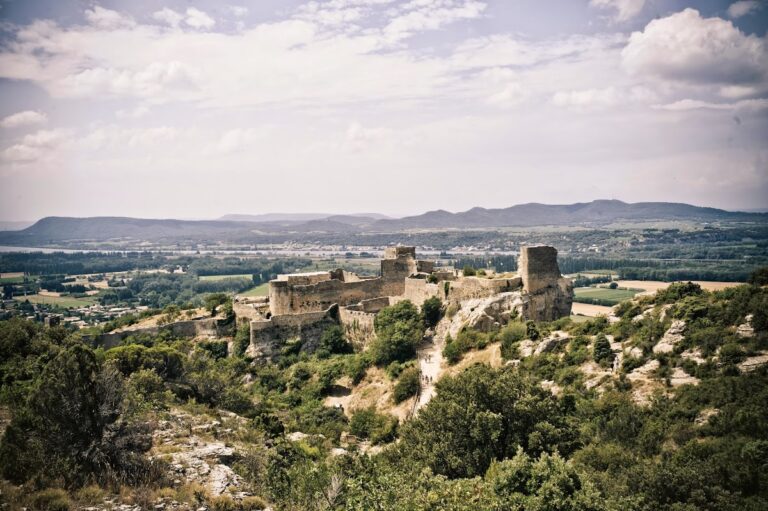
Château de Gicon stands at an altitude of 245 metres, above the Gicon farm at approximately 160 metres. The surviving site combines elements associated with the earlier Celtic stronghold, medieval defensive works, and later castle buildings. Its elevated position also provides views across the Rhône valley toward the fortress of Mornas and Mont Ventoux, westward toward the Lacau plateau, and toward the Sainte-Madeleine chapel and the Rhône.
Earlier defenses and the citadel
The northeastern, northern, and western walls are of Celtic origin and support a terrace that incorporates remains of the earlier oppidum. A Roman-period paved track, or calade, also survives at the site. Made from laid stones, this type of road or track could follow a sloping surface.
The entrance to the citadel incorporates a Celtic substructure and stands beside a fortified house, a defensible residence generally smaller and more domestic than a major castle. Together, these elements preserve the relationship between the earlier elevated settlement and the later medieval stronghold.
Medieval buildings
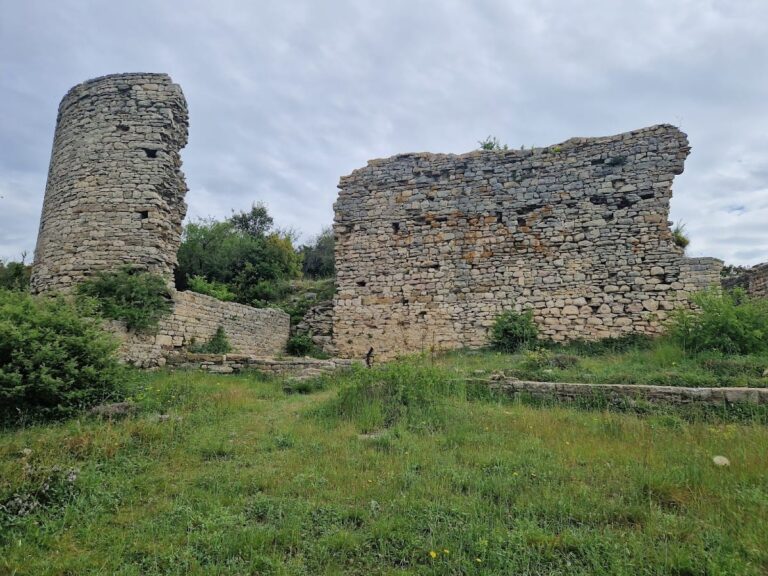
The seigneurial residence dates from the twelfth and thirteenth centuries. The site also contains a thirteenth-century sheepfold and the ruins of the thirteenth-century keep. These surviving structures represent the principal domestic, agricultural, and defensive components of the medieval castle complex.
Nearby sites