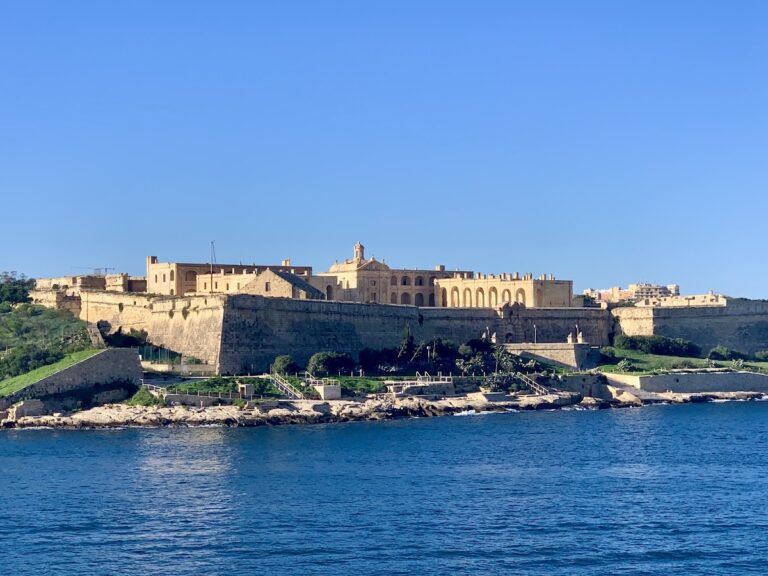
Fort Tigné: An Early Polygonal Harbour Defence in Malta


Site at a Glance
- Rating
- 4.2
- Popularity
- Low
- Country
- Malta
- Primary era
- Early Modern
- Eras represented
- Early Modern, Modern
- Civilizations
- British, Crusader, Knights Hospitaller
- Site type
- Military
- Remains
- Fort
On this page14 sections
History
Fort Tigné is a limestone polygonal fort in Sliema, Malta, built by the Order of Saint John in the late eighteenth century to protect the entrance to Marsamxett Harbour. The Order of Saint John, also known as the Knights Hospitaller, was the Catholic military-religious order that governed Malta from 1530 until the French invasion of 1798. Designed in 1792 and constructed between 1793 and July 1795, the fort was one of the earliest polygonal fortifications in the world and the last major fortification built by the Order.
Early defences at Tigné Point
A watch post stood on Punta di Santa Maria, now Tigné Point, in 1417. It was probably a small, unfortified structure manned by three people. During the Great Siege of Malta in 1565, Ottoman forces built a battery on the peninsula to bombard Fort Saint Elmo and eventually capture it. The area later became known as Dragut Point, after the Ottoman corsair Dragut.
Several plans for stronger defences were considered but not carried out. In 1670, the military engineer Antonio Maurizio Valperga proposed a fortified city called Borgo della Città Piccola, probably abandoned as a result of insufficient funds. Philippe de Vendôme proposed a casemated redoubt, a small enclosed work with protected vaulted gun positions, in 1715. René Jacob de Tigné proposed a large artillery battery in 1716, while a bastioned entrenchment planned in the early 1760s also remained unbuilt.
Lembi Battery was finally constructed on the peninsula’s northern shore in 1757 as an outwork of Fort Manoel, an early eighteenth-century fortification on Manoel Island in Marsamxett Harbour. Once Fort Tigné had been completed, Lembi Battery was decommissioned and converted into a private residence.
Construction under the Order of Saint John
The threat of a French invasion prompted the preparation of Fort Tigné’s designs in 1792. Grand Master Emmanuel de Rohan-Polduc, the elected head of the Order of Saint John, commissioned the work. Antoine Étienne de Tousard, the Order’s newly appointed military engineer, produced the final design, drawing chiefly on the Lunette d’Arçon and the ideas of Marc René, marquis de Montalembert. Construction began in 1793 under the supervision of capomastro Antonio Cachia and ended in July 1795.
The fort was named for François René Jacob de Tigné, a knight of the Order and nephew of the engineer René Jacob de Tigné. François René Jacob de Tigné contributed 1,000 scudi, Emmanuel de Rohan contributed about 6,000, Bali de Tillet donated 500, and the Fondazione Manoel provided the remaining funds. Although small by eighteenth-century standards and closer in scale to a large redoubt than to a conventional fort, Fort Tigné was considered a revolutionary example of polygonal design. It was also the Order’s final project intended to provide large-scale employment for local workers.
Around 1797, another plan proposed a fortified city covering the entire peninsula, with Fort Tigné serving as its keep. Like the earlier schemes, this proposal was not realized.
French invasion and British service
Fort Tigné first entered combat during the French invasion of Malta in June 1798. Joseph Maria von Rechberg, a Bavarian knight of the Order, commanded the fort. Its garrison consisted of members of the Cacciatori volunteer light-infantry regiment, bombardiers from the ship San Zaccharia, and Maltese militia. The fort mounted 28 guns and 12 mortars, although only 15 of the guns were serviceable.
On 10 June, French forces attempted to seize the fort in a minor skirmish but were repelled. Fort Tigné supported a counterattack by the Order’s fleet and prevented French ships from entering Marsamxett Harbour. French forces then bombarded it from land and sea on 11 and 12 June. Rechberg secured extra ammunition from Floriana, but the Maltese militia abandoned the fort on 12 June, leaving a garrison of 80 men. Ammunition ran out, parts of the fort were damaged, and French troops captured Rechberg and his soldiers as they tried to escape. The fort was in French hands by 13 June.
During the Maltese uprising against French rule, insurgents built six batteries facing the French-held fort. By 1799, its armament had been reduced to 21 guns. British forces formally took over Fort Tigné in September 1800, and a permanent garrison was installed in 1805. Damage from the French occupation was repaired, and the fort carried 30 guns in 1815.
British modifications and later history
By the 1860s, British authorities regarded Fort Tigné as an exemplary small fort without flanks and used it as a prototype for other polygonal forts. Major changes began between 1870 and 1875 and continued into the late nineteenth and early twentieth centuries. These works included new rifled muzzle-loading and breech-loading gun positions, together with the conversion of parts of the fort for gun crews and magazines.
Other British works transformed Tigné Point. Cambridge Battery was built between 1878 and 1886, followed by Garden Battery between 1889 and 1894. Barrack blocks occupied the remainder of the peninsula in the early twentieth century. Fort Tigné was placed on Malta’s 1925 List of Antiquities and suffered damage from aerial bombardment during the Second World War.
After British troops left Malta in 1979, the fort was abandoned, deteriorated, and was partly vandalized. It was also used at some point as a desalination plant. Since the early 2000s, Tigné Point has been redeveloped by MIDI plc. The British barracks were demolished and replaced by high-rise apartments, while Fort Tigné was restored in 2008. The restoration repaired British-period features and landscaped the glacis. Proposed later uses included catering facilities, a military museum, an exhibition space, and an art gallery. Since 1998, the fort has formed part of the Knights’ Fortifications around the Harbours of Malta on the country’s tentative UNESCO World Heritage list.
Remains
Fort Tigné is an early polygonal limestone fort organized around a diamond-shaped main structure, a circular keep, and a surrounding ditch. Its defensive plan uses projecting and recessed angular faces rather than the traditional bastioned arrangement. The fort was built to control the entrance to Marsamxett Harbour, and its surviving fabric combines the original design of the Order of Saint John with substantial British alterations. It is described as intact and in good condition following restoration.
Central and outer defences
Circular keep and entrance
The most prominent surviving feature is the circular keep, which contains the main gate. It originally had two rows of musketry loopholes and a roof parapet with four embrasures. During the 1860s, the original parapet was replaced by a sloping parapet carrying a single gun on a traversing platform, which allowed the weapon to rotate horizontally. A commemorative plaque is positioned above the main gate.
Diamond-shaped fort
The main body of the fort forms a diamond with two faces and two flanks. Embrasures originally occupied both faces and the right flank, but the British dismantled them in the late nineteenth century. A central blockhouse stood within the fort, with a courtyard on each side.
Ditch and counterscarp
The main structure and circular keep were enclosed by a ditch. Its counterscarp, the outer side of the ditch opposite the main wall, contained three musketry galleries. These galleries were substantially altered during the British period, as were other parts of the original defensive system.
Artillery adaptations
Rifled muzzle-loading positions
Between 1870 and 1875, some parapets with embrasures were demolished to make room for emplacements for RML nine-inch, twelve-ton guns. RML means rifled muzzle-loading, describing guns loaded through the front of the barrel. By the 1860s, the fort was armed mainly with 68-pounder guns. Its 1864 armament included eighteen 32-pounder guns, four 10-inch guns, and another 32-pounder mounted on the keep.
Breech-loading emplacements
Three BL-gun emplacements were built on the glacis in the 1890s. A glacis is a gently sloping area outside a fortification, intended to shield the walls while exposing attackers to defensive fire. These emplacements were repaired during the 2008 restoration. The modern works also created landscaped gardens and walkways across the glacis.
Subterranean features
A maze of hand-dug tunnels lies beneath the fort. The tunnels were excavated before the Second World War and reportedly extend for kilometres. Their construction forms part of the later military landscape beneath Fort Tigné.
Nearby sites