Fort of Mount Chaberton: Italy’s High-Altitude Frontier Battery


Site at a Glance
- Rating
- 4.9
- Popularity
- Low
- Country
- Italy
- Primary era
- Modern
- External website
- Open
- Eras represented
- Modern
- Civilizations
- Italian
- Site type
- Military
- Remains
- Fort
On this page10 sections
History
The Fort of Mount Chaberton is a ruined Italian frontier battery in France, on the summit of Mount Chaberton above Montgenèvre. Built by the Royal Italian Army between 1898 and 1910 as a late nineteenth-century Alpine fortification, it was designed to fire on French military positions from a strategically dominant height. The project formed part of Italy’s wider frontier-defense planning within the Triple Alliance, the pre-First World War agreement between Italy, Germany, and Austria-Hungary.
Construction and Italian frontier planning
Mount Chaberton was chosen for its high position, difficult approach, and perceived protection from the curved-fire weapons available when the project was designed. The summit stood near the former French border and offered a position from which a long-range battery could engage fortifications in foreign territory, especially those defending the approaches to the Susa Valley.
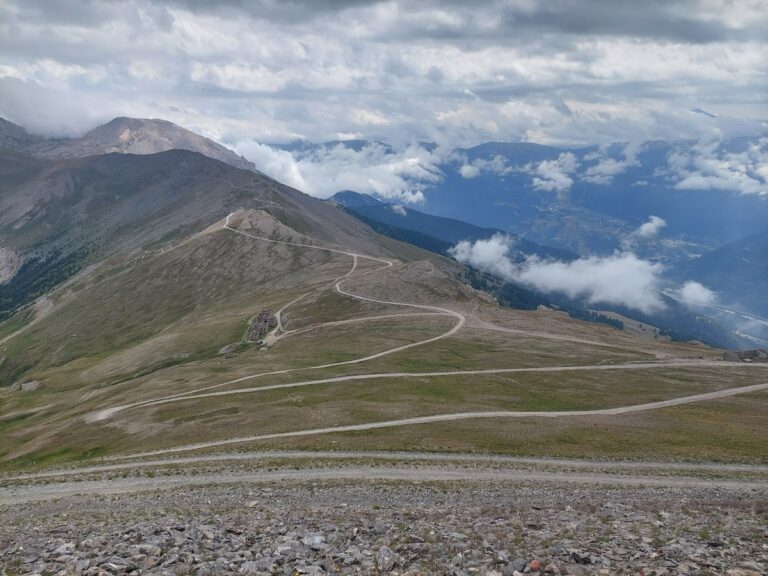
Work began in 1898 with the construction of a military road from Fenils to the summit. The summit itself was lowered by about six metres to create a building platform. Construction continued until 1910 under Major Engineer Luigi Pollari Maglietta. Although the wider project was not yet complete, the battery had received its eight 149/35 A guns by 1906.
From the First World War to the 1930s
During the First World War, the fort was disarmed and its guns were sent to the eastern front. The position was not garrisoned during the conflict, but it returned to service after the fighting ended.
Developments in heavy artillery later exposed the limits of the original design. During the 1930s, the fort underwent major reconstruction, and its service facilities were moved into underground galleries. A proposal to place the guns inside caverns was abandoned because of insufficient funds and political opposition. The open-air gun towers and the underground works therefore remained separate elements of the defensive arrangement.
The Western Alpine Wall
The battery became part of the Western Alpine Wall, Italy’s system of fortified works along the Alpine frontier. It served as a strongpoint, a defended complex intended to control an important route or area, within the Seventh Monginevro Covering Sector. This sector was intended to control access to the Susa Valley through Monginevro and Claviere and to engage positions in the Clarée Valley and around Briançon. An underground center at Col Chaberton and Battery B14 at Petit Vallon were also built within the system.
In 1938, the battery was incorporated into the Frontier Guard, or GaF, the organization responsible for frontier defense. When Italy entered the Second World War, Captain Spartaco Bevilacqua commanded the position, whose garrison numbered 320 men.
The 1940 artillery battle
On 17 June 1940, the battery shelled the French Fort de l’Olive near Plampinet. It remained largely inactive until 20 June, when it fired toward the area of the planned Italian advance around Montgenèvre and against the French forts of Janus and Gordan. One shell struck the armored observation turret of Fort Janus, damaging it without penetrating the armor.
France had planned countermeasures against the high battery since 1937. In spring 1940, two sections of concealed Schneider 280 millimetre siege mortars were positioned near Poët-Morand and Eyrette. These weapons were designed to fire heavy shells on a high, curved trajectory against fortified positions. After fog lifted on 21 June, French observers at the forts of Janus and Croix de Toulouse directed the mortar fire onto Chaberton.
During three and a half hours, the mortars fired 57 shells. Six of the eight gun turrets were disabled, the service cableway was put out of action, and the bombardment killed nine men and wounded 50. The fort was also seriously damaged. Fighting continued at reduced intensity on 22 June. On 23 June, the two surviving guns supported the Italian attack on Mount Chenaillet, while French counterfire was ineffective because of fog. Further French mortar fire took place on 24 June, when the two sections fired 14 and 24 shells respectively. The armistice took effect on 25 June 1940, and the fort ceased operations.
Abandonment and transfer to France
The fort was abandoned after 8 September 1943. Units of the Folgore formation occupied it in autumn 1944. Folgore belonged to the Italian Social Republic, the German-backed state established in northern Italy after the 1943 armistice. The position was definitively abandoned after the surrender of Germany and the Italian Social Republic in 1945, and its strategic function ended on 25 June 1945.
Under the Paris peace settlement of 1947, Mount Chaberton and the fort passed into French territory. The abandoned installation was stripped of its metal structures in 1957. The military road from Fenils to the summit was closed to traffic in 1987. The fort is now owned by the French Ministry of Defence and lies in the Provence-Alpes-Côte d’Azur region. The last surviving artilleryman of the 1940 attack, Enrico Ronchetti, died in 2022 at the age of 102.
Remains
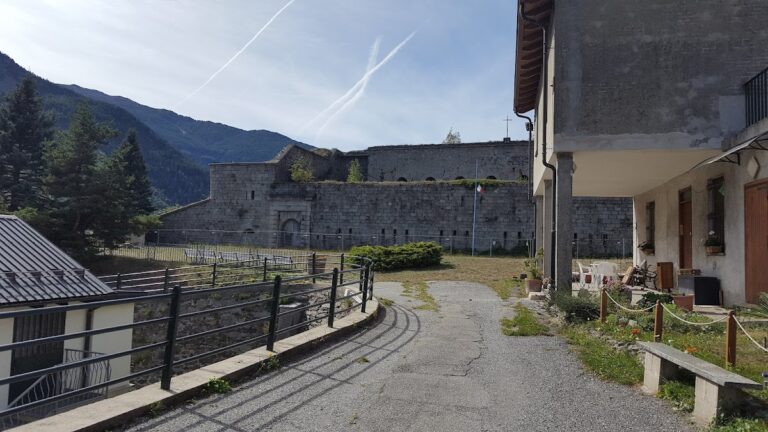
The Fort of Mount Chaberton occupies the 3,130-metre summit of Mount Chaberton and is regarded as the highest fortification in Europe. The summit was reshaped for construction, with a rocky step about 12 metres high formed on the Italian side. The masonry works were built at the base of this step, creating a long, linear arrangement of open-air structures and underground facilities.
Masonry battery and internal facilities
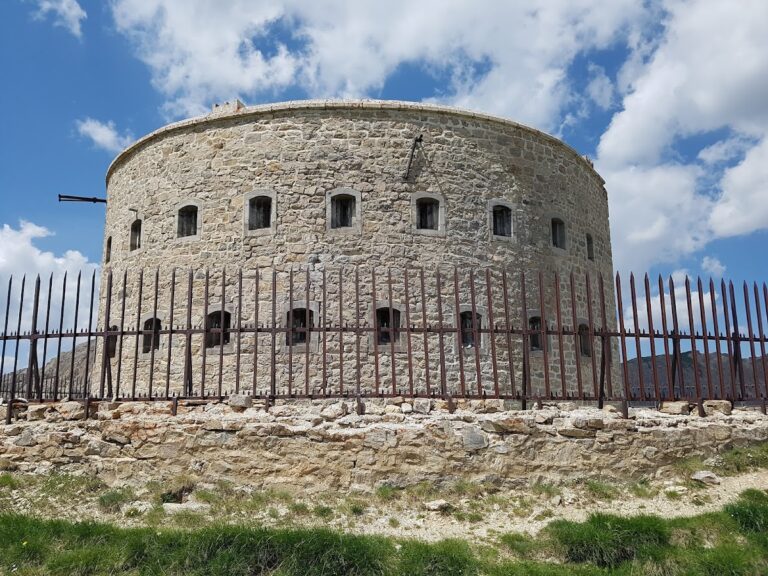
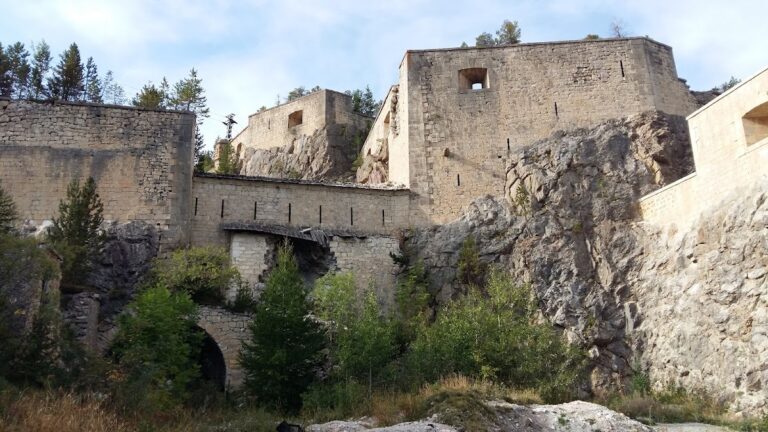
The original fort consisted of masonry buildings arranged lengthwise along the rocky step. Two long corridors connected the barracks, storerooms, infirmary, command facilities, and kitchens. The principal ammunition store was placed in an underground work beneath the masonry structures. The gun towers stood on a concrete base that also contained stores, the command post, and service rooms.
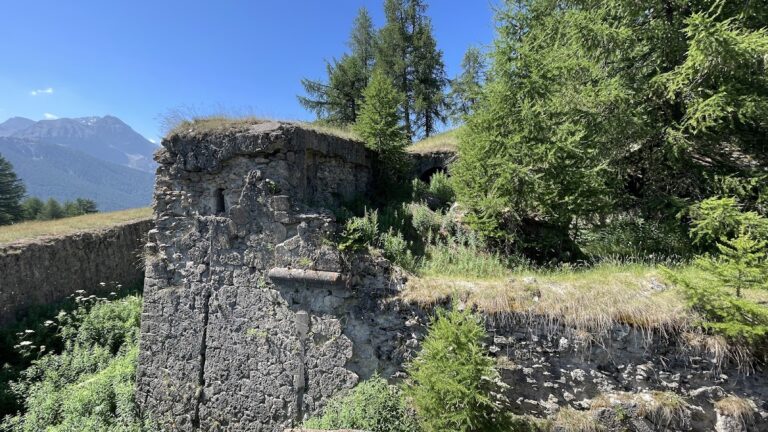
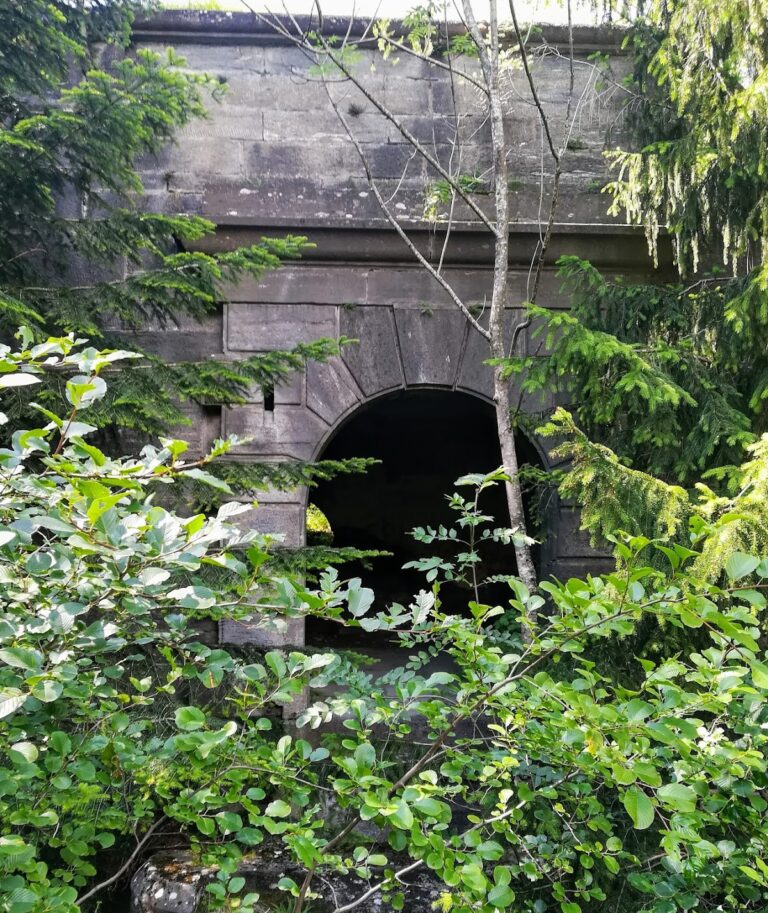
The service areas were transferred into underground galleries during the 1930s reconstruction. The surviving complex consequently combines ruined open-air masonry with subterranean works. Many of the underground galleries are obstructed by ice, while the exposed structures have been damaged by the 1940 bombardment, severe weather, and decades without maintenance.
Gun towers and armored turrets
Eight gun towers were arranged in a single row along the roof, with roughly six metres between them. Each tower was slightly more than seven metres high, built in masonry and faced with small concrete blocks. Internal metal spiral staircases led to the tops of the towers.
Each tower carried one 149/35 A long-range gun inside a rotating armored turret. Supplied by Armstrong, these turrets were known as Armstrong Montagna turrets and resembled naval gun housings. Their armor measured up to five centimetres at the front, 2.5 centimetres on the roof, and 1.5 centimetres at the rear. It was intended primarily to shield the seven crew members at each gun from shell fragments, since direct curved-fire attacks were not expected when the fort was designed.
Transport and present condition
A cableway transported supplies and ammunition to the battery, but it was disabled during the French bombardment and has not survived. The original metal installations were later stripped from the abandoned fort. The present remains include the damaged gun-tower row, open-air masonry structures, concrete foundations, and underground galleries. The position behind the summit provided additional protection from enemy fire, but the surviving structures are now in ruins and their stability is not guaranteed.
Nearby sites