Forte Busa Grande: An Austro-Hungarian First World War Fortification in Italy


Site at a Glance
- Rating
- 4.6
- Popularity
- Low
- Country
- Italy
- Primary era
- Modern
- Eras represented
- Modern
- Civilizations
- Austria-Hungary, Habsburg
- Site type
- Military
- Remains
- Fort
On this page12 sections
History
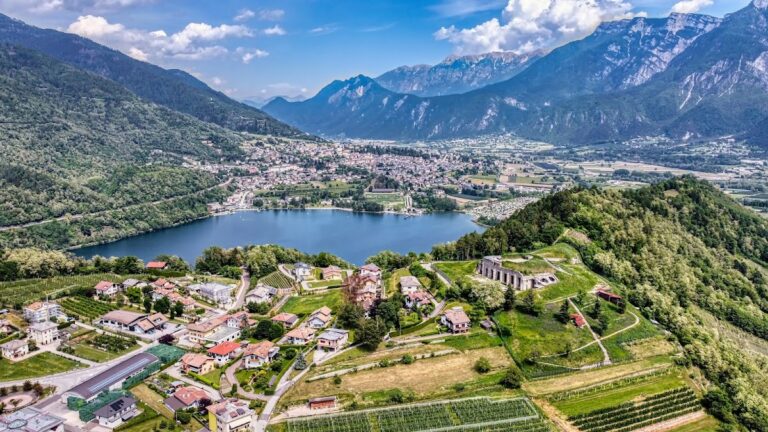
Forte Busa Grande is an Austro-Hungarian First World War fortification in Italy, above Levico Terme in the Compet area of Vignola-Falesina. Built in 1915 as an underground mountain fort, it was designed to observe and defend the Valsugana from a summit approximately 1,500 metres above sea level.
Planning and construction
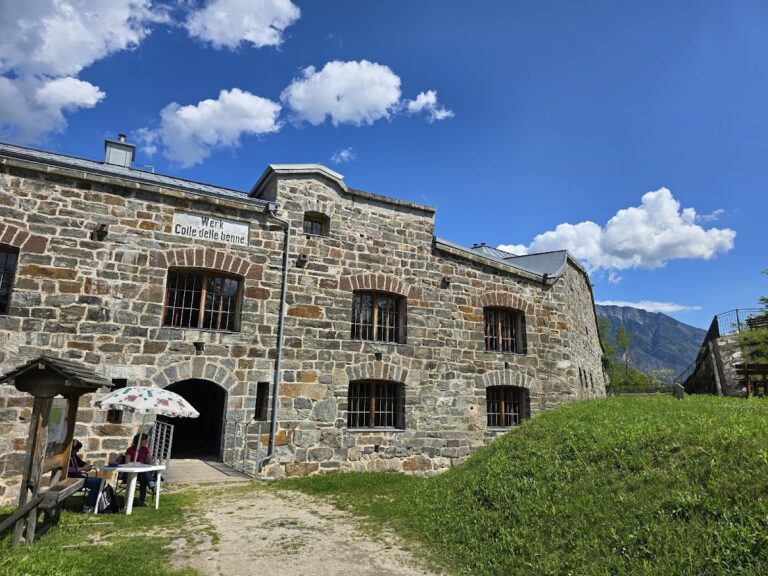
The Austro-Hungarian General Staff had considered fortifying Busa Grande as early as 1906, but financial limitations postponed the project. By early 1915, the permanent fortifications at Colle delle Benne and Tenna, both dating from the late nineteenth century, were judged inadequate against modern artillery. Their guns were therefore removed and transferred to newer positions.
Busa Grande was built to replace the lower Fort Colle delle Benne. Captain Emil Huetter of the Trento military engineering directorate prepared the initial designs and supervised the work, while Franz von Steinhart headed the directorate responsible for the project. The Viennese firm Eisler & Bruder undertook the road and fort construction, at an estimated cost of about 736,527 crowns.
The access road was completed in 1911 and 1912, while construction of the fort began in March 1915 and ended in May. The installation was ready before Italy declared war on Austria-Hungary on 23 May 1915, and it entered operation when hostilities began on 24 May.
Russian and Serbian prisoners of war were forced to dismantle Fort Colle delle Benne, move its equipment to the Busa Grande summit, and build and arm the new position. Prisoners and civilians also cleared the road during the severe winter of 1915 and 1916. They worked with inadequate food, equipment, and assistance, and some prisoners were buried without identified graves.
Wartime service
The garrison consisted of approximately 50 men from Fortress Artillery Regiment No. 1 “Trient” and nearly 50 Tyrolean territorial riflemen from Battalion Kaltern II. The artillerymen operated the guns, while the riflemen guarded the fort and provided close defence.
During the first year of the war, Busa Grande repeatedly fired on Italian troops advancing through the Valsugana. Italian forces entered Borgo Valsugana on 24 August 1915, but Busa Grande remained a secondary target. In December, heavy snowfall halted fighting on the Trentino front. Snow exceeded five metres, temperatures fell far below freezing, and roads and supply routes became unusable.
Fighting resumed in April 1916. Italian forces attempted a breakthrough near San Osvaldo, west of Roncegno Terme, and Austro-Hungarian forces launched a counteroffensive in which the Busa Grande batteries participated. The Austro-Hungarian spring offensive, known as the Strafexpedition, began in May 1916 and pushed the front beyond the range of the fort’s artillery. The two turret howitzers were then removed and placed closer to the fighting.
Until the end of the war, the position served as an anti-aircraft site equipped with several anti-aircraft guns and searchlights. In October 1918, British units entered the Valsugana and released prisoners held at Levico. The end of the war consequently brought Busa Grande’s military service to a close.
Abandonment and restoration
After the war, local inhabitants and salvage workers dismantled usable parts of the complex. They removed wooden elements, doors, electrical equipment, structural frames, steel, iron, armoured cupolas, beams, cisterns, and other fittings. The abandoned fort then deteriorated and partly collapsed.
The Municipality of Vignola-Falesina sponsored extensive restoration between 2014 and 2016. Directed by architect Roberto Pezzato, the work cleared debris and vegetation, secured the complex, reconstructed the former armoured cupolas and selected interiors, and installed electric lighting and multilingual information panels. A permanent exhibition of photographs and original documents was placed inside. Forte Busa Grande reopened as a museum site in September 2016 and remains owned by the Municipality of Vignola-Falesina.
Remains
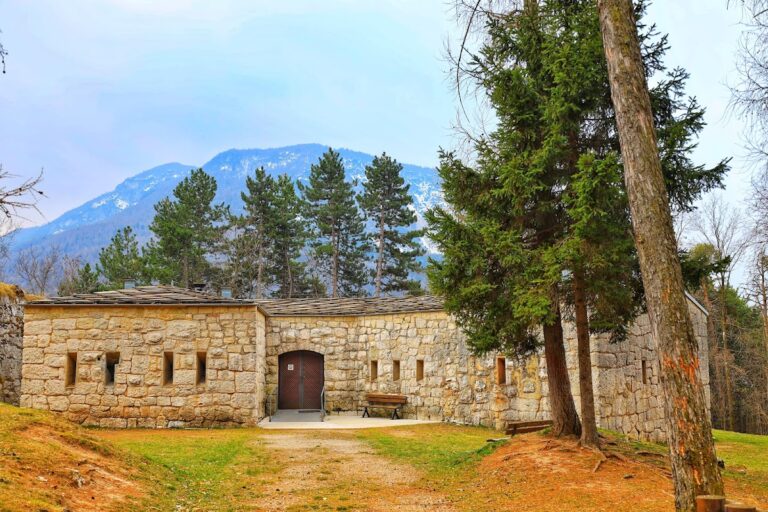
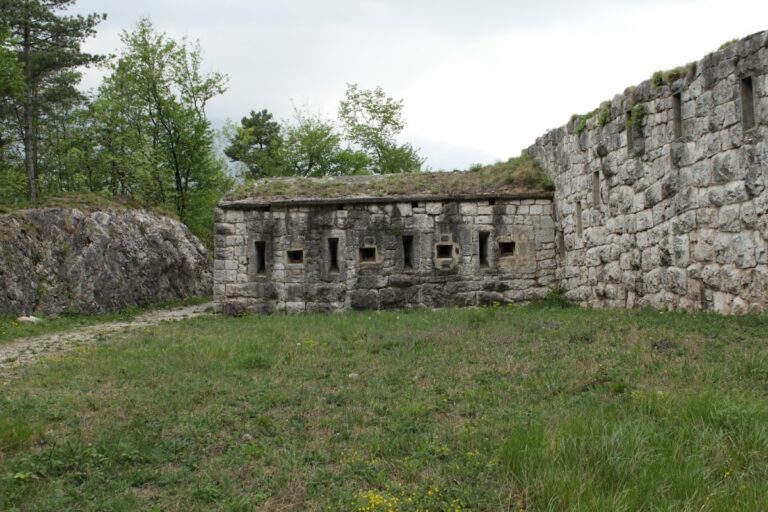
Forte Busa Grande occupies the Busa Grande summit beneath the similarly named peak. Its principal installation was excavated entirely into the rock, while open artillery and close-defence positions were distributed around the summit. The underground works and the surrounding positions formed a fortified system designed to shelter the main weapons while supporting observation and defence of the mountain approach.
Underground fortification
Main tunnel and chambers
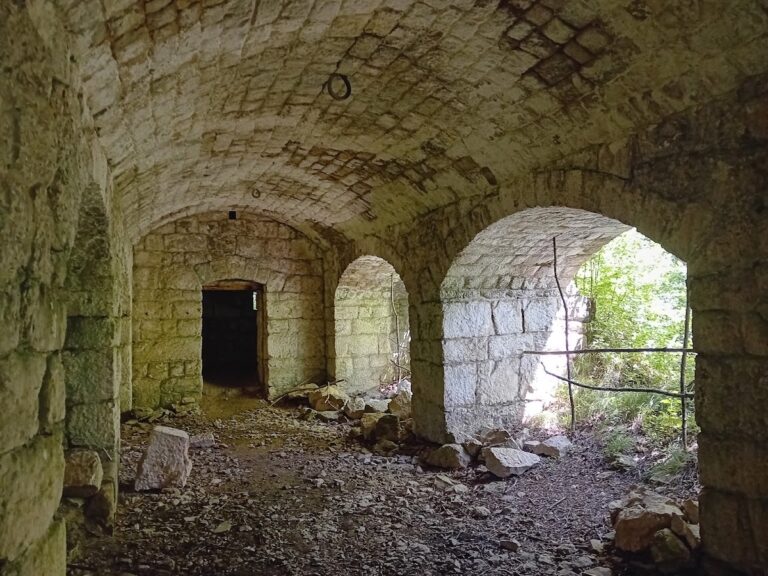
A main tunnel approximately 110 metres long crosses the summit from north to south. Numerous side passages and chambers branch from it, some extending to about 60 metres. Parts of the passage system are covered by brick vaults, while other sections use vaults made from plastered stone blocks.
The underground complex included accommodation for soldiers and officers, a central ammunition magazine, storage rooms, kitchens, latrines, a workshop, a generator room, a water cistern, and a first-aid station. Geological conditions allowed substantial water infiltration, so the construction was altered to add a third shaft for the observation position, a cistern, a generator station, additional chambers, and a tunnel connecting with the surrounding infantry trench. The depth of the tunnels protected the installation from bombardment, although water infiltration and other geological problems weakened that protection.
Armoured cupolas and gun wells
Three armoured cupolas, rotating protective turrets for artillery or observation equipment, were separated from one another to reduce their vulnerability to artillery fire. Two eastern gun wells, each about 12 metres high and roughly 20 metres apart, contained the main artillery cupolas and their ammunition hoists.
The two main weapons were Škoda 10 cm M05 turret howitzers, short-barrelled artillery pieces mounted inside protected turrets. They had been transferred from Fort Colle delle Benne in spring 1915. The northernmost cupola served as an artillery observation position. Its access passage branches from the main tunnel near the entrance but remains buried and inaccessible.
External batteries and access
Open batteries and close defence
A short descending passage at the southern end of the main tunnel leads to the southern entrance of the underground battery, where weapons were placed inside fortified chambers rather than exposed emplacements. A trench ran around the summit and connected in part with the surrounding field-gun and machine-gun positions. A western side tunnel led to one of the field-gun batteries in the open air.
Three open batteries held eight 9 cm M75 field guns. Two batteries, each equipped with two guns, stood east of and somewhat below the main fort. A third battery of four guns adjoined the underground installation to the west. Two advanced underground machine-gun positions provided close defence, one to the south and one to the east. They carried Schwarzlose M07 machine guns and 11 mm/1869 Montigny mitrailleuses.
Access road
The road from Pergine to Compet continued towards Monte Panarotta and served both the construction site and the completed fort. It was designed with a maximum gradient of 10 percent, an average width of at least three metres, and curves with a radius of 10 metres.
Restored interiors and interpretation
Restoration exposed the two gun wells, partially cleared the surrounding trench, and reconstructed the former cupolas for interpretive purposes. Some interior rooms were also rebuilt, and the underground complex received electric lighting and multilingual information panels. The permanent exhibition presents photographs and original documents connected with the fort.
Two later artworks by Roberto Conti are associated with the site. One is a large carved wooden book bearing Alberto Toldo’s poem “Sentinella,” dedicated to the fort. The other, “Oltre le linee,” combines a twisted root with artefacts to suggest a soldier emerging from a trench.
Nearby sites