Fort of Cão: A Mannerist Coastal Bastion Fort in Portugal


Site at a Glance
- Rating
- 4.3
- Popularity
- Low
- Country
- Portugal
- Primary era
- Early Modern
- Eras represented
- Early Modern
- Civilizations
- Portuguese
- Site type
- Military
- Remains
- Fort
On this page5 sections
History
Fort of Cão is a small coastal fort in Portugal, built in the Mannerist style between 1699 and 1702 during the reign of King Peter II. It stands at Gelfa, near the mouth of the Âncora River, and formed part of a wider effort to strengthen the Atlantic coast of Alto Minho.
Coastal defenses after the Restoration
The fortifications along this coast expanded after the War of Restoration of Independence, the Portuguese conflict with the Spanish monarchy that ended with Portugal’s independence being restored in 1668. The coastal area was considered vulnerable to attacks by pirates and the Spanish Armada, prompting the construction of four small forts between Caminha and Viana do Castelo.
Fort of Cão was one of these works, alongside the forts of Vinha at Areosa, Montedor at Carreço, and Lagarteira at Vila Praia de Âncora. They complemented Ínsua Fort, built during the war to defend the southern entrance of the Minho River. Existing defenses at Valença, Vila Nova de Cerveira, and Santiago da Barra were also remodeled, while Fort São Francisco de Lovelhe was built to reinforce the southern bank of the Minho River.
Construction and later status
Built between 1699 and 1702, Fort of Cão was intended to defend the coast at the mouth of the Âncora River and to support the defenses of the Caminha stronghold. Its active military use ended in 1716, when the garrison was withdrawn. A commander remained associated with the fort, and its period of use is recorded as extending through the eighteenth century.
Fort of Cão was classified as a Property of Public Interest in Portugal in 1967. The protection was established by Decree No. 47,508 of January 24, 1967, later rectified in March of that year, and the fort was also registered under Decree No. 95/78 of September 12, 1978.
Remains
Star-shaped coastal fort
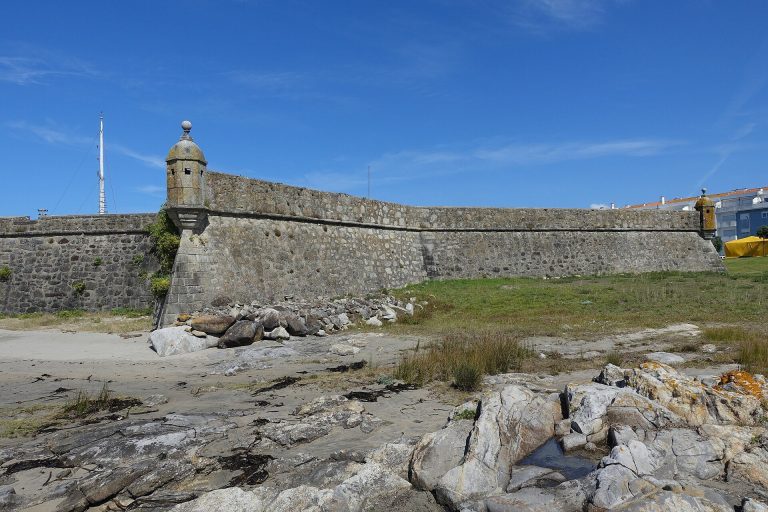
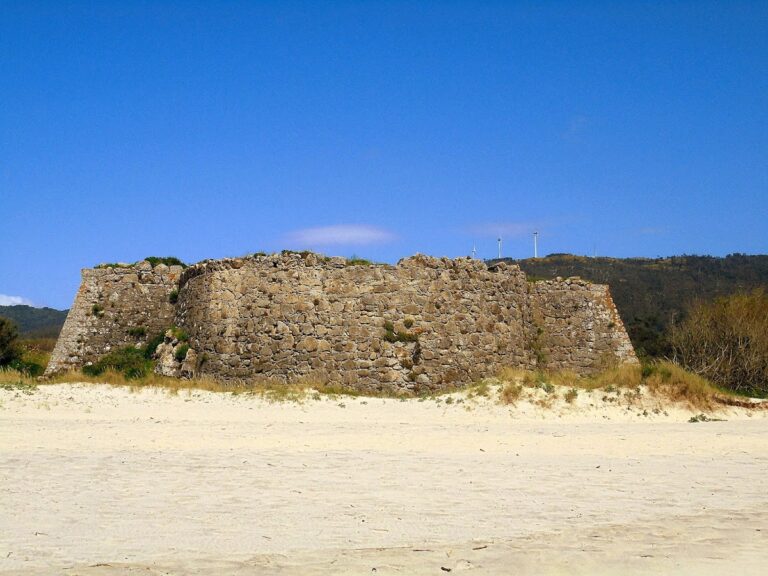
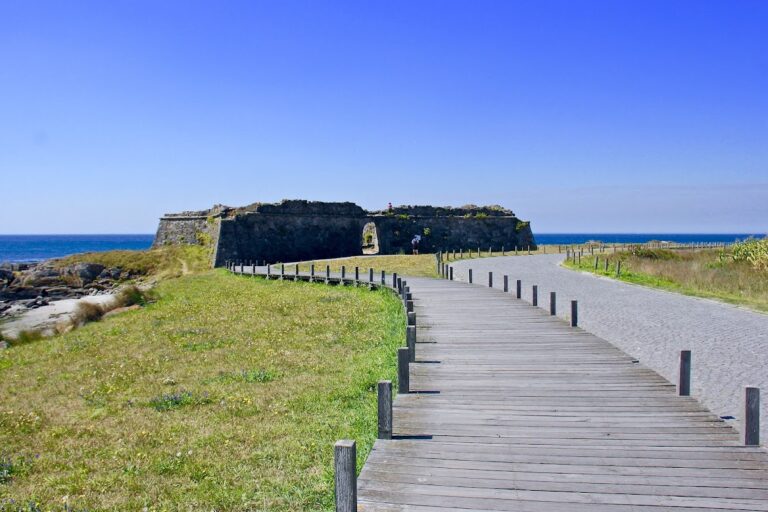
Fort of Cão is a small bastion fort, a defensive work with projecting points that allowed defenders to cover the wall faces with flanking fire. Its simple elevations enclose a star-shaped plan of four unequal bastions. The seaward side curves outward, while the landward side is concave.
The concave side contains the gate of arms, formed by a semicircular arch. Inside, service rooms once created a central corridor across the courtyard. The plan and structural form resemble those of the forts at Areosa and Montedor, whose designs represented an advance in coastal defense and watch systems at the time. The three forts may have been designed by the same architect. Fort of Cão survives in a ruined condition.