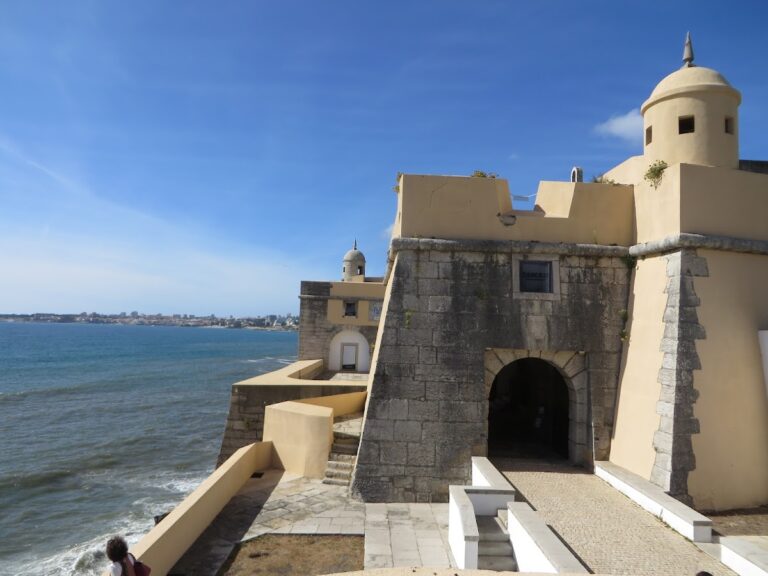
Forte de Santo Amaro: A Portuguese Bastion Fort on the Tagus


Site at a Glance
- Rating
- 4.5
- Popularity
- Low
- Country
- Portugal
- Primary era
- Early Modern
- Eras represented
- Early Modern, Modern
- Civilizations
- Portuguese
- Site type
- Military
- Remains
- Fort
On this page11 sections
History
Forte de Santo Amaro is a small Portuguese maritime bastion fort in Oeiras, Portugal, built in the Mannerist style during the Portuguese Restoration War between 1647 and 1659. A bastion fort uses projecting angular defenses to allow overlapping artillery fire along its walls, while Mannerism is a late Renaissance style marked by formal complexity and controlled spatial effects. Also known as Forte de Santo Amaro do Areeiro, Forte de Santo Amaro do Rio de Oeiras, Forte Velho, and Forte do Areeiro, it was ordered by King João IV to strengthen the defense of the Tagus estuary, complement the defenses of São Julião da Barra, and control access toward Lisbon.
Construction during the Restoration War
João IV’s accession in 1640 began the Braganza Restoration, which ended the period of Iberian union and led to the Portuguese Restoration War. Construction of the fort began in 1647 under António Luís de Meneses, 3rd Count of Cantanhede and military governor of Cascais. The work was completed in 1659, when the fort had a garrison and seven cannon of different calibers.
Eighteenth-century repairs and military service
Rodrigo da Costa became governor by royal decree of 30 August 1701, followed by João Pedro Fernandes, a corporal, in 1723. The fort’s condition declined during the first half of the century. In 1735 its main entrance door needed replacement, and by 1751 the deterioration was severe enough for the fort to be described as ruinous. Repairs were estimated at 900,000 réis, after which conservation work was undertaken and an officer was assigned to supervise the premises.
During Portugal’s war with Spain in 1762 and 1763, part of the wider Seven Years’ War, the fort was commanded by Carlos José da Cunha, an ensign in the Navy Regiment. The Seven Years’ War was an international conflict fought from 1756 to 1763. At that time the fort had eight cannon, although one was out of service. By 1798, six gunners and six cannon were recorded there. Colonel of engineers Romão José do Rego inspected the fort after later conservation work in 1793, and Manuel dos Reis, a major in the Court Artillery Regiment, became governor by royal decree on 17 December 1800.
Nineteenth-century garrison and disarmament
In 1805 the garrison consisted of the governor, adjutant captain Bartolomeu Agostinho Pereira de Carvalho, a quartermaster, two squad corporals, and twenty invalid soldiers. The fort was in good condition in 1813 and held six cannon, but its armament had declined to three by 1824.
During the Liberal Wars, a conflict associated with the struggle over Portugal’s constitutional government, the fort had five mounted cannon in 1831. Its governor, Matias José de Almeida, abandoned it in 1833 and withdrew north. José Victorino de Amarante, who had previously served at the Fort of São Lourenço do Bugio, became governor in 1836. Luís da Silva Seabra held the post in 1841, and three 24-calibre cannon remained in 1847. José de Gouveia Lobo Soares and José Maria de Mendonça were governors in 1855. The fort was disarmed in 1868, although Joaquim José Esteves and Francisco Maria Esteves Vaz served as governors in 1870 and 1874.
From reduced garrison to residential use
By 1896 the fort was occupied only by one soldier and his family, and António Francisco was governor in 1897. Francisco de Carvalho Moreira Júnior held the post in 1909. Frederico Augusto Guerra Soares was appointed in 1911, when the position had become merely symbolic.
During the Second World War, five families lived in the fort in 1945. The residential population had reached twenty-seven adults and several children by 1947, and about forty people in 1950. Eviction proceedings subsequently began. In 1953 the fort was transferred to the Port of Lisbon Administration, which did not use it. It passed to the General Secretariat of National Defence in 1954, followed by major conservation and improvement works. The premises served as the summer residence of the Minister of the Army in 1961 and 1962.
Late twentieth-century and modern status
After the Carnation Revolution of 1974, the Portuguese military-led revolution that overthrew the Estado Novo dictatorship, the fort hosted political meetings. An external wall was built for the security of certain public figures, and its later demolition was awaited. During the 1980s, the premises served as a holiday colony for children of public servants.
Forte de Santo Amaro was classified as a Property of Municipal Value in a notice published in 2004. This is a local heritage designation. In December 2010, the government authorized its sale at an estimated price of 1.273 million euros as part of the reorganization and requalification of military infrastructure.
Remains
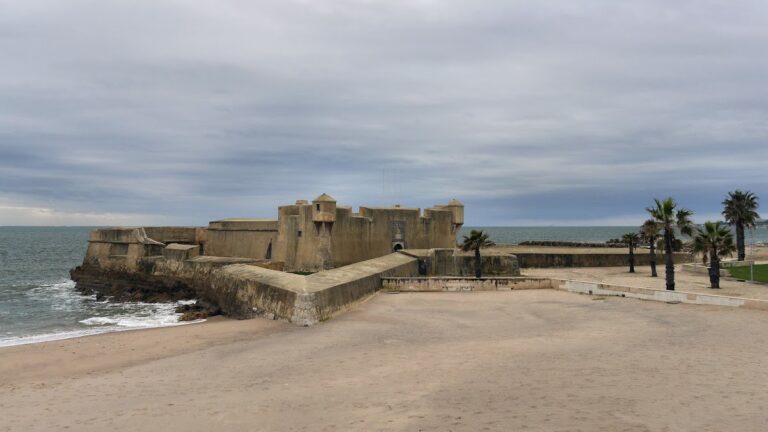
Forte de Santo Amaro occupies a dominant position beside Praia da Lage, on the right bank of the Ribeira da Lage and west of Praia de Santo Amaro. It stands on the right bank of the Tagus within the municipality of Oeiras. The restored fort is a compact polygonal work with a Mannerist design and a total area of 6,100 square metres. Basalt forms part of its construction.
Fortification and entrance features
Polygonal bastion fort
The surviving structure is organized as a small polygonal maritime fortification. Its angular defensive form belongs to the Mannerist design created during the 17th-century rebuilding and completion of the fort. The position beside the Tagus estuary reflects its defensive purpose, while the restored fabric preserves the principal form of the military work.
Main gate and commemorative inscription
Above the main gate is an inscription engraved on a durable surface and surmounted by the royal arms. It records the completion of the fort’s rebuilding works in 1659, linking the entrance directly to the final phase of the 17th-century construction campaign.
External wall and present appearance
An external security wall erected after 1974 altered the fort’s appearance when viewed from outside. Its presence can give a misleading impression of the original design, which is represented by the restored polygonal fortification itself.
Nearby sites