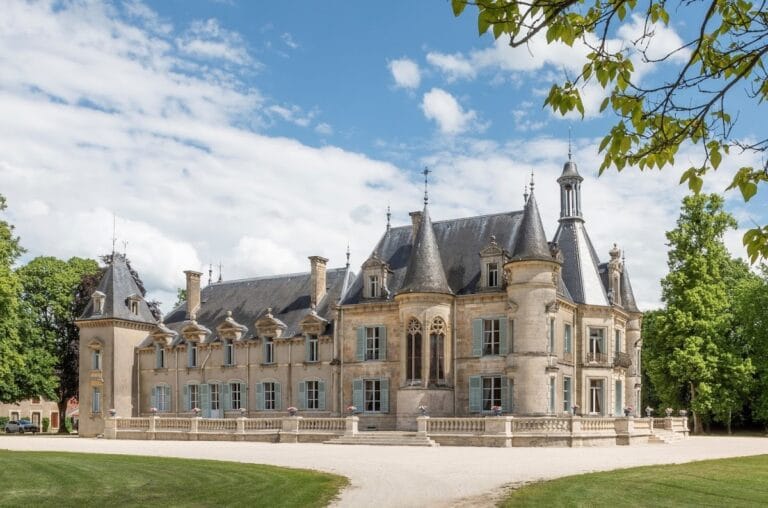
Fort de Liouville: A Séré de Rivières Fortress in France


Site at a Glance
- Rating
- 4.4
- Popularity
- Very Low
- Country
- France
- Primary era
- Modern
- External website
- Open
- Eras represented
- Modern
- Civilizations
- French
- Site type
- Military
- Remains
- Fort
On this page13 sections
History
Fort de Liouville is a French fortress near Apremont-la-Forêt, built between 1876 and 1878 as part of the Séré de Rivières system. This late-nineteenth-century network of forts, batteries, and defensive positions was created after France’s defeat in the Franco-Prussian War of 1870–1871. The fort guarded the approaches to the Meuse valley and formed part of the fortified line between Verdun, Toul, and Metz, facing the routes by which Germany could advance.
Construction and the Séré de Rivières system
Fort de Liouville was constructed on the elevated terrain of the Liouville area in the Meuse department. It belonged to the defensive line of the Hauts de Meuse, the high ground along the Meuse in northeastern France. As a curtain fort, it was intended to form part of a defensive line between major fortified positions rather than operate only as an isolated stronghold. Its position allowed it to overlook the Woëvre valley, protect the approaches to the Meuse valley, block the Marbotte and Lérouville gaps, and watch the railway leading to Lérouville.
Construction cost 2,108,000 francs. The fort was designed for a garrison of roughly 700 to 750 men, with an authorized strength of 686 to 691 men in 1914. Its original facilities included accommodation, kitchens, dining rooms, a bakery, a medical room, storage areas, ammunition magazines, and cisterns for collected rainwater.
The changing name of the fort
The original name referred to the Liouville region. In January 1887, Georges Boulanger, then French minister of war, ordered the forts of the Séré de Rivières system to be named after French military heroes. Liouville consequently became Fort Stengel, commemorating General Henri Christian Michel Stengel, a French Revolutionary-period officer killed at the Battle of Mondovi in 1796. Boulanger’s successor, Théophile Ferron, revoked the order in October 1887, and the name Liouville was restored. The name Stengel nevertheless remained engraved above the entrance.
Modernization before the First World War
Advances in artillery made the earlier stone-and-earth fortifications increasingly vulnerable. Between 1904 and 1910, the fort received reinforced-concrete protection, a new concrete roof, additional armored installations, a redesigned defensive ditch, and a fortified entrance. The improvements strengthened the position without providing concrete-protected barracks. A new underground powder magazine had already been excavated in 1890.
The fort’s military history also entered French literature. Émile Driant, a military officer who wrote under the name Captain Danrit, stayed at Liouville in 1880 while serving as a young sub-lieutenant and conducting topographical surveys. He drew plans of the fort and later used it as the setting for his 1892 novel La Guerre de Forteresse.
Bombardment and service in 1914
German heavy artillery opened fire on Fort de Liouville on 23 September 1914, during the First World War. Guns of 210 and 305 millimetres caused extensive damage, penetrated the northern ammunition magazine, and struck the fort’s artillery installations. A direct hit rendered the 75 mm gun turret unusable. The fort was evacuated on 30 September, but it was not captured.
After the evacuation, Liouville served mainly as an observation post until 1918. Infantry continued to hold the surrounding area, while the fort faced the German lines and provided a resting place for regiments withdrawn from combat. In September 1918, during the Battle of Saint-Mihiel, it sheltered United States expeditionary troops. The surviving artillery turret supported the American advance during the recovery of the Saint-Mihiel salient.
Abandonment and preservation
After the First World War, the construction of the Maginot Line made many older Séré de Rivières forts secondary defensive positions. They were regarded as obsolete before the Second World War and were eventually abandoned. In 1938, one of Liouville’s machine-gun turrets was removed and installed at the Bastion de la Riene in the Citadel of Verdun.
The Association for the Preservation of Fort de Liouville began clearing and restoring the remains in 1988. Its founding president, Jackie Bruneteau, lived at the fort for four years without water or electricity while carrying out the work. He died on 26 April 1992 during the annual ceremonies at the Éparges ridge. The fort is now maintained by the preservation association as a memorial site associated with the First World War and is used for guided historical visits.
Remains
Layout and construction
Fort de Liouville occupies a hill approximately 380 metres above sea level, about 5 kilometres south of Apremont-la-Forêt and roughly 10 kilometres east of the Meuse River. It stands between Fort de Gironville and Camp des Romains, on a west-facing escarpment. Its roughly rectangular plan measures about 400 metres from side to side and 150 metres in depth. The fort is described as a central-massif fortress and as a curtain fort within the defensive line of the Hauts de Meuse.
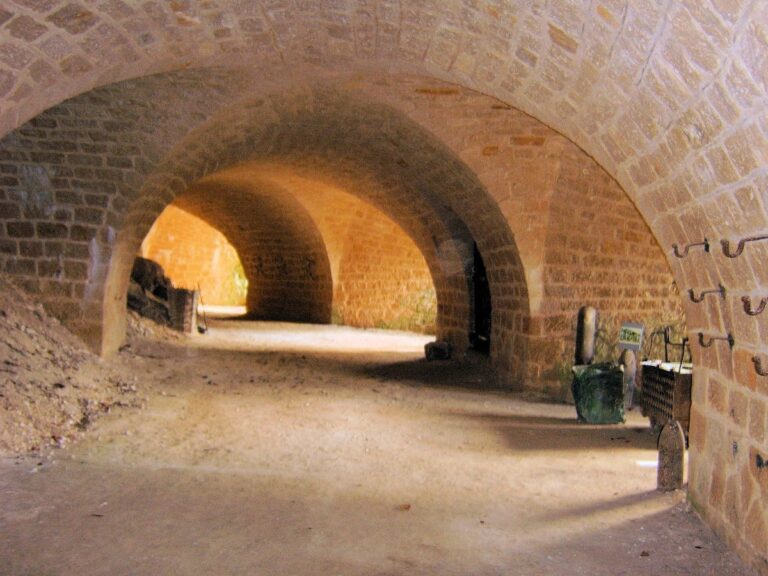
The builders removed soil from the hill and formed the internal rooms with local stone and brick. Later work covered the fort with approximately one metre of sand beneath a new reinforced-concrete roof. The surrounding ditch was redesigned, and the earlier caponiers, fortified structures projecting into a ditch, were replaced by counterscarps and counterscarp coffers. Counterscarps are defensive works on the outer side of a ditch, while counterscarp coffers are enclosed positions built into that edge.
The gorge, or entry side, faces German territory, an unusual arrangement for a fort of this type. Internal entrances and window frames use Gothic-style arches or tracery, giving the structure an architectural character unusual among the forts of the Séré de Rivières system.
Armament and observation positions
Mougin turret
A Mougin turret, an armored rotating gun turret, was constructed at Liouville in 1881. The 1876 model was designed to carry heavy artillery while protecting its crew and machinery. By 1914, the turret held two 155 mm guns. It was reinforced during the modernization of 1910–1911. A 305 mm shell struck it during the bombardment of September 1914, but one of its guns continued firing until 28 September.
Additional turrets and cloches
A 75 mm gun turret was installed between 1907 and 1908, and a heavy machine-gun turret followed between 1908 and 1909. Three armored observation cloches were also in place by 1914. These steel-domed observation posts protected observers while allowing them to survey the surrounding ground. The 75 mm turret developed mechanical problems before a direct hit disabled it during the German bombardment.
In 1914, the rampart armament comprised 25 guns and four mortars. Ten additional weapons served the fort’s flanking defenses, bringing the total artillery equipment to 40 pieces. The fort had no Bourges casemate.
Interior facilities and magazines
The internal rooms were arranged to support a large permanent garrison. Soldiers’ quarters stood alongside toilets, dining rooms, kitchens, a bakery, a medical room, and stores for equipment, water, and food. Rainwater-collection cisterns supplied the fort, while ammunition magazines served its artillery. A new underground powder magazine was excavated in 1890, and later modernization added a protected magazine.
Batterie de Saint-Agnant
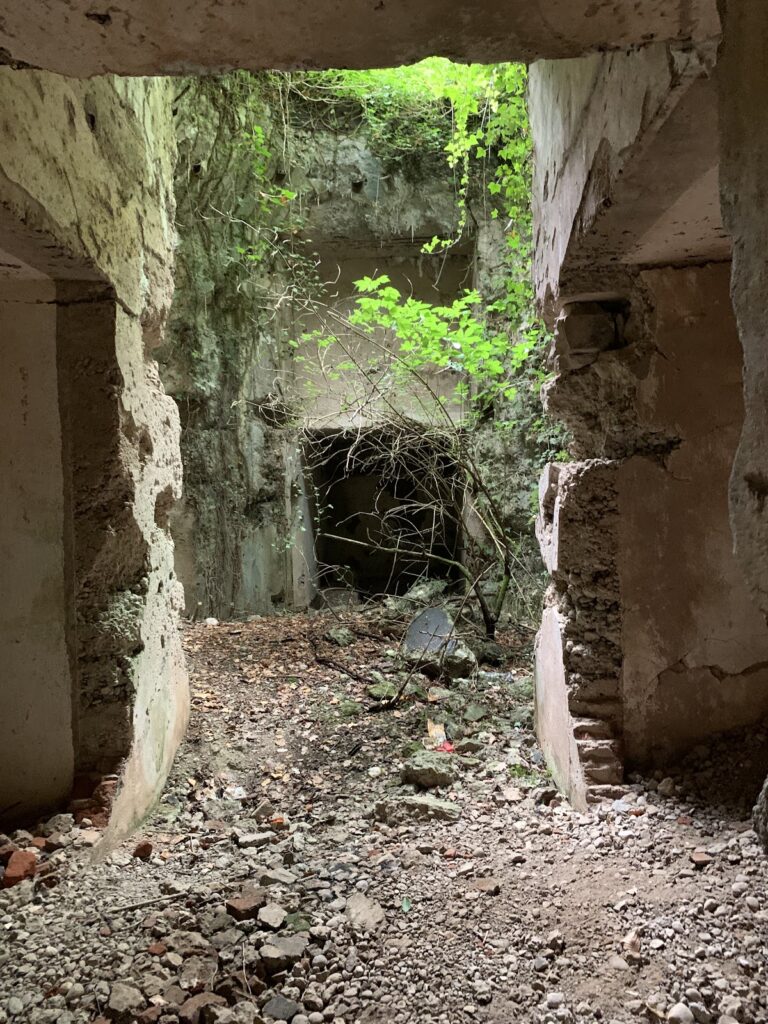
Batterie de Saint-Agnant was a triangular annex to Fort de Liouville, built between 1878 and 1880. Before 1910, it mounted three 120 mm guns and contained two Pamart machine-gun casemates, enclosed positions for protected fire. The annex was severely bombarded during the First World War and is now abandoned.
Nearby sites