Fort de Fléron: A Belgian Fort of the Fortified Position of Liège
Site at a Glance
- Rating
- 3.8
- Popularity
- Very Low
- Country
- Belgium
- Primary era
- Modern
- External website
- Open
- Eras represented
- Modern
- Civilizations
- Belgian
- Site type
- Military
- Remains
- Fort
On this page9 sections
History
Fort de Fléron is a Belgian fort constructed between 1881 and 1891 as part of the late nineteenth-century Fortified Position of Liège. Planned by General Henri Alexis Brialmont, it formed one of twelve forts in a defensive ring that belonged to the National Redoubt, Belgium’s strategic system of fortified positions intended to preserve a defensible core of the country during an invasion. Fléron helped protect the approaches to Liège, including the Hesbaye plain, the railway connection from Aachen, and the road toward Herve.
Construction and defensive role
The Belgian Army controlled the fort, whose design allowed for the possibility of a Belgian counterattack from the rear. That side was therefore less heavily defended, and the barracks and service areas were placed there. The fort also kept the Aachen to Liège road within artillery range. Together with Fort d’Évegnée, it helped cover the eastern and southeastern approaches to the fortified position.
The First World War
At the beginning of the First World War, the garrison comprised 307 artillerymen and 80 infantrymen under Commandant-Captain Mozin. German forces began attacking the forts south and east of Liège on 4 August 1914. Fléron joined the fighting on 5 and 6 August and helped drive back the German 11th Brigade, including three companies of Brandenburg light infantry that had begun to besiege the fort.
After the Belgian Army’s 3rd Division withdrew from the fortified perimeter on 7 August, German troops positioned siege artillery around Liège and attacked the forts from the rear. Fléron rejected a surrender demand and repelled an assault that afternoon by two light-infantry companies, a pioneer company, and a field-artillery battery. On 8 August, it bombarded the German 39th Rifle Regiment and inflicted heavy losses on part of the 35th Rifle Regiment at Soumagne.
On 10 August, Fléron fired on Fort de Barchon after its capture by German forces, supported Fort d’Évegnée, and continued shelling positions at Julémont, Romsée, Micheroux, and Rétine. After rejecting another surrender demand on 11 August, it came under increasingly intense German fire. The bombardment reached approximately 250 shells per hour on 12 August, disabling the gun turrets one after another. Ammunition became scarce, while the kitchens and infirmary were destroyed and the central gallery was damaged.
A German 420 mm gun opened fire on 13 August. By then, the fort was damaged, filled with toxic smoke, short of ammunition, and unable to offer effective resistance. Mozin surrendered at 9:45 a.m. on 14 August 1914. Five Belgian soldiers were killed during the battle, and twelve members of the garrison later died as prisoners of war.
Interwar modernization
During the 1930s, Fléron was modernized as part of the Fortified Position of Liège II, the interwar strengthening of Liège’s defenses against a renewed German attack. The work improved the armament, ventilation, sanitary facilities, communications, electrical supply, and protection of the fort. An air-intake tower and new peacetime barracks were added. Before the Second World War, the garrison consisted of 250 soldiers, 20 non-commissioned officers, and 13 officers.
The Second World War and later fate
German aircraft repeatedly attacked the fort between 10 and 16 May 1940. Its electrical system was destroyed on the first day, forcing the crews to adjust fire and load the guns manually. Fléron fired at German forces in the surrounding area, supported neighboring forts, engaged attacking aircraft, and targeted the Citadel of Liège, the airport, and the Château de Tancrémont.
Heavy air attacks on 17 May destroyed the communications center and the 150 mm turrets. The 105 mm guns ran out of ammunition, and a 75 mm gun became unusable. Captain Armand Glinne, the commander, received permission from his superiors to release the garrison so that its members could join the field army. Four soldiers were killed and six were wounded during the fighting. German forces subsequently occupied the damaged fort but did not continue to use it.
After the war, Fléron was largely demolished and buried beneath a public park and a residential development known as the Cité du Fort. Unlike some other forts around Liège, it does not contain a museum. The surviving traces preserve parts of its military history beneath the later landscape.
Remains
Fort de Fléron had a semi-buried, isosceles-triangular plan. Its base measured 300 metres and its two sides 235 metres. A defensive ditch, 6 metres deep and 8 metres wide, enclosed the fort. The structure was built entirely of unreinforced concrete rather than masonry, an innovative choice for the period. Four metres of concrete covered the central massif, which contained the principal armament, while the less exposed barracks walls were 1.5 metres thick.
Defensive layout and armament
The rear ditch opened toward Liège and brought natural light and ventilation to the barracks and living spaces. The two salient sides received heavier protection. In the counterscarp, the outer side of a defensive ditch opposite the fort’s main interior position, were the latrines, showers, kitchen, and morgue. The service area stood opposite the barracks, while rapid-fire guns in counterscarp casemates defended the ditches with enfilade fire, a method that swept along the length of a narrow defensive passage.
In 1914, the distant-fire weapons included two Grüsonwerke turrets with 210 mm Krupp howitzers, one Creusot turret with two 150 mm guns, and two Châtillon-Commentry turrets, each carrying two 120 mm Krupp guns. Four retractable Grüsonwerke turrets carried 57 mm guns for close defense. Eight additional rapid-fire 57 mm guns protected the ditches and the postern, a small protected passage through the fortification, while other 57 mm weapons in the counterscarp structures fired lengthwise along the ditches. The heavy guns were chiefly made by Krupp, and the turret armor came from Belgian, French, and German manufacturers.
An observation turret with a searchlight supported signaling and communication with Fort d’Évegnée, Fort de Chaudfontaine, and other positions. Observation personnel were also posted at nearby church towers, crossroads, and elevated locations, communicating by telephone. The guns used black powder rather than smokeless powder. Its choking gases could spread through the enclosed firing rooms and other internal spaces, although the smoke was also expected to impede attackers in the ditches.
Modernized structures
The 1930s modernization replaced the 210 mm guns with longer-range 150 mm weapons. The original 150 mm turret was converted for machine guns and grenade launchers, while the 120 mm turrets gave way to turrets carrying paired 105 mm guns. Three 75 mm turrets were added. By 1940, the armament had been reduced to one 105 mm turret, one 150 mm turret, and a turret for machine guns and grenade launchers. The former searchlight turret was replaced by a special cupola developed by the Royal Cannon Foundry.
Improved ventilation, sanitary installations, communications, and electrical generation formed part of the same rebuilding program. A separate air-intake tower was constructed on the other side of the railway line formerly known as Line 38, and new barracks provided accommodation during peacetime. The tower was designed to resemble a water tower.
Surviving traces
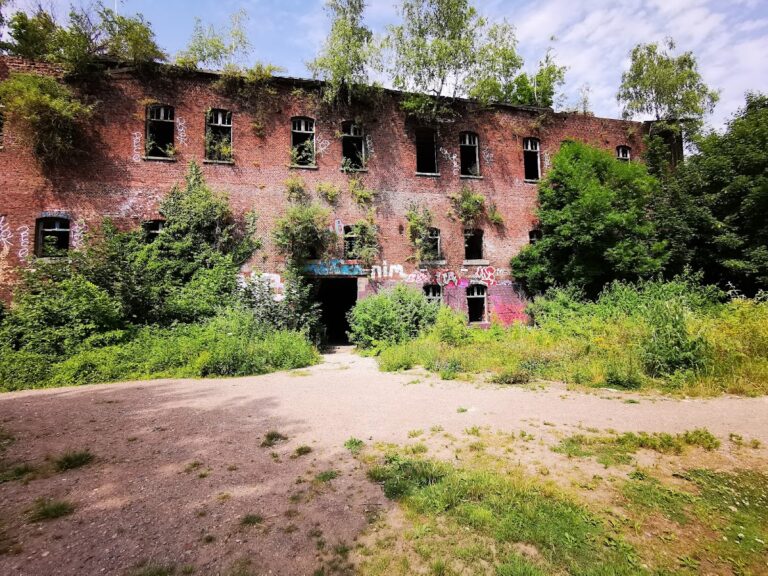
The military structure is now largely concealed beneath the public park and the Cité du Fort housing development. Identifiable remains include the air-intake tower at the Retinne entrance, a surviving section of the head counterscarp wall, and underground rooms reached through the air-tower entrance. The positions of the gun turrets can still be identified, while a memorial monument and plaque preserve the site’s wartime associations. The fort’s imprint also survives in the layout of the surrounding streets.
Nearby sites