Fort Berchem: A Spanish Redoubt in the Netherlands


Site at a Glance
- Rating
- 4.1
- Popularity
- Very Low
- Country
- Netherlands
- Primary era
- Early Modern
- External website
- Open
- Eras represented
- Early Modern
- Civilizations
- Dutch, Spanish
- Site type
- Military
- Remains
- Fort
On this page7 sections
History
Fort Berchem is a former Spanish redoubt in the Netherlands, forming part of the State–Spanish Lines near Retranchement. The present fort remains from a small enclosed field fortification built for local defense, and its history begins with Fort Terhofstede, constructed by the Spanish in 1584 on a salt marsh beside the Zwin, a coastal inlet in the region.
The Spanish Fort at Terhofstede
A storm surge on 25 September 1597 largely destroyed Fort Terhofstede. The Spanish eventually abandoned it around 1603 and moved to Saint John’s Fort near Cadzand, although a few men remained at the site.
On 25 April 1604, State troops commanded by Prince Maurice, the Dutch military commander and stadholder, landed at Cadzand. Forces led by Ernst Casimir of Nassau-Dietz, a military leader of the Nassau dynasty serving the Dutch States, also captured Fort Terhofstede. The States soon built Fort Nassau, after which Fort Terhofstede was abandoned.
Construction of Fort Berchem
In 1634, a new fortification called Fort Berchem was built east of the earlier fort. Its name commemorated Jan Godfroot and Christoffel van Berchem, who had jointly purchased half of the Bewesten Terhofstede polder in 1632. A polder is land reclaimed from water and protected by dikes.
Fort Berchem was intended partly to protect the lock in the Canael van de Sluys, a former channel of the Zwin left from fifteenth-century land reclamation. The channel survives as a small drainage canal.
Reconstruction and Landscape Planning
Plans formulated in 2005 proposed a four-hectare nature area around the former fort and sought to emphasize its cultural-historical value. The redoubt was being reconstructed in accordance with its original layout, alongside archaeological investigation.
Remains
Redoubts and Waterway
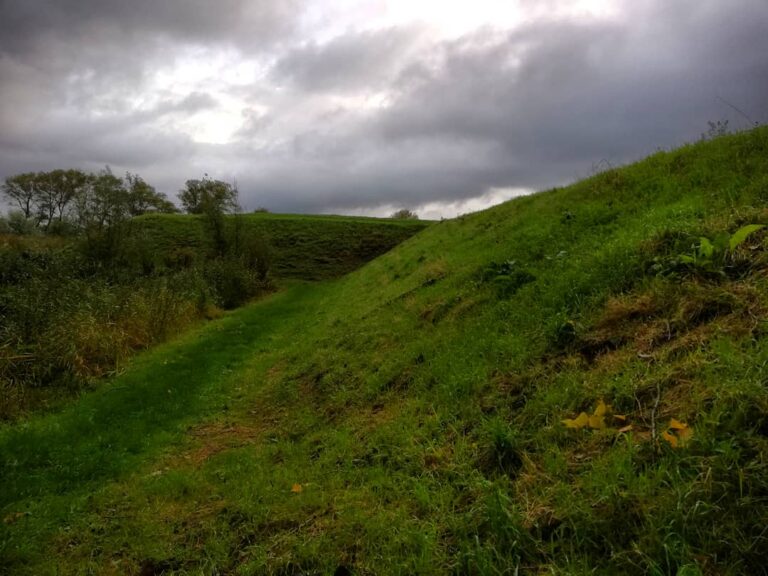
The former redoubt is identifiable in the landscape through surviving ground irregularities. In 1604, Fort Terhofstede consisted of two redoubts connected by a passage. Fort Berchem, built east of that earlier fortification, was associated with the Canael van de Sluys, the drainage channel it was built to protect.
Surrounding Landscape
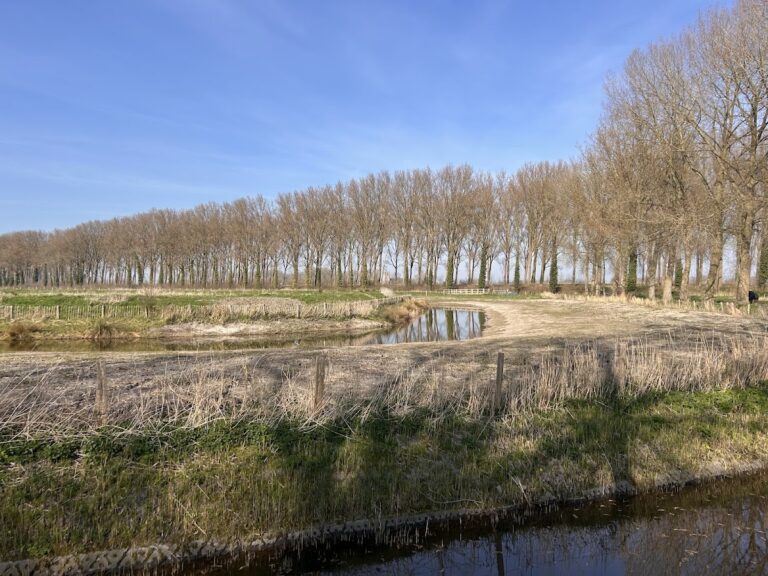
The four-hectare area around the former fort contains pollarded willows along the dikes. These trees are repeatedly cut back to form dense, branching crowns. The tree frog and great crested newt occur in the vicinity, while the little owl breeds in the pollarded willows.
Nearby sites