Avant-poste de Pont-Saint-Louis: A Coastal Alpine Maginot Outpost

Site at a Glance
- Rating
- 4.9
- Popularity
- Very Low
- Country
- France
- Primary era
- Modern
- Eras represented
- Modern
- Civilizations
- French
- Site type
- Military
- Remains
- Fort
On this page12 sections
History
Avant-poste de Pont-Saint-Louis is a small alpine fortification at Menton, France, built between 1930 and August 1932 as part of the Alpine Maginot Line. It stood within the fortified sector of the Alpes-Maritimes and the Corniches sub-sector, beside the only cross-border road in that sector. Its purpose was to warn of an attack, delay an advance, and provide limited protection for Castillon, Castellar, and Menton.
The forward defense of the Corniches
The outpost belonged to a forward line positioned in front of the main resistance line, which ran about 5 kilometres behind the border along the heights west of the Careï valley. That deeper system included fortified works at Col-des-Banquettes, Castillon, Sainte-Agnès, Col-de-Garde, Mont-Agel, Roquebrune, Croupe-du-Réservoir, and Cap-Martin. Unlike the other six outposts of the Corniches sub-sector, Pont-Saint-Louis did not block a route descending from the border ridge. It guarded the coastal road itself and was classified in engineering documents as a rapid roadblock.
The first proposal called for a simple concrete guard post protecting a movable barrier. The completed work was instead a well-armed blockhouse. A civilian contractor built it from plans prepared by the engineering service of the 15th Military Region, rather than by the organization responsible for the larger Maginot works. Construction cost 340,000 francs. A permanent mine installation was added beneath the Garavan crossroads in 1933, and the machine-gun embrasure was modified that year to accept an antitank gun.
Garrison and mobilization
From April 1934, personnel from the 5th Battalion of the 3rd Alpine Infantry Regiment manned the outpost. The garrison rested in a sheet-metal shelter between the customs post and the rock face, rotated weekly, and underwent response-time tests twice a week by an officer. In October 1935, the unit became the 76th Alpine Fortress Battalion. An Alpine Fortress Battalion was a French unit assigned to frontier fortifications in mountainous regions.
On 23 August 1939, reservists joined the 76th Battalion to form the 58th Alpine Fortress Half-Brigade. This larger formation contained three battalions, including the 96th Alpine Fortress Battalion, which thereafter supplied the Pont-Saint-Louis garrison. The theoretical combat crew numbered nine: a firing-room chief, two corporals serving as gunners, two loaders, two ammunition suppliers, and an armament mechanic. The listed garrison comprised seven men, an adjutant, and a sub-lieutenant.
A proposed extension in 1940 would have added an ammunition store, a small generator, a kitchen, toilets, sleeping space for eight men, and an emergency exit. It was approved but never built because there was insufficient time before the crisis.
The June 1940 fighting
Menton’s inhabitants were evacuated between 3 and 5 June 1940. After Italy declared war on France and the United Kingdom on 10 June, the road barrier closed at 11:00 p.m. The permanent mine beneath the Garavan crossroads detonated at 11:30 p.m., producing fumes inside the outpost and temporarily cutting its telephone connection. The radio also worked poorly, leaving the position temporarily isolated until it could be ventilated.
Italian operations began on 14 June. Fire from the outpost blocked attacks along the coastal road, including a major attempt on 20 June, and the position continued to hold the passage until the fighting ended. Artillery from Cap-Martin, Sainte-Agnès, and batteries elsewhere in the Corniches sub-sector supported it. Italian forces nevertheless captured Menton on 22 June by advancing along inland paths and the railway.
The armistice between Italy and France took effect at 12:35 a.m. on 25 June 1940. The garrison left the outpost on 27 June after locking its armored door. Menton subsequently became part of the Italian occupation zone. In August 1944, German forces evacuated the coast and withdrew toward defensive positions in the hinterland around Nice.
Later condition
Avant-poste de Pont-Saint-Louis remains part of the Alpine Maginot fortification system and is treated as an alpine outpost rather than a main-line fortification. Its position beside the international border explains its specialized role in controlling the coastal route. The outpost is owned by the Central Directorate of Border Police, and access is restricted. Since late 2015, repairs have addressed the armored door and the façade has been cleaned.
Remains
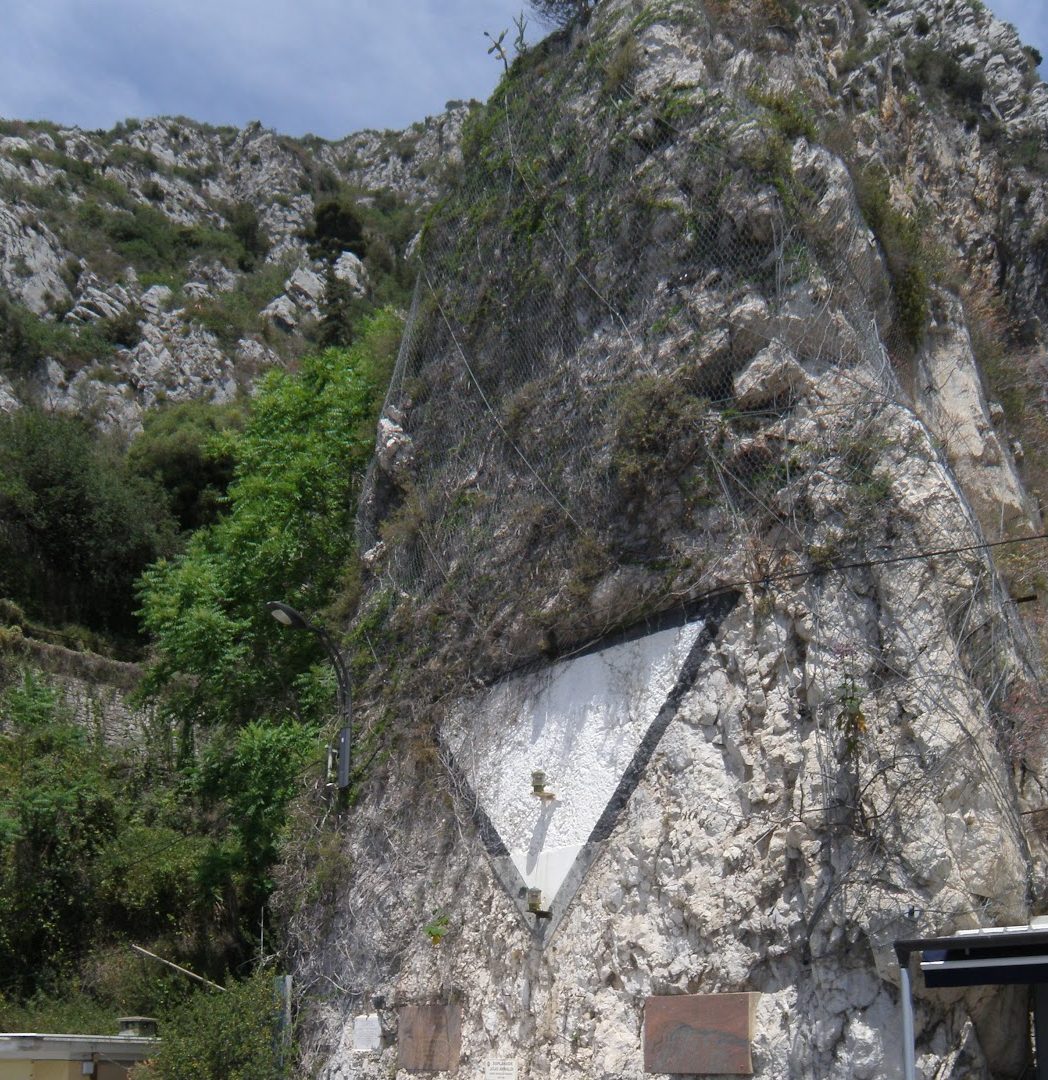
The surviving work is a single-block casemate, a small reinforced-concrete blockhouse cut into the cliff beside the road from Menton to Ventimiglia. It stands immediately west of the bridge over the Saint-Louis stream, known in Italy as the San Luigi stream, only a few metres from the border. The road was formerly France’s RN 7 and continues in Italy as the Via Aurelia. Road widening and redevelopment of the border crossing after the Second World War altered the surroundings, while the present small esplanade occupies the former customs and police-post area.
Roadside defenses
Casemate and weapons
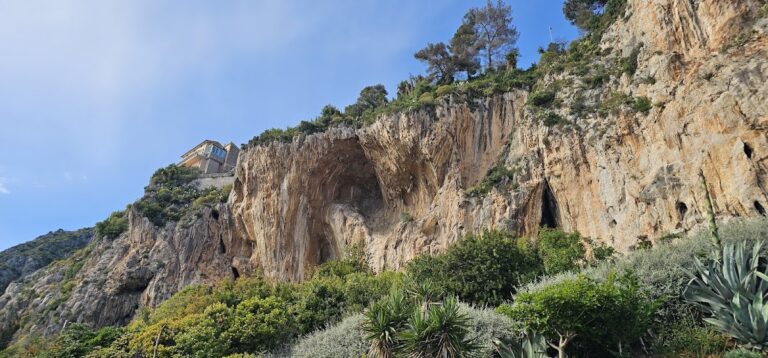
The casemate was excavated into the rock just before a bend, placing its weapons along the axis of the road. Its façade combines an armored entrance door with a machine gun on one side and a reinforced-concrete wall with two firing openings on the other. One opening held a Model 1924/29 light machine gun. The second was a mixed embrasure, a firing opening designed for alternative weapons, which could receive either two MAC 31 machine guns mounted together or a 37 mm antitank gun.
Armored ball-mount fittings protected the weapon openings, and a grenade-launching chute completed the armament. During the 1940 crisis, the 37 mm antitank gun remained permanently installed in its embrasure. The casemate still physically survives, although access is restricted and the road and border installations around it have been substantially changed.
Barrier and road mines
A removable steel barrier stood directly in front of the casemate. It measured 7 metres across and was perforated so that an attacker could not use it as cover. A hand-cranked winch moved it along a rail, and the barrier could be stored in a narrow compartment beside the rock face between the casemate and the border.
Behind the barrier lay a small antitank minefield of six charges. Each charge consisted of a 105 mm shell set in a hole cut into the road and connected to a stake and fuze. A separate permanent mine device was positioned 100 metres behind the outpost beneath the Garavan crossroads, just west of the present French customs building. It contained one tonne of explosives, made up of fifty 20 kg charges of melinite, a military high explosive used in demolition. Detonation on 10 June 1940 created a crater about 6 metres wide and 3 metres deep.
Interior arrangements
Protected service room
The casemate was equipped for independent operation over several days. Its airtight armored door opened onto a right-angled corridor leading to two rooms. The first measured about 5 square metres and contained a hand-operated ventilator, an air filter, and 100 litres of drinking water. The ventilator could be worked by hand cranks or bicycle-style pedals with a saddle. During a gas alert, the filtered air was kept at slightly higher pressure than the air outside.
Combat chamber
The second room, an approximately 7-square-metre combat chamber, held the ammunition and communications equipment. Supplies included light-machine-gun magazines, machine-gun ammunition boxes, thousands of 7.5 mm cartridges, and hundreds of 37 mm shells. A telephone and radio connected the outpost with Cap-Martin, 5,200 metres to the west. The public toilets were outside the casemate.
During the 1940 emergency, the garrison slept inside on four mattresses placed on the floor and used two oil lamps for light. A bowl served as a latrine and was emptied outside through the firing opening of the machine gun in the entrance door. These arrangements supported the crew while the steel barrier and the permanent mine were intended to stop vehicles moving along the coastal route.
Nearby sites