Megginch Castle: A Historic Lowland Castle in Scotland

Site at a Glance
- Rating
- 4.7
- Popularity
- Very Low
- Country
- United Kingdom
- Primary era
- Early Modern
- External website
- Open
- Eras represented
- Medieval, Early Modern, Modern
- Civilizations
- British, Kingdom of Scotland
- Site type
- Domestic
- Remains
- Castle
On this page7 sections
History
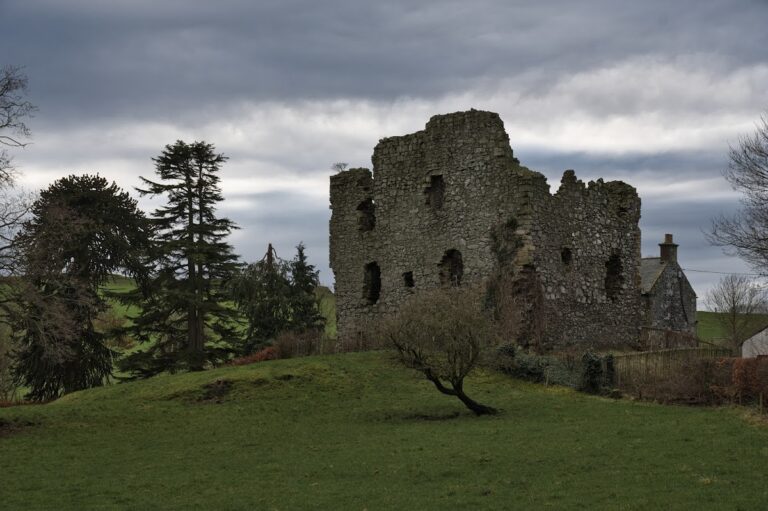
Megginch Castle is a restored castle in Scotland, United Kingdom, north of Errol in Perth and Kinross. The present castle was built in 1575, while its complex incorporates a tower and fortification dating from around 1460. Its surviving fabric reflects several periods of alteration, including major work in the seventeenth, eighteenth, nineteenth, and twentieth centuries.
Seventeenth- and Eighteenth-Century Changes
The castle was remodeled during the 1680s. Around 1790, an unfinished addition was planned on the southwest side. Designed by the architects R. and J. Adam, this extension had a curved facade and became part of the castle’s later architectural composition.
Nineteenth- and Twentieth-Century Alterations
In 1820, W. M. Mackenzie designed an additional northeast wing and a north porch. An armorial stone bearing the date 1820 remains associated with this phase. Mills and Shepherd altered the porch, corridor, and interiors in 1928.
A fire led to a major restoration in 1969 and 1970, when the castle was restored to its original condition. Megginch Castle was the family home of Cherry Drummond, the 16th Baroness Strange. A baroness is a woman who holds a baronial title in her own right or through succession. The castle is now occupied by her daughter, her daughter’s husband, and their children.
Protected Historic Estate
Historic Scotland lists Megginch Castle as a Category A listed building. This is Scotland’s highest level of statutory designation for historic buildings and applies to structures of exceptional national or architectural importance. The gardens were entered on the Inventory of Gardens and Designed Landscapes in Scotland in 1987, the national register for gardens and designed landscapes valued for their historic or horticultural importance.
Remains
Castle Exterior
Megginch Castle is built from rubble-stone blocks with dressed-stone and concrete margins. Battlements and corbels contribute to its fortified appearance. The south facade serves as the entrance front, with three storeys, six bays, and symmetrically arranged windows. A large first-floor window is set above the entrance, while an armorial stone dated 1820 occupies the centre of the second floor. Entry passes through a two-storey round tower crowned by an ornamental gable.
The west facade faces the garden. Its northern bay is recessed and contains a large first-floor window with smaller openings above. A projecting corner turret with a conical roof stands at the corner, and the other bays are battlemented. The broad central bay has small, asymmetrically arranged windows. Beside it is a rounded stair bay in the re-entrant angle, with a ground-floor door and a window above. The curved-facade bay added on the southwest side around 1790 contains windows on every storey. Its larger first-floor window was extended into a doorway opening onto a balcony.
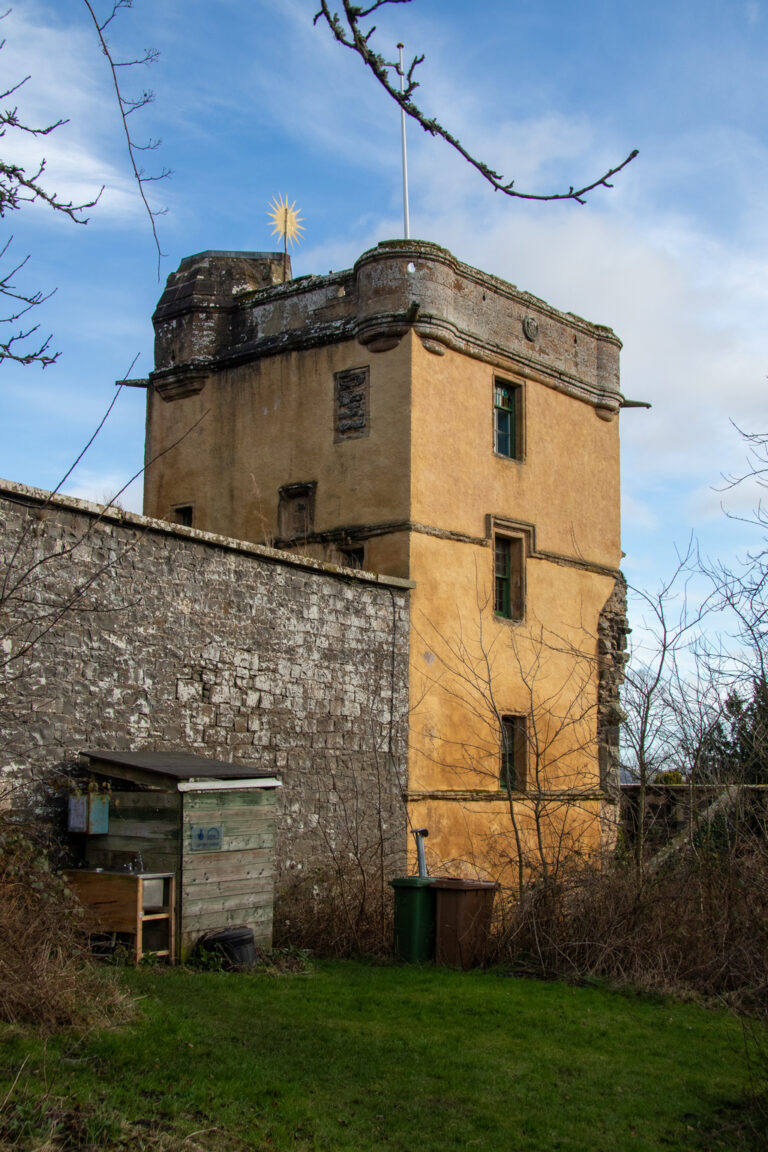
The north facade has asymmetrically arranged windows and a projecting porch added in 1928. Its central round-arched doorway is framed by recessed outer bays. A central tower has a projecting upper section, a stepped gable, and a roof weather vane. Projecting corner turrets with conical roofs stand at both ends of the facade. On the east side, a projecting single-storey bay lies beside a recessed central bay with a large multi-paned window. The projecting wing to the right has a second-floor window with a carved hood before receding farther back, while an angled oriel includes a projecting first-floor balcony.
Landscape Garden
The grounds form a landscape garden with a terraced garden on the west side of the castle. Stone garden structures include a Greek temple and several statues. Old yew trees and topiary trees stand among the planting, while daffodils provide an extensive spring display. An orchard contains National Plant Collections of Scottish apples, pears, and cider apples.
Nearby sites