Lindores Abbey: A Medieval Tironensian Monastery in Scotland


Site at a Glance
- Rating
- 4.9
- Popularity
- Low
- Country
- United Kingdom
- Primary era
- Medieval
- External website
- Open
- Eras represented
- Medieval
- Civilizations
- Kingdom of Scotland
- Site type
- Religious
- Remains
- Monastery
On this page15 sections
History
Lindores Abbey is a medieval Tironensian Benedictine abbey in the United Kingdom, on the outskirts of Newburgh in Fife. It was founded in 1191 by David, Earl of Huntingdon, on land granted by his brother, William the Lion. The Tironensians followed the customs of the abbey of Thiron in France, forming a reform movement within Western monasticism. Lindores was a daughter house of Kelso Abbey, its mother house, which helped establish and supervise the new foundation.
Foundation and monastic life
An earlier priory may have occupied the site in 1178. A fifteenth-century tradition connects the later foundation with David’s survival from a storm or shipwreck while returning from the Holy Land. According to the tradition, he vowed to establish a monastery on his lands in gratitude and selected the Tironensian order. Guido, Prior of Kelso and Lindores’s first abbot, directed the completion of most of the abbey’s buildings. The resident community was relatively small, usually numbering about 26 monks.
At its height, Lindores controlled substantial territory and regional rights connected with coal, salt, fishing, woodland, and other resources. David granted the monks fishing rights around Mugdrum Island in the Firth of Tay. Conan, an illegitimate son of Henry, Earl of Atholl, gave them permission to gather birch and alder logs and hazel rods from woodland at Tulyhen near Blair Atholl. The Tironensian rule required hospitality towards travellers, and visitors included Alexander III of Scotland, Edward I of England, John Balliol, David II of Scotland, James II, James III, and William Wallace.
The abbey also received royal and aristocratic guests in later centuries. In August 1595, Anne of Denmark met the Earl of Orkney at Lindores while Patrick Leslie was commendator. A commendator was a lay or ecclesiastical administrator who held a monastery’s revenues and property after its regular monastic administration had weakened or ended.
Burials, cultivation, and distilling
Lindores served as a burial place for important figures. David Stewart, Duke of Rothesay, who died while imprisoned at Falkland Palace in 1402, was buried there. Other recorded burials included James Douglas, ninth Earl of Douglas, and Robert and Henry, the infant sons of David, Earl of Huntingdon. After James Douglas was captured by troops of James III in 1484, he withdrew from secular life and spent his final four years as a monk at Lindores.
The monks maintained a garden containing rare plants, and a pear variety developed there continued to grow in the surrounding region. They produced rosewater, and rosewater and apples from Lindores were sent to James V in May 1540. The abbey is also associated with the earliest known Scottish record of whisky production. An entry from 1494 in its tax records lists materials purchased to produce aqua vitae, meaning “water of life,” a historical term for distilled alcoholic spirit, for James IV.
Reformation and decline
A mob from Dundee sacked the abbey in 1543. It was attacked again in 1559 during the Scottish Reformation, the sixteenth-century religious and political transformation through which Scotland changed from Catholicism to Protestantism. John Knox and his supporters overthrew altars, broke statues, burned books and vestments, and forced the monks to abandon their habits. Services ended in 1559, although some monks remained for a time.
After the Reformation, Lindores passed to a commendator who received its ecclesiastical income and property as a reward for loyal service to the Crown. The buildings began to be dismantled around 1584 and were largely abandoned by the seventeenth century. Stone, slate, timber, carvings, and architectural fragments were reused in buildings at Newburgh and elsewhere in the region. The former abbey then became a picturesque ruin that attracted artists.
Archaeology and modern distilling
Lindores is a scheduled monument, a nationally protected archaeological or historic site. Modern archaeological work has revealed remains connected with distillation, including evidence uncovered in 2018. Since 2024, a summer field school run by the University of St Andrews and Brandeis University has investigated patterns of monastic water use.
Whisky production associated with Lindores was revived in the 2010s. Construction of a modern distillery began in 2015 within the perimeter of twentieth-century farm buildings. It opened commercially in 2017 and began distilling Scotch whisky that December. The first barrels of Lindores Abbey single-malt whisky, made at one distillery from malted barley, were filled in December 2020. The distillery also produces Lindores Aqua Vitae, recreated from medieval recipes through research by Scottish universities.
Remains
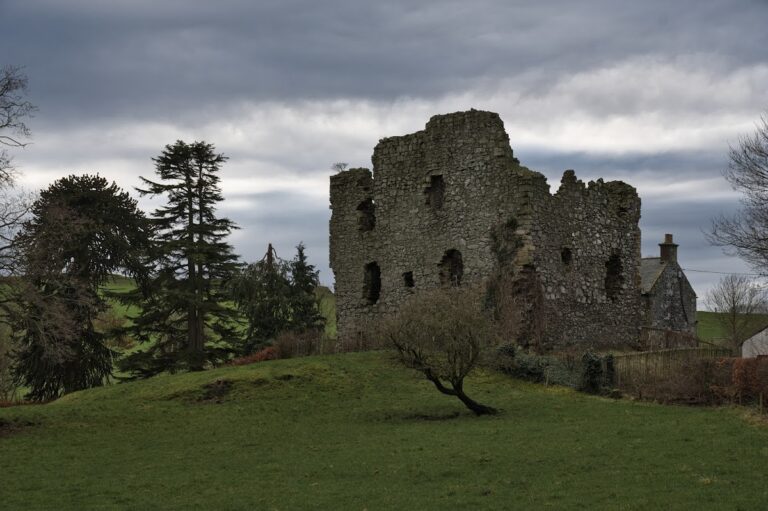
Lindores Abbey stands on the southern bank of the River Tay, near Newburgh and about 1 mile (1.6 km) north of Lindores village. The complex is now a reduced ruin, but its ground plan remains traceable. The church occupied the northern part of the monastic core, with the cloister to the south, while gateways, precinct walls, and ancillary buildings extended the site beyond the principal buildings.
Church and cloister
Cruciform church
The church was cruciform, meaning that its main body was crossed by projecting arms, and it was aligned east to west. Dedicated to the Blessed Virgin Mary and Saint Andrew, it measured 195 feet (59 metres) in length, with transepts, or cross-arms, measuring 110 feet (34 metres). Parts of the southern and western walls survive, together with sections of the chancel, the eastern part of the church containing the main altar and liturgical space. The western tower also remains.
Cloister and eastern rooms
The cloister lay south of the nave. Its square plan enclosed a central garden, known as the cloister garth, and much of its fabric is described as original thirteenth-century work. The eastern walk extended from the church’s southern transept, while the northern walk abutted the church’s southern wall. An eastern entrance led into rooms that remain recognizable on either side; one may have been the chapter house, where the monastic community met for formal business. A slype, or covered passage, connected the cloister garth with the exterior of the abbey.
Precinct and surviving structures
Gateways and precinct wall
One gateway into the monastic enclosure, the eastern cloister entrance, and a southern gateway survive or remain identifiable. Sections of the former precinct wall can still be seen in fields south of the abbey. A modern road crosses the former monastic site, and further remains of ancillary buildings are visible on the opposite side. The loss of much of the complex during the seventeenth century left sections of wall, but enough survives to make the overall arrangement clear.
Distillation remains
Excavation in 2018 uncovered a distillation vat and evidence of whisky production. The remains of the still are preserved for display within the ruins. Foundations of a medieval still used by the monks to produce aqua vitae from the fifteenth century onward have also been identified.
Relocated objects and emblem
Bell, clock, and carved panels
A silver bell from the tower of the principal church is preserved in the parish church of Auchtermuchty. A clock from Lindores was transferred to St Giles’ Cathedral in Edinburgh. Early-sixteenth-century carved wooden panels from the abbey survive in the Laing Museum in Newburgh and, reset in a nineteenth-century cabinet, in St Paul’s Episcopal Cathedral in Dundee.
Heraldic emblem
The abbey’s heraldic emblem shows a bear leaning against a tree. A representation of the emblem is laid out on a hillside near Lindores.
Nearby sites