Festung Tschingel: A Swiss Artillery Fortress in Fläsch
Site at a Glance
- Rating
- 4.7
- Popularity
- Very Low
- Country
- Switzerland
- Primary era
- Modern
- External website
- Open
- Eras represented
- Modern
- Civilizations
- Swiss
- Site type
- Military
- Remains
- Fort
On this page9 sections
History
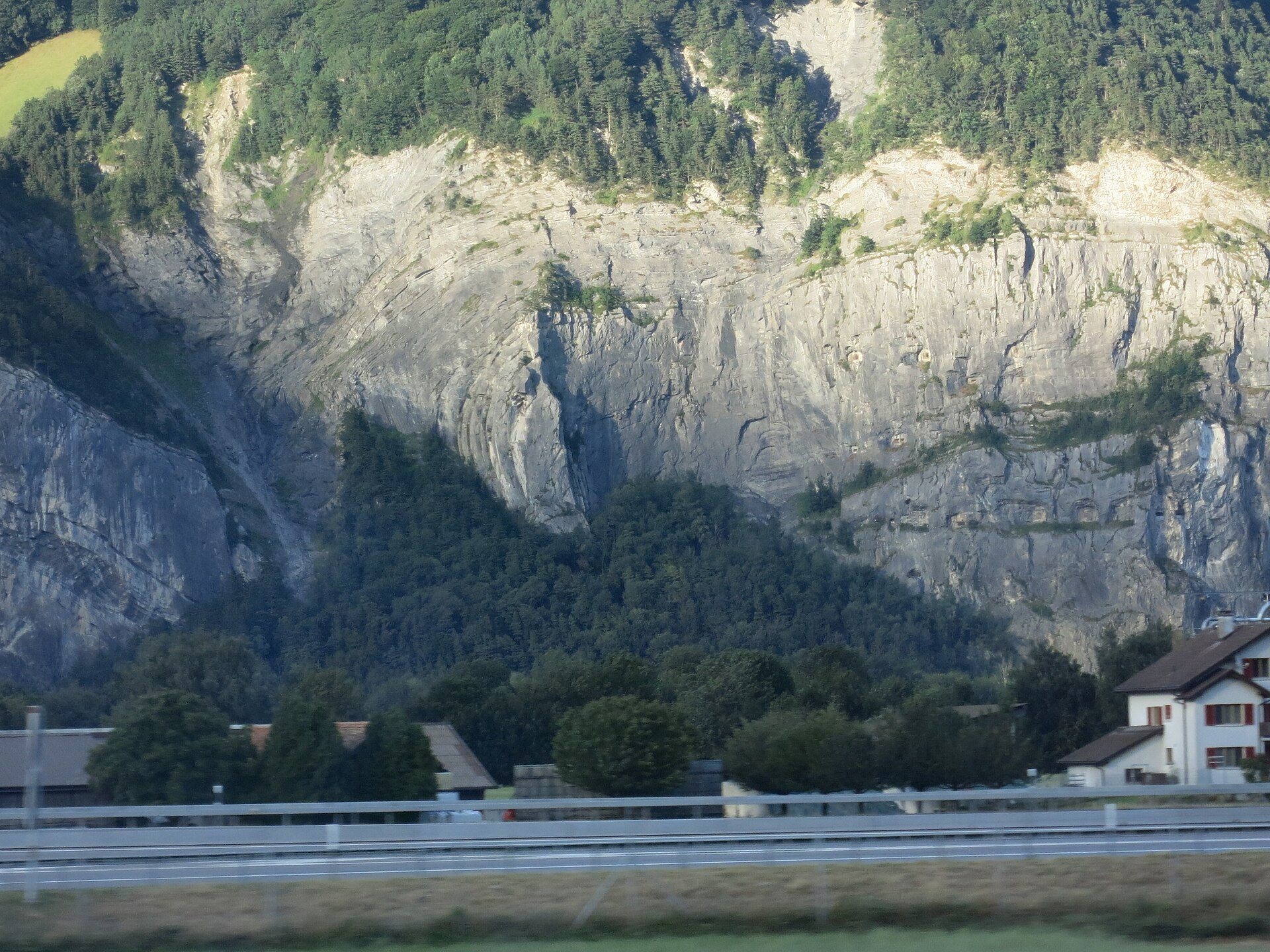
Festung Tschingel is a Swiss Army artillery fortress in Fläsch, Switzerland, planned from 1938 and built from 1940 into the rock face of Fläscherberg. Designated A 6225, it formed part of the Festung Sargans and became the largest artillery fortress in the canton of Graubünden, as well as the defensive system’s easternmost cornerstone.
Second World War defenses
Tschingel belonged to Fortress Brigade 13 and formed part of the Ellhorn defensive barrier, a prepared military zone intended to block or delay movement through a strategic area. The Swiss Army acquired the necessary land from the municipality of Fläsch. The fortress was assigned to protect the anti-tank barrier in the Sarganserau and Melserau, a lowland area that could be flooded to hinder an advance. Its guns were to engage an attacker directly if the principal barriers at Schollberg were breached.
The original armament included machine guns, large searchlights for illuminating the barrier before Sargans, and a 7.5 cm BK 39 bunker gun covering the direction of Bad Ragaz. Tschingel also had a central command function. Its own artillery fire-control station directed fire by receiving observations and calculating firing data, while a second station coordinated fire for four fortresses. A telephone distribution center brought together the connections serving the Sargans basin. The fortress was also intended to host the antenna of a very-high-frequency transmitter for radio broadcasts to the fortress region.
The wider Festung Sargans system included Artillery Work Tamina, built in 1942 at the entrance to the Tamina Gorge near Bad Ragaz. Its 7.5 cm bunker gun was designed to protect Tschingel, engage the Fläsch barrier position, and cover the area northwest of Bad Ragaz. The Ellhorn defensive position was later strengthened by Infantry Bunker A 6229 and Combat Cavern A 6224. Switzerland acquired the strategically important Ellhorn area from Liechtenstein in 1948 through a land exchange and subsequently fortified it. The infantry work at Ellhorn remained in service until 1982.
Postwar and Cold War adaptation
After the Second World War, Tschingel received four 10.5 cm Model 1946 anti-tank guns and additional tunnels for personnel and supplies. The artillery-unit fire-control station was established on the fourth level beside the fortress’s own battery station. The four guns could fire conventional shells toward the Seeztal area, while Furggels fortress was intended to support them with four 15 cm bunker guns. Tschingel’s anti-tank mission continued until 1984, when the required ammunition was withdrawn.
During the 1950s, the searchlights were removed because their positions would have made them easy targets, and a very-high-frequency antenna for the Sargans defensive area was installed in their place. In the 1960s, the fortress was renovated for the Cold War, the period of military and political tension between the Western bloc and the Soviet-led Eastern bloc after the Second World War. The personnel section was converted to provide protection against contaminated air and operated under positive air pressure. The original bunker gun, machine guns, and large searchlights were removed during this decade.
A rockfall in the 1970s led to the construction of a new material cableway and a new footpath to the main entrance. The 1995 army reform ended Tschingel’s role as a combat installation, and the fortress was formally declassified on 1 January 2000. The Swiss Army sold it to the Festungsverein Tschingel in 2005. Since January 2006, the association has continued renovating the complex to preserve it for the future. Its original construction cost was approximately 5 million Swiss francs.
Remains
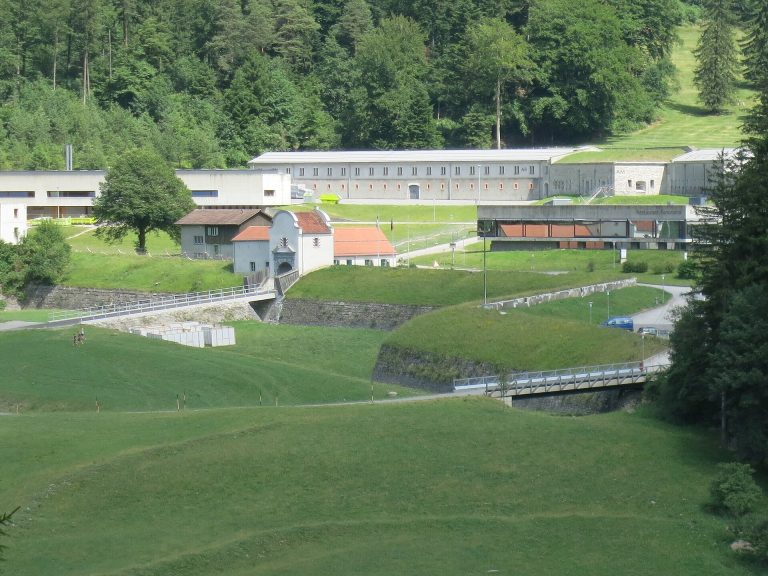
Festung Tschingel is a four-level underground complex excavated directly into solid rock in the Tschingel rock face of Fläscherberg. Its passages extend for approximately 4 km, linking artillery positions, observation posts, command facilities, stores, personnel areas, and technical installations. The fortress lies about 150 m above the surrounding plain at its upper level, with the defensive ground of the Sarganserau and Melserau extending in front of it.
Fortress levels and armament
Upper level
The fourth level held the searchlights used for night illumination of the two lowland barriers. After their removal during the 1950s, a very-high-frequency antenna serving the Sargans defensive area occupied this role in the fortress’s communications system. The level also contained the artillery-unit fire-control station, which coordinated firing for four separate fortresses alongside Tschingel’s own battery station.
Observation and artillery levels
The third level contained machine-gun positions and observation posts. The second level housed the artillery, including the four 10.5 cm Model 1946 anti-tank guns installed after 1945. These fixed weapons were intended to fire across the Sarganserau and Melserau toward the Seeztal area and to support the broader barrier system.
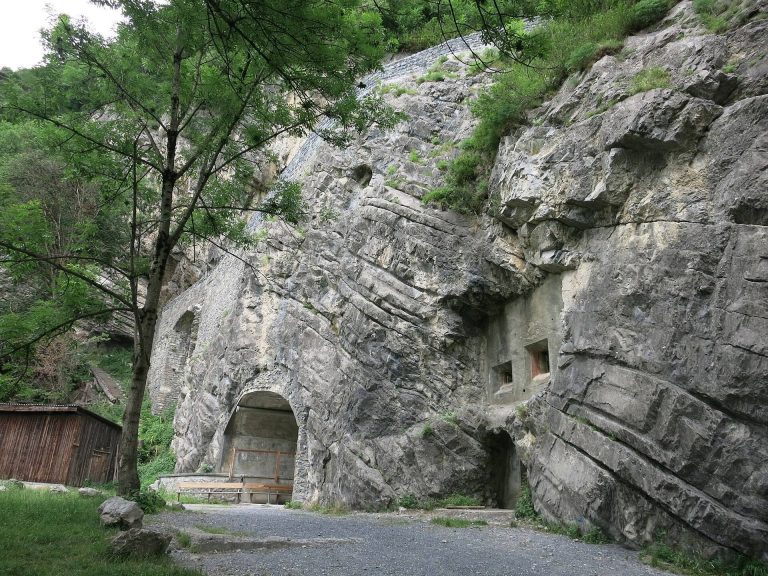
Main entrance defenses
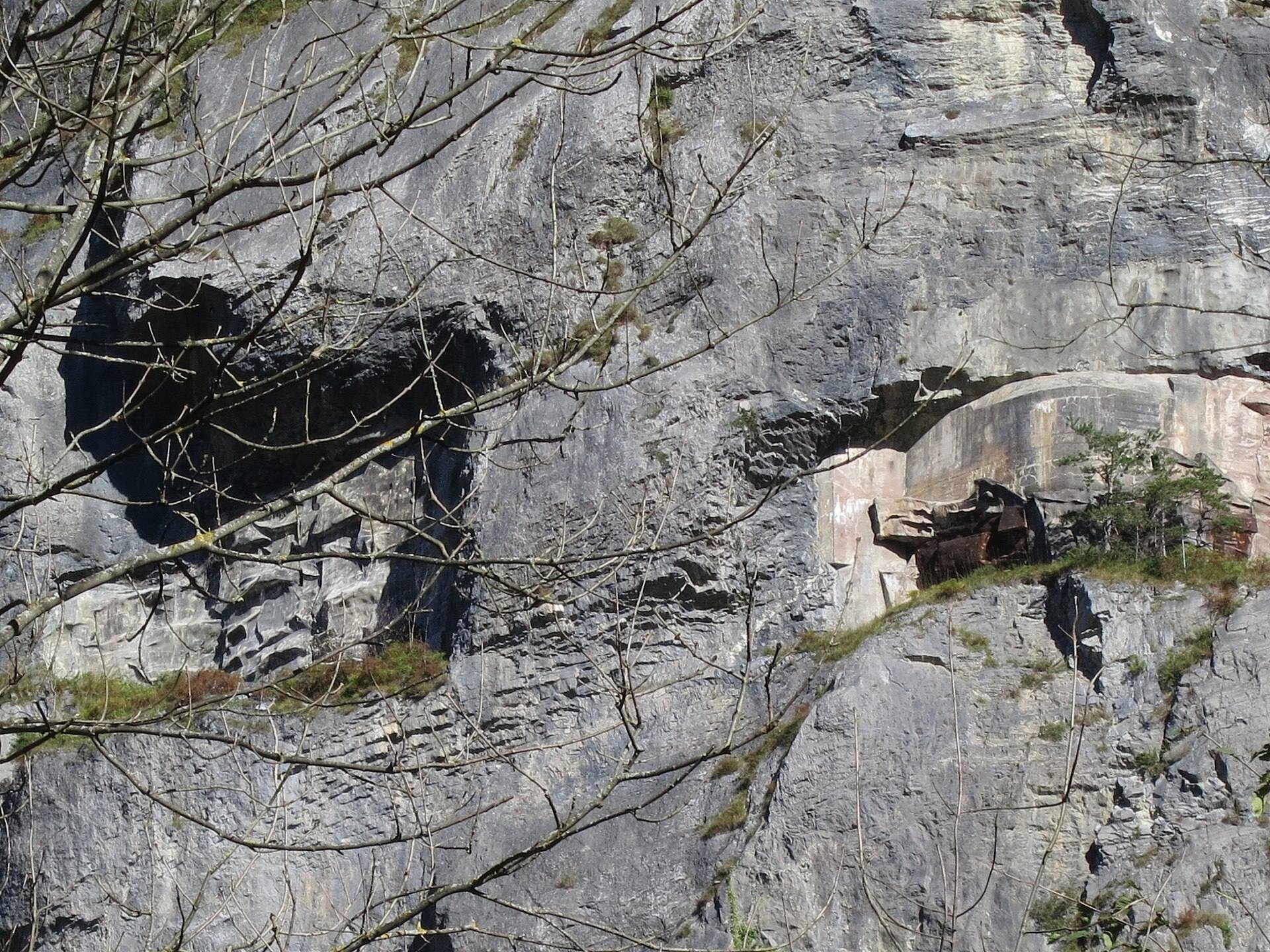
The first level contains the main entrance. It was protected by a 7.5 cm BK 39 bunker gun, a fixed artillery piece in a fortified emplacement, together with machine-gun defenses. The former gun position had a large opening through which the weapon fired, while a lower opening served an observation post. A 63 m-long inclined funicular lift, a rail vehicle moved by cable or winch through a steep tunnel, connects this level with the second level. Built by Bell Kriens in 1946, it runs from the lower station at 545 m elevation to the upper station at 578 m and is driven from the upper station. Since 2000, it has not been approved for passenger transport.
Support infrastructure
The fortress was equipped for approximately 160 personnel to remain self-sufficient for extended periods. Its underground infrastructure included an emergency power plant, a high-capacity ventilation system, large drinking-water reserves, food and fuel stores, an emergency hospital, ammunition storage, spare parts for weapons and technical equipment, and a burial recess. A second inclined lift once carried materials from the first to the third level; it has since been dismantled.
Small caverns cut into the rock and external infantry positions provided additional air-defense installations outside the principal underground complex. The related Ellhorn defenses included Infantry Bunker A 6229, armed with two machine guns, and Combat Cavern A 6224, a fortified chamber excavated into rock and equipped with a 7.5 cm 38 L49 anti-tank bunker gun and a machine gun. Other associated defensive remains include the Ellstein bunker and the Sarganserau bunker.