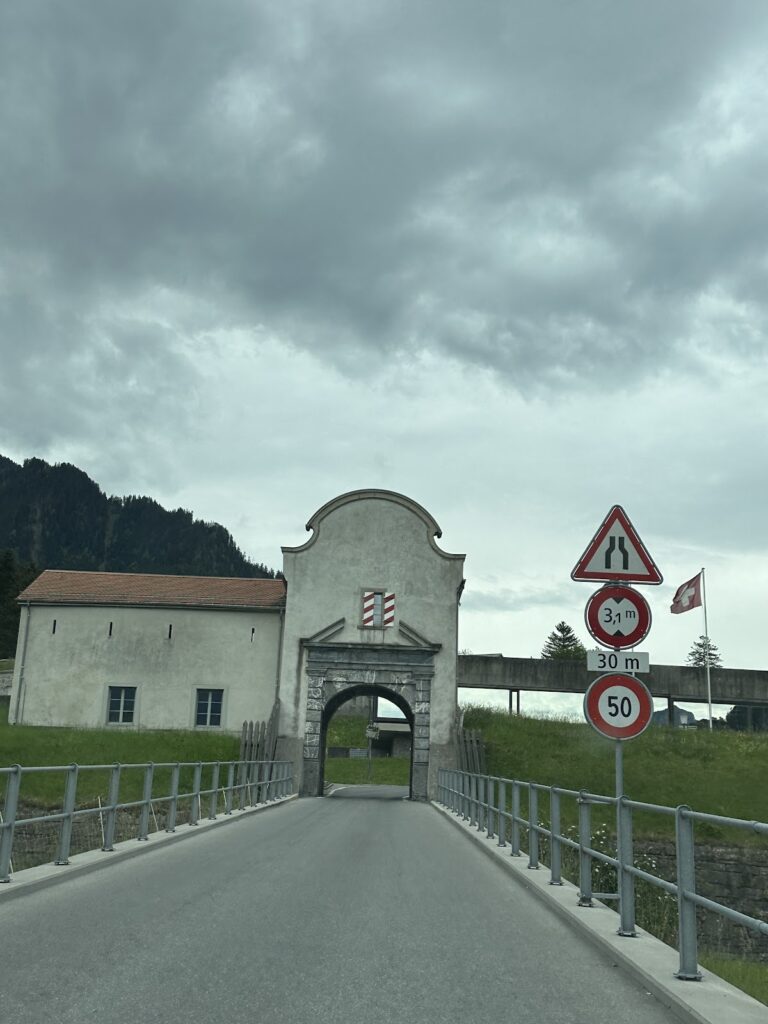
Festung Schollberg: A Swiss Army Fortification in Sargans


Site at a Glance
- Rating
- 4.9
- Popularity
- Very Low
- Country
- Switzerland
- Primary era
- Modern
- External website
- Open
- Eras represented
- Modern
- Civilizations
- Swiss
- Site type
- Military
- Remains
- Fort
On this page17 sections
History
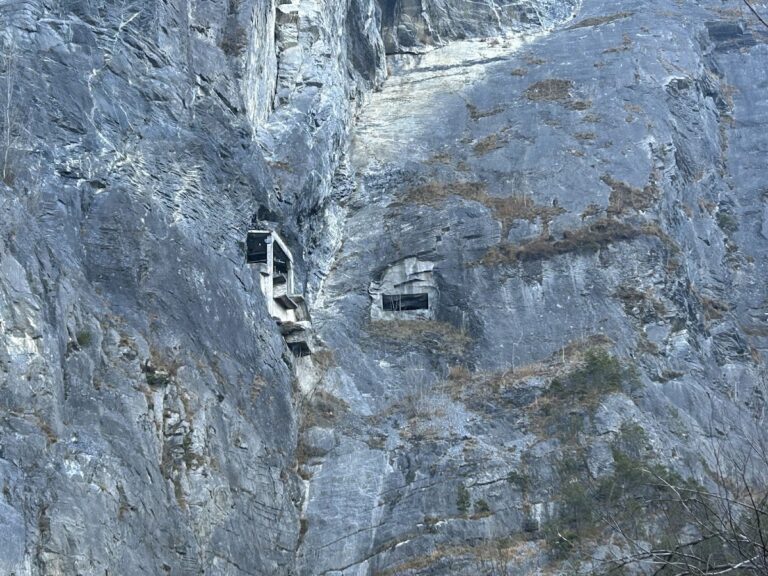
Festung Schollberg, in Sargans, Switzerland, was a Swiss Army fortification built into the rock face at Trübbach during the late 1930s. It formed part of the Schollberg-Sarganserau-Tschingel defensive front and the Sargans fortified area, where artillery, infantry positions, obstacles, and flood installations protected the Rhine valley and approaches to the Alpine interior.
Routes and earlier defenses
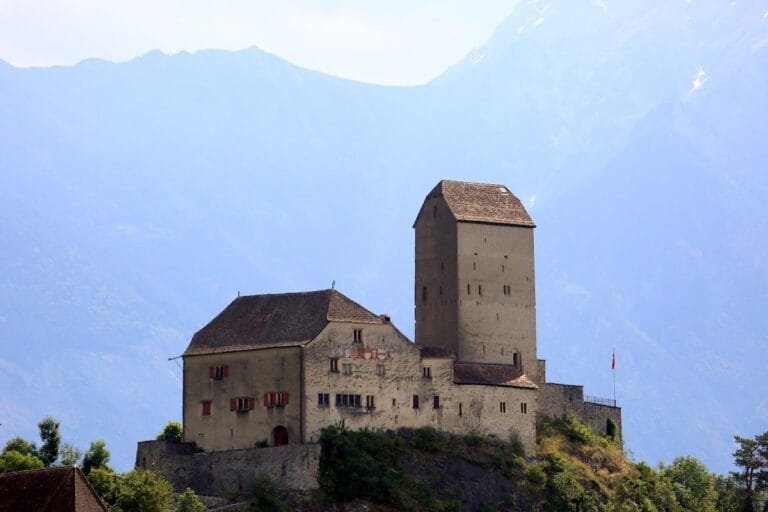
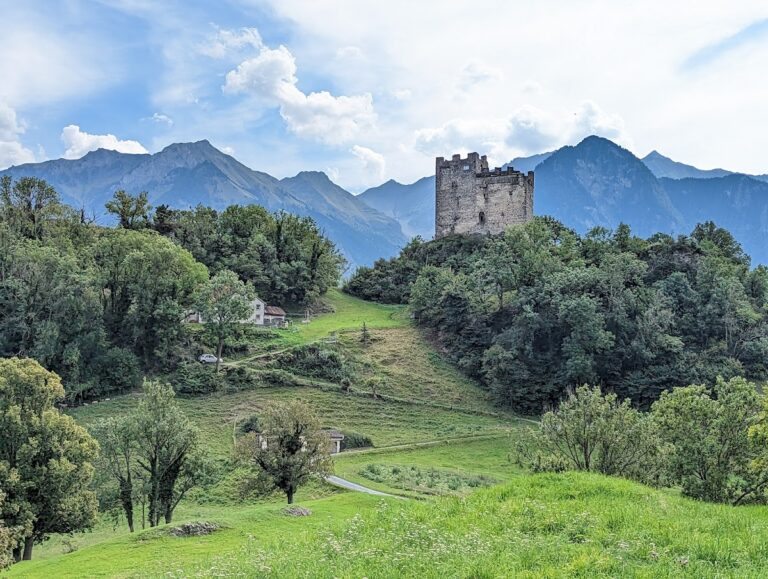
The passes at Matug and St. Luzisteig had been fortified since prehistoric times. Before the Rhine was corrected, the river ran along the foot of the Schollberg until about 1850. During the Roman period, the road on the Rhine’s right bank served as the principal north-south route in the area.
The Schollberg road opened in 1492 after approval by the Swiss Tagsatzung, the federal governing assembly of the Old Swiss Confederacy before the creation of the modern Swiss federal state in 1848. It replaced a mule track over Matug, which lay 200 metres higher, and remained an important commercial and military route until 1823. The state road constructed on an embankment then took over its role.
Construction of the fortress system
A military-engineering course in 1934 proposed fortifications at Schollberg, including a flanking gallery, a protected firing position intended to direct fire along the side of a defensive obstacle. Together with Artilleriewerk Ansstein, the proposed works were to block the Rhine valley north of Sargans. Both positions were initially planned for border defense, and construction began at the end of 1938 under the Swiss federal fortification plan of 1936-37.
In spring 1939, the works were incorporated into the wider Sargans fortress system. Artilleriewerk Schollberg 1 was intended to fire in front of the Schollberg-Sarganser Au key front, while Infanteriewerk Schollberg 2 operated within that defensive line. Schollberg and Ansstein were designed as mutually flanking artillery works. The northern approach was protected by the Schollberg-Trübbach obstacle position, while four bunker lines in the Sarganser Au protected the southern approach.
The Schollberg obstacle position, designated 1306, protected the Sargans basin from the north and east. Reconnaissance for its terrain anti-tank obstacle began in February 1939, and the obstacle with its flanking bunker chain was complete by 1944. A terrain anti-tank obstacle, abbreviated GPH in Swiss fortification designations, was a fixed barrier of rails, concrete blocks, walls, ditches, or barricades designed to stop or channel armored vehicles. This position became the most important obstacle protecting the northeastern entrance to the Sargans fortress.
The Sarganser Au obstacle position, designated 1307, formed the key front behind the approximately 1.5-kilometre-wide gap between Schollberg and Ellhorn. Its purpose was to prevent a breakthrough toward the eastern entrance of the Gotthard fortress or westward through the Walensee region into central Switzerland. Its defenses extended for about three kilometres in a deeply echeloned arrangement. Six bunkers secured the Rhine embankment, a second line followed the Saar, a third stood west and south of the Saar line, and a fourth occupied the slope above St. Gallerstrasse. The installations were arranged to support one another with fire.
Expansion during and after the Second World War
The works were occupied by units of Fortress Artillery Battalion 12. Schollberg 2 was assigned to Fortress Artillery Company 38 and Schollberg 1 to Fortress Artillery Company 40. After the 1952 army reorganization, Company 40 became responsible for all three Schollberg works. Under Army 61, the Swiss Army structure adopted in the early 1960s and used during the Cold War, the unit became Fortress Artillery Company I/13, with 370 personnel, including 80 fortress infantrymen.
After the Second World War, Schollberg 2 was enlarged by the Schollberg 3 annex. Built in 1946 as an artillery annex, it was converted into an infantry annex in 1960-61. The Ellhorn position was fortified as new Swiss territory in 1948, immediately after a land exchange with Liechtenstein, to protect a former weak point in the Sargans front. Schollberg and Ellhorn were operationally linked, while the Ellhorn infantry work was taken out of service in 1982.
The Sarganser Au system was expanded in 1962 with installations for flooding the northern Sargans plain. A weir on the Vilterser-Wangser Canal at Trübbach and a water intake at the Ellhorn Rhine weir could divert river water into the lowland. Within several days, the operation was intended to create a lake about 1.60 metres deep extending as far as Sargans railway station, while leaving the higher bunkers above the flood level. Controlled releases from reservoirs could temporarily raise the Rhine during periods of low water.
The Trübbach was repaired and converted into a tank ditch in the mid-1970s. In the late 1980s, the terrain obstacle was extended from Vild to the Rhine by an angled wall. Two Centurion anti-tank bunkers and a GPH 66 terrain obstacle were added to the Sarganser Au defenses in 1993. The Centurion was a British-designed tank platform used by Switzerland in hardened anti-tank positions, and the associated bunkers held 10.5-centimetre anti-tank guns. The bunkers were withdrawn from service in 2003.
Conversion and release from military use
In the early 1980s, Schollberg 1 was converted from an artillery work into an infantry work for anti-tank defense. In 1990, its 9-centimetre anti-tank guns and remaining weapons were removed, although the complex continued to provide accommodation until 1999. The works were emptied apart from their machine rooms in 2003.
The Schollberg works were sold to the municipality of Wartau in 2012. Schollberg 3 was restored by the Association Artillerie-Fort-Verein-Magletsch for guided public visits. The association also maintains the Vild command post, which the local community of Sargans acquired, restored, and maintained for visits. Vild served as the command post and combat installation of the Schollberg-Sarganserau-Tschingel defensive front from the Second World War onward. It was the last object in this Reduit key front to be released from secrecy, in 2010.
The Reduit was a Swiss defensive strategy that concentrated resistance in the Alpine interior, using fortified passes, valleys, and approaches to delay or block an invading force. The Schollberg, Sarganser Au, Ansstein, and Ellhorn obstacle positions are classified as military-historical monuments of national importance. Ansstein was subordinated to Fortress Command Sargans in September 1940, while the Tschingel artillery work contained the fire-control center for the artillery division serving four Sargans fortresses.
Remains
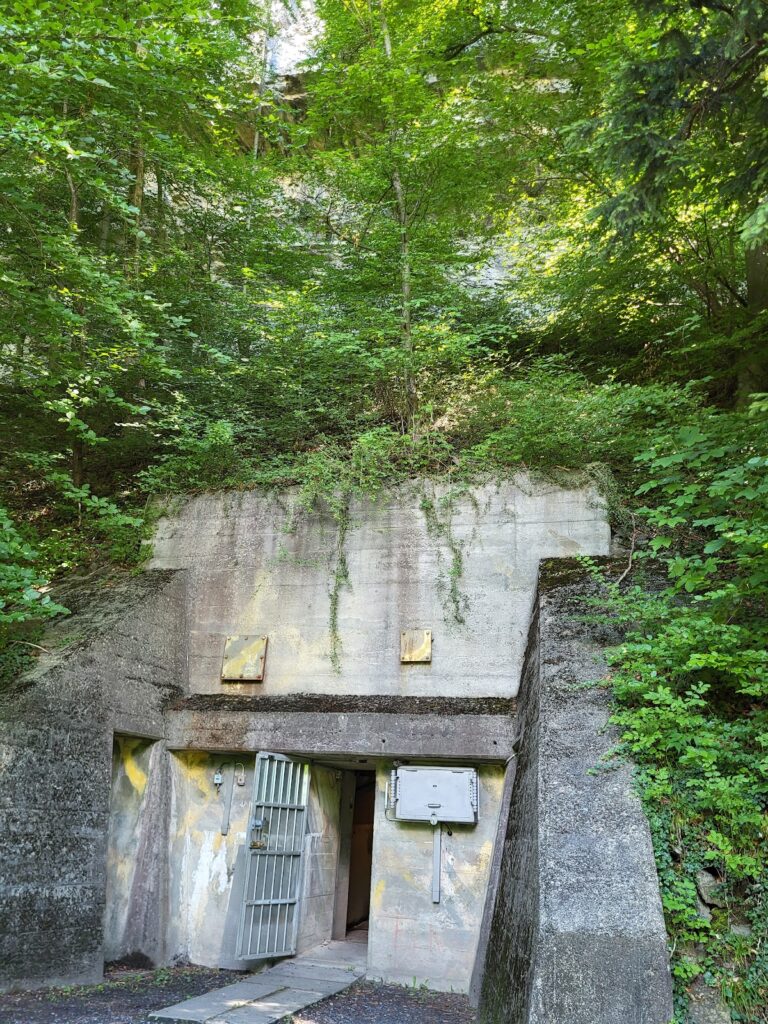
The surviving defenses form a connected landscape of rock installations, concrete bunkers, gun positions, command posts, shelters, road barriers, tank ditches, and water-control works. The principal Schollberg complex comprises Artilleriewerk Schollberg 1, A 6100.01, Infanteriewerk Schollberg 2, A 6100.02, and Infanteriewerk Schollberg 3, A 6100.03. Around them, the Schollberg and Sarganser Au positions spread along the Rhine, the Saar, the slopes above Trübbach, and the approaches toward Ellhorn and Ansstein.
Schollberg fortifications
Schollberg 1
Schollberg 1 originally contained two 7.5-centimetre guns and one 7.5-centimetre Mountain Gun 06. Its later armament comprised three 7.5-centimetre fortress guns, a 4.7-centimetre anti-tank gun later replaced by a 9-centimetre gun, two machine guns, and a searchlight installation. The work was converted for infantry use in the early 1980s and subsequently retained as accommodation after its weapons were removed.
Schollberg 2
Schollberg 2 was described as the strongest infantry work in the Sargans fortress. It contained one 24-millimetre anti-tank gun, three 4.7-centimetre anti-tank guns later replaced by 9-centimetre guns, eight machine guns, and a searchlight installation. Its position within the key front made it part of the close-defense system operating directly behind the principal obstacles.
Schollberg 3
Schollberg 3 was built in 1946 for four mobile 7.5-centimetre 03/22 guns. Conversion into an infantry annex in 1960-61 replaced that artillery arrangement with a 9-centimetre anti-tank gun. The work also contained three machine guns and a searchlight installation. During Army 61, the three Schollberg works together held five 9-centimetre anti-tank guns, three 7.5-centimetre guns, eight machine guns, four light machine guns, seven observers, and three infrared searchlights. In 1994, this armament was reduced to two 9-centimetre anti-tank guns and nine Fortress MG 51. Schollberg 3 has been restored for guided visits.
Schollberg obstacle position
The Schollberg obstacle position contained three artillery observers, two gun positions, 19 infantry bunkers, 14 light-machine-gun bunkers, five machine-gun bunkers, two ammunition magazines, and 28 shelters cut into rock or built in concrete. Two terrain anti-tank obstacles incorporated 22 road barricades, and a stream obstacle added another fixed barrier.
The GPH Trübbach ran along the northern edge of the position from the Rhine bank at Trübbach, with a northwestern extension toward the Kurhaus on the Alvier. Completed by 1942, the Alvier extension comprised bunkers and shelters on mountain pastures intended to prevent a northern bypass. Its installations included the Guggstein artillery command and observation post, A 6050, the Buchboden bunker, A 6051, the Kalberboden bunker, A 6052, and the Alvier V, Alvier IV, Alvier II, Alvier I, Kaufboden, Malanserholz I, Lafadarsch-Loch, Lafadarsch, Eichendohlenweg, and Flied infantry positions. The Alvier III light-machine-gun bunker and the Alvier II and Lavadarschberg shelters formed part of the same mountain section.
The Trübbach section occupied a sector between Schollberg and the Rhine that was in places only 250 metres wide, concentrating the anti-tank defenses. It included the Wiesenrank, Mumpertjörs, Kracher I and II, Bergweite, Lusbüchel, Wolfsloch, Scherm, Mazifer, and Pflanzgarten infantry bunkers, together with the Lauterbach artillery bunker. Shelters at Walsergasse, the Richtbühl shelter cavern, and other rock installations supported the line. The Richtbühl infantry work had a machine gun, observation post, and anti-tank gun, while its separate command bunker was not connected to the infantry work. Further positions included the Bühl infantry work and infantry-gun position, the Richtbühl infrared observation post, and the Fluhwand cavern infantry bunker.
The southern Schollberg group included the Matug Kantine and Matug Hang infantry bunkers, the Schollbergkopf cavern infantry bunker, several shelter caverns, two ammunition caverns and shelters, and the Schollberg North artillery command and observation post. Near the Rhine, the Rheinau 1 and Rheinau 2 infantry bunkers carried machine guns. Associated barriers included the footbridge road barricade, the Schollberg and Schollberg South obstacles, the Trübbach tank ditch, concrete anti-tank blocks and rails, and the stream obstacle between Schollberg 2 and the Saar Canal.
Sarganser Au obstacle position
Rhine and Saar lines
The Sarganser Au defenses contained four bunker lines and more than 20 bunkers. The first line followed the Rhine embankment and consisted of six Schindler bunkers, also called sugarloaf bunkers, armed with light machine guns. The second line followed the Saar from Baschärgiessen to Schollberg. It combined the long GPH T 3320/3322 with bunkers and assault-group shelters linked by telephone and signal-light networks.
Named structures in this area included Rheindamm bunkers 1-6, the Ellhorn shelters, Battalion Command Post Naus, and the Egg telephone center. The Vild cavern and battalion command post contained two machine guns and observation facilities. The Römerstrasse machine-gun cavern, Rheinknie bunker, Saarspitz bunker, and other Saar-line positions extended the defensive arrangement toward the interior.
Interior bunkers and shelters
Further installations included the Äuli shelters, Sarganserau 2 and 3 bunkers, Hüttenau shelter, Saar Rheinbrugg Landi, Baschäräuli bunker, Baschär shelter, Melserau 1-3 bunkers, Baschärgiessen 1 and 2 shelters, and the Melchi and Schwettnen shelters. A Cold War shelter cavern and another shelter cavern formed part of the later defensive infrastructure. The two Schollberg Centurion infantry bunkers, Schollberg South and Schollberg North, were designated A 6181 and A 6182.
The Sarganser Au anti-tank system included the partly demolished GPH with rails, the Saarkanal barrier, western and eastern sections of GPH T 3320, GPH 66, the Vilderweg-Saarhof barrier, and GPH Saar. The Sarganser Au flood-control weir formed another element of the defensive landscape. The Schollberg South flood installation was dismantled.
Ansstein and Ellhorn positions
Ansstein
Artilleriewerk Ansstein, A 6256, contained two 7.5-centimetre bunker guns and initially two 7.5-centimetre Mountain Guns 06 at the entrance. In 1942, the mountain guns were replaced by two machine guns and two 4.7-centimetre anti-tank guns, later replaced by 9-centimetre guns. An infrared searchlight was installed in 1962-63. After the 9-centimetre guns were removed, the work served only as accommodation from 1990 and was completely emptied in 2000.
The Ansstein obstacle position included the five-row rail obstacle T 3326, built in 1939 and reinforced in 1941 with a row of concrete anti-tank blocks. Its rock works, bunkers, command posts, observers, and shelters extended from Guschaspitz and Ochsenberg through Elleli, Wisli, Hölzli, Mattheide, Ankaschnallkopf, Riegel, and Fläscherloch. The Fläscherloch rock work held an infantry or anti-tank gun, two machine guns, and a bunker gun. The Guscha rock work also served as a military-supplies depot. Anssteinwald bunker A 6257 was dismantled after the 1949 border adjustment with Liechtenstein, while the St. Luziensteig-Balzers infantry bunker was demolished.
Ellhorn and Tschingel
The Ellhorn position comprised the Ellhorn anti-tank cavern, A 6224, the Tschingel artillery work, A 6225, and Ellstein infantry bunker, A 6229. Tschingel occupied a central position with a broad view over the Sargans fortress area and housed the fire-control center for the artillery division serving four fortresses. The Vild cavern was another rock installation, equipped with two machine guns and observation facilities, and remains associated with the command structure of the defensive front.