Žuta Tabija: An Ottoman Cannon Fortress in Sarajevo


Site at a Glance
- Rating
- 4.6
- Popularity
- Medium
- Country
- Bosnia and Herzegovina
- Primary era
- Early Modern
- External website
- Open
- Eras represented
- Early Modern
- Civilizations
- Ottoman
- Site type
- Military
- Remains
- Fort
On this page7 sections
History
Ottoman Construction
Žuta Tabija is an Ottoman cannon fortress in Bosnia and Herzegovina, built between 1727 and 1739 as part of the defensive fortifications of Vratnik above Sarajevo’s historic center and the Baščaršija bazaar quarter. Its construction followed the 1697 attack in which Prince Eugene of Savoy, a prominent Habsburg commander, captured, looted, and burned Sarajevo. In response, the Ottoman governor Gazi Ahmed Pasha Rustempašić Skopljak began strengthening the heights of Vratnik in the late 1720s.
Work on the defensive wall began in 1727. Five architects from Dubrovnik supervised the project, which was completed in 1739 during the governorship of Hekimoğlu Ali Pasha, an Ottoman statesman and provincial governor. The finished Vratnik fortification consisted of five bastions and five entrance gates. Žuta Tabija formed one of the defensive positions protecting the historic settlement.
Military Use and Reconstruction
The Vratnik fortress system served for defense until the Austro-Hungarian conquest and occupation of Sarajevo in 1878. The Austro-Hungarian army then used the installations. Muslims were nevertheless permitted to continue the cannon-firing tradition associated with Ramadan, the Islamic month of fasting, when cannon fire marks the end of the daily fast in some communities. The tradition continues at Žuta Tabija.
The fortress suffered damage on several occasions and was reconstructed in 1883, 1903, and 1998. In 2005, Žuta Tabija was proclaimed a National Monument of Bosnia and Herzegovina.
Remains
Fortress Fabric and Defensive Setting
Žuta Tabija
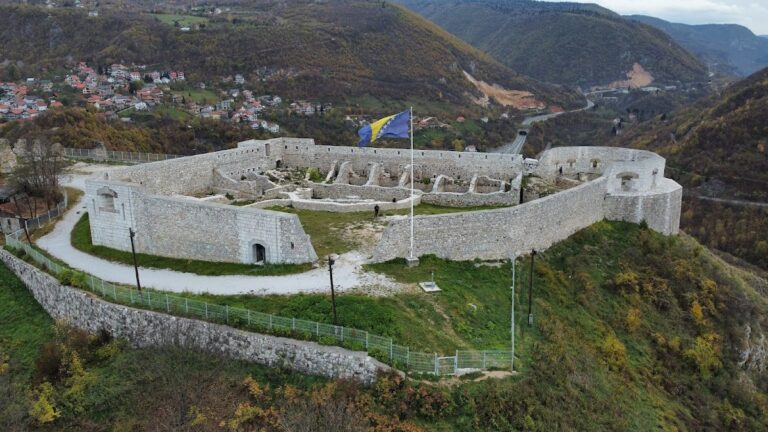
Žuta Tabija stands at approximately 615 metres above sea level on the Jekovac cliff, above Sarajevo’s historic center. It is built of sandstone and forms part of the walled city of Vratnik, a historic fortified settlement and neighborhood. The bastion has seven exterior sides approximately 10 metres high, while its northern side reaches 27.5 metres. Its walls are 35 centimetres thick. The surviving tower remains include walls, an entrance, and windows.
Vratnik Defensive Works
The bastion stands at the entrance to the former walled settlement in the Jekovac area. It is located near the Jajce Barracks and the Jekovac water reservoir, within the wider defensive landscape of Vratnik. From the bastion, the Kovači cemetery, a Muslim necropolis, can be seen. The White Bastion and Višegrad Gate also survive in the Vratnik area.