Fertőrákos Mithraeum: A Roman Sanctuary of Mithras in Hungary
Site at a Glance
- Rating
- 4.5
- Popularity
- Medium
- Country
- Hungary
- Primary era
- Classical
- Eras represented
- Classical, Modern
- Civilizations
- Hungarian, Roman
- Site type
- Religious
- Remains
- Mithraeum
On this page11 sections
History
The Fertőrákos Mithraeum is a Roman sanctuary of Mithras in Hungary, founded in the early third century. It served Mithraism, a Roman mystery cult devoted to Mithras, an ancient Indo-Iranian deity adopted into Roman religion. The sanctuary is one of four known sites of this kind in Hungary. Inscriptions and coins support its date, while two altars referring to people from Carnuntum appear to have prompted its construction.
Foundation and Roman use
Although nearer to Scarbantia, the sanctuary probably belonged to the territory of Carnuntum, a Roman settlement and provincial center in Upper Pannonia. Scarbantia was also a Roman settlement in Pannonia. The Amber Road, a long-distance route between the Baltic region and the Roman Mediterranean, passed nearby.
Abandonment and later burials
Mithraism lost influence in Pannonia amid social and economic changes in the mid-to-late third century, and the sanctuary was abandoned. It did not return to use during a revival of the cult under Emperor Diocletian. In 378, Emperor Gratian ordered Mithraic sanctuaries destroyed. The secluded Fertőrákos site escaped demolition and was gradually covered by water- and wind-borne deposits and vegetation.
The relationship between burials at the sanctuary and Mithraic worship is uncertain. Specialists have considered the cremation burials more likely to belong to a newly settled population than to a revival of early Roman burial customs. They do not indicate human sacrifice. Specialists also rejected historical writer Miklós Massalszky’s claim that Emperor Julian visited the sanctuary in 361 and performed a human sacrifice there, judging the story unreliable and factually wrong.
Discovery and nineteenth-century investigation
Ferenc Storno the younger and stonemason György Malleschitz independently discovered the sanctuary in July 1866. Local stonemasons began clearing it before Storno’s father, Ferenc Storno the elder, arrived under commission from Vienna’s Central Commission for the Preservation of Monuments. The early clearance disturbed the arrangement before it could be properly surveyed, limiting what could be established about the original placement of the remains. Storno the elder prepared a report and drawings, and his surviving sketchbook preserves a record of the site.
After the excavation, Storno arranged for the stone monuments to be taken to Sopron and the coins to be sent to János Simor, bishop of Győr. A local magistrate funded a protective stone vault, described as Hungary’s first reconstruction at an archaeological site; it was later demolished. Paur Iván published the first account of the excavation in 1866. Király Pál and Friedrich Kenner published further studies in 1867, including Kenner’s detailed discussion of the finds.
Borderland neglect and archaeological restoration
After the First World War, the sanctuary lay in a no-man’s-land and deteriorated with little visitation. Following the Second World War, it stood within a heavily guarded border zone and sustained shrapnel or bullet damage. Local recollections also place a grenade explosion inside or just in front of it. Archaeologists could not visit the site before 1990. After István Tóth, a specialist in Pannonian religious history, drew attention to its condition, Gabriella Gabrieli of the Sopron Museum led an authorized excavation in 1990–91.
The excavation removed more than a metre of accumulated deposits and exposed the foundations of the raised platforms and entrance hall. It also recovered fragments of the cult relief and other small finds. In 1992, the sanctuary was restored on the basis of the new investigation and earlier studies. It is protected as a Hungarian historic monument and lies within Fertő-Hanság National Park and the Fertő/Neusiedlersee cultural landscape, inscribed on UNESCO’s World Heritage List in 2001.
Remains
The sanctuary combines natural rock and stone construction in a north–south arrangement. Its overall plan is trapezoidal, with a recorded footprint of 143 square metres, a length of about 13 metres, a width of 8–11 metres, and a stated height of 6 metres. Natural rock forms the eastern and southern sides, while stone-built walls form the northern and western sides.
Interior arrangement
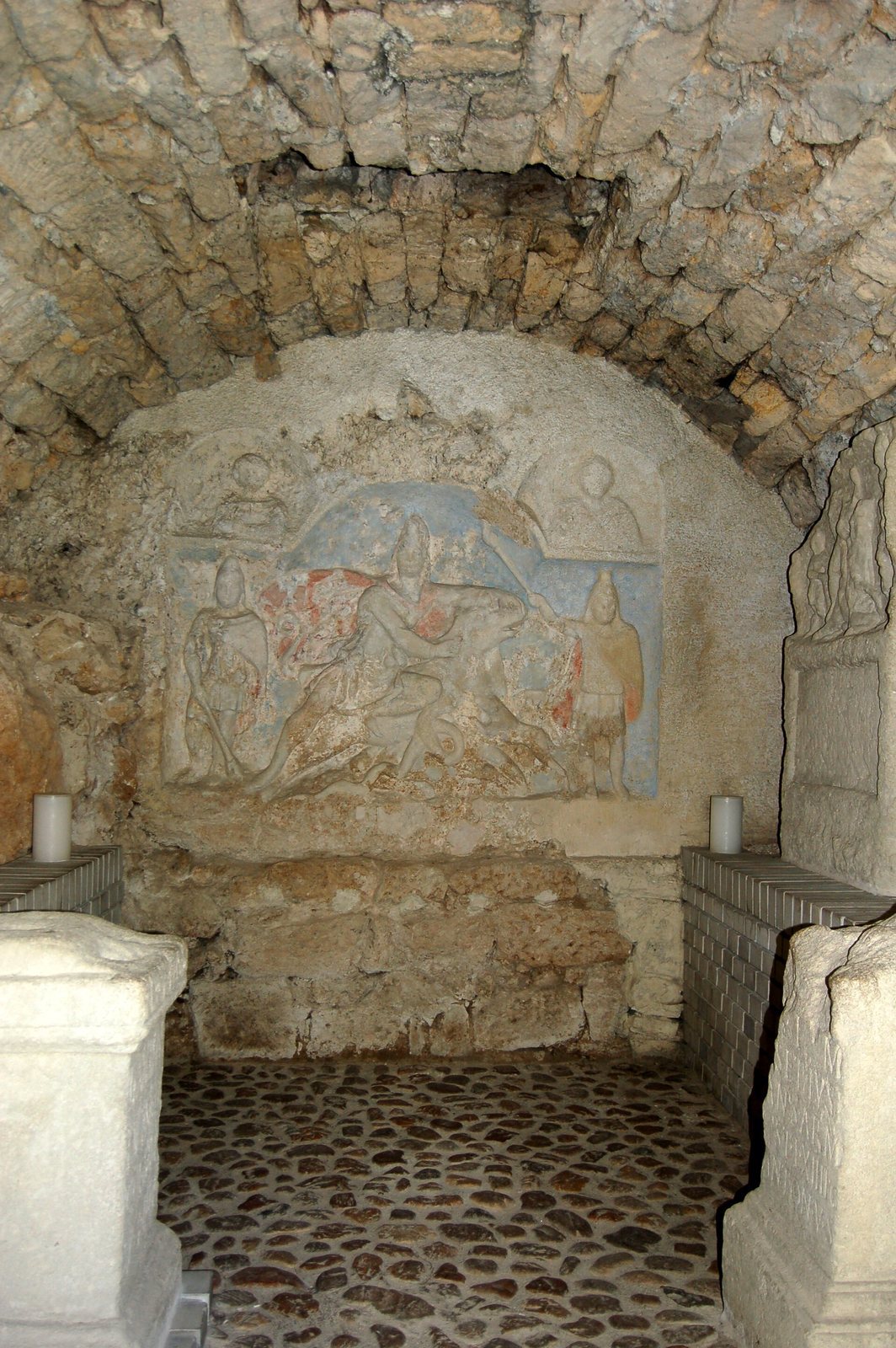
A narrow entrance hall leads lengthwise into the sanctuary proper. Two raised side platforms flank a lowered central chamber, reached by four steps and set 80 centimetres below the platform and entrance-hall level. The room could hold about 18–20 people. The sanctuary proper widens toward its entrance and measures about 5.2–5.5 metres long, from roughly 3.5 metres wide at its narrow end to 5.2–5.5 metres at its broad end. The central chamber is 4.41 metres long and 2.07 metres wide. At the rear, the platforms measure 0.63 and 0.87 metres in width; near the entrance, each is 1.75 metres wide.
Rock-cut cult relief
Opposite the entrance, a relief carved into the rock depicts Mithras killing a bull. It measures 2.20 by 1.41 metres. A thin coat of stucco finished the rough carving, which was painted and apparently repainted, as overlapping plaster and paint layers survive in places. Mithras, dressed in Phrygian clothing, holds the bull’s head and strikes it. Cautes and Cautopates stand at either side with torches pointing upward and downward. A dog and snake lap at the bull’s blood, while a scorpion bites its genitals. The scene sits beneath an arched cornice, with busts of the sun god Sol and a lunar goddess above. The remaining Latin words on the lower frame, FECIT INPENDIO SUO, indicate that the work was erected at someone’s expense. Sculptor-restorer György Kovács restored the relief during the modern work.
Altars and furnishings
Three or four inscribed altar stones were found at the sanctuary. Their inscriptions name Lucius Avitus Maturus, a member of Carnuntum’s town council; Septimius Iustinianus, a soldier responsible for the armoury of the Roman legion Legio XIV Gemina Antoniniana; and Julius Saturninus, described as a politician of a colony. The original monuments are held in the Roman stone collection at the Sopron Museum. Copies of four altars are displayed on either side of the central chamber. Two stone lions were also found, and copies now stand on the platforms beside the entrance. Other finds include one intact lamp, a fragment of another, and a grey beaker about 9 centimetres high.
Burials and other archaeological finds
Twenty-seven ash urns were found in the central chamber. Each was made from two rimmed tiles placed together, contained a coin, and formed part of an arrangement of three urns across nine rows. The 28 coins found at the site include groups dated to 254–282 and 307–383; 16 were minted in the second half of the fourth century. At the western end of the west platform, a skeleton burial lay beneath an inscribed marble slab, or stele, measuring 1.47 metres high and 1.03 metres wide. A copy of the slab is displayed on the sanctuary’s right-hand interior side. The 1990–91 excavation also yielded pottery fragments, animal bones, and fourth-century coins. Roof-tile fragments occurred in a Roman-period layer around the sanctuary.
Protective building and memorial
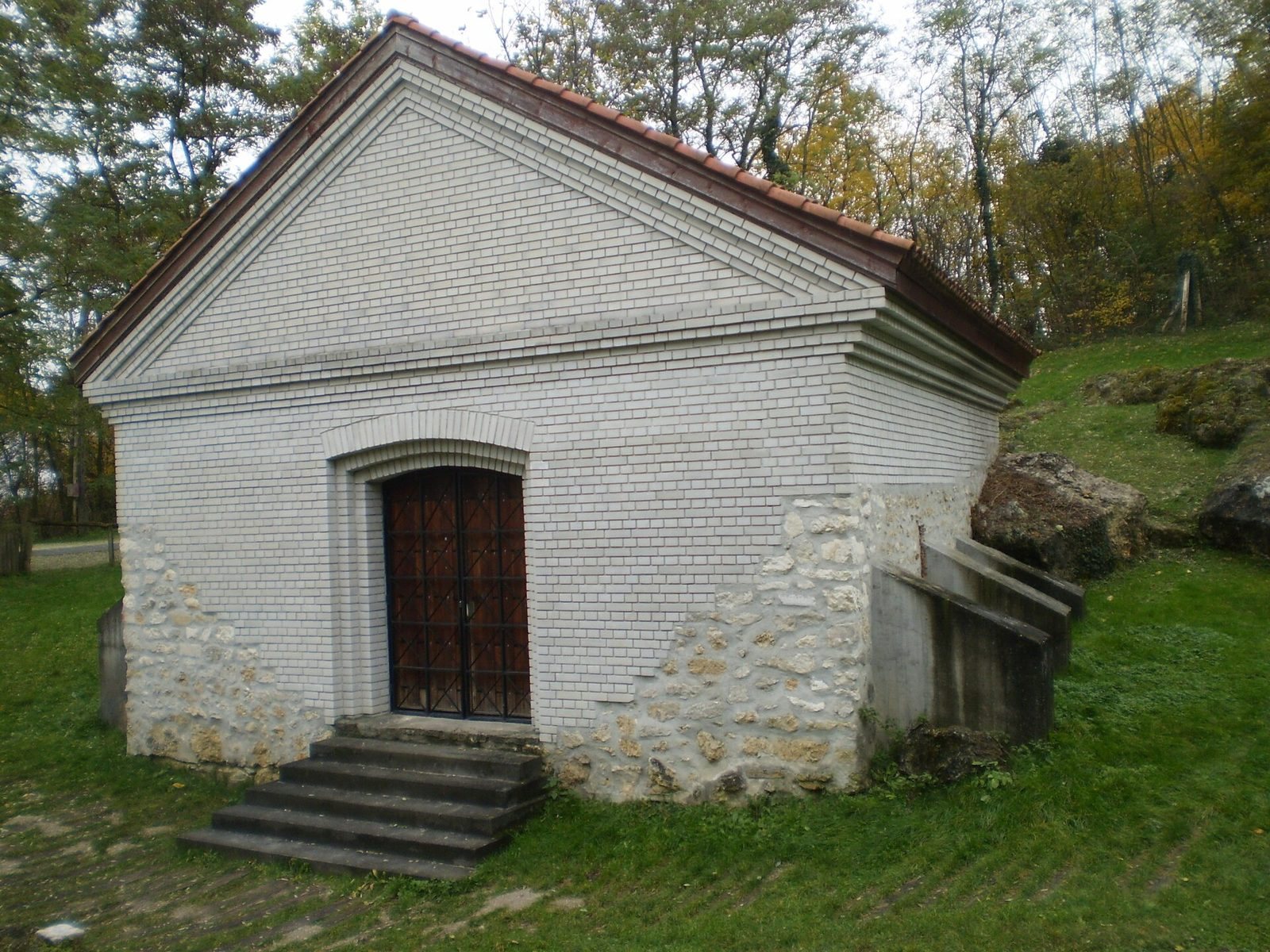
The present protective building has stonework below and brick above, with modern materials that evoke a Roman sanctuary while making clear that the structure is contemporary. A Latin-inscribed memorial to István Tóth was erected near the sanctuary in 2007.