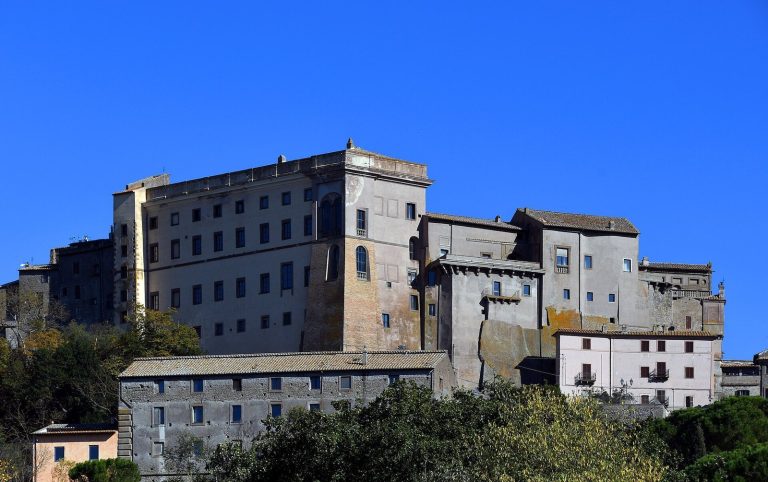
Ferentium: An Ancient Roman and Medieval City in Italy
Site at a Glance
- Popularity
- High
- Country
- Italy
- Primary era
- Classical
- Eras represented
- Classical, Medieval
- Civilizations
- Lombard, Papal States, Roman
- Site type
- City
On this page14 sections
History
Etruscan predecessor and Roman town
Ferentium was an ancient Roman town on the elevated Pianicara site near Viterbo, Italy. Its history is linked to an earlier Etruscan settlement nearby and to its later growth as a prosperous Roman community.
At nearby Acquarossa, where an Etruscan necropolis is known, a settlement called Frentis flourished in the seventh or sixth century BCE. It belonged to the Etruscan territory centered on Velzna, near modern Orvieto. Frentis was destroyed late in the sixth century BCE. People displaced from Acquarossa may then have moved to Pianicara around 550 to 500 BCE, perhaps because of warfare, though the cause is uncertain.
Ferentium first appears in references dated to 123 BCE, including the Liber coloniarum, a collection concerning Roman colonies and land assignments, and the Gromatici veteres, ancient Roman surveying texts. The references may concern the founding of a colony or the allocation of public land. After the Social War, the first-century BCE conflict between Rome and its Italian allies, Ferentium became a municipium, an incorporated Roman community with local civic institutions. It belonged to the Stellatina, one of Rome’s citizen tribes, and to Italy’s seventh administrative region.
The town’s wealth rested on several activities. It traded between the Tyrrhenian coast and the Tiber valley, cultivated crops and raised livestock, worked local volcanic building stone, and extracted and traded iron, which was plentiful in the surrounding area.
Imperial prosperity
Ferentium reached its greatest prosperity in the early imperial period, and remained prosperous into the following century. A marble inscription found near the town called it civitas splendidissima, or “most splendid city.”
Roman families associated with Ferentium included that of Otho, emperor in 69 CE during the brief succession crisis known as the Year of the Four Emperors. Flavia Domitilla, wife of Vespasian and mother of the emperors Titus and Domitian, was also linked to the town. Either she or her daughter of the same name was worshipped as diva Domitilla, a title for a deified woman.
Christian community and early medieval decline
A Christian diocese, a church district under a bishop, existed at Ferentium by about 400 and continued until the middle of the seventh century. The identity of its first bishop is uncertain. Dionysius has been proposed, perhaps in the third century, while Eutychius is also named. Eutychius was martyred near Soriano in 269 during the persecution under Emperor Aurelian, and his cult was practiced at Ferentium. Recorded bishops include Maximinus in 487, Boniface, probably between 519 and 530, Redemptus in 567 or 568, Marcian between 595 and 601, and Bonitus in 649. Fourth-century records also connect the town with Emperor Constantine and with Popes Sylvester and Damasus.
The sixth-century Gothic War between the Byzantine Empire and the Ostrogothic kingdom, followed by wars between the Byzantines and Lombards, brought a sharp decline in Ferentium’s population. Residents retreated to the west of the ancient town and fortified an area there. In the seventh century the bishop’s seat moved to Bomarzo, a more advantageous position for controlling the Tiber valley. The Lombards divided Ferentium’s territory among the dioceses of Bagnoregio, Bomarzo, and Tuscania.
In 740 the Lombard king Liutprand left Ferentium for Umbria and founded Ferentillo near the Marmore Falls in memory of the city. In 787 or 788, Charlemagne transferred Ferentium to Pope Adrian I, following the territorial donation made by Pepin the Short in 744. By 940, the town belonged to the administrative district known as the Comitato Ferentensis.
Medieval revival and destruction
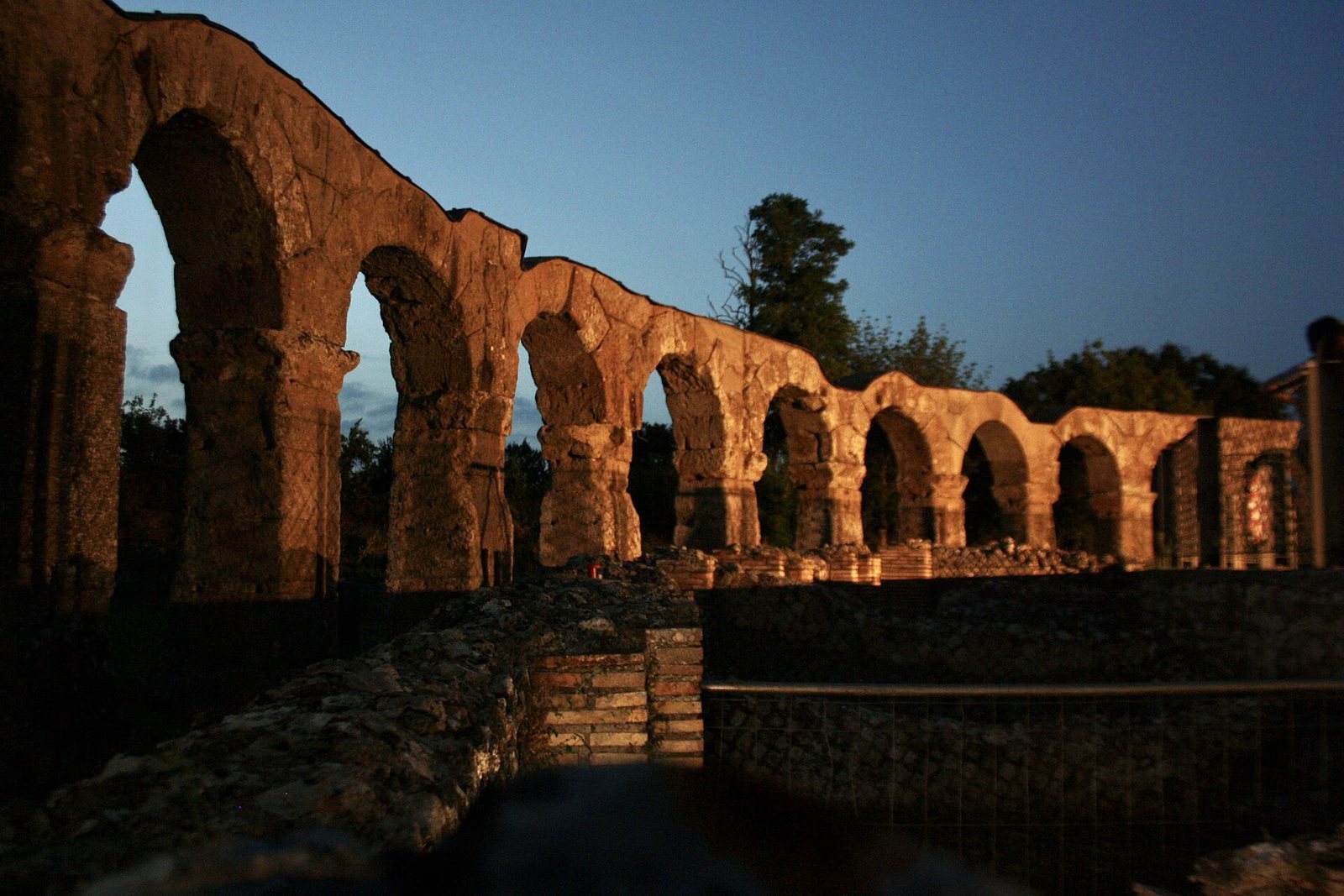
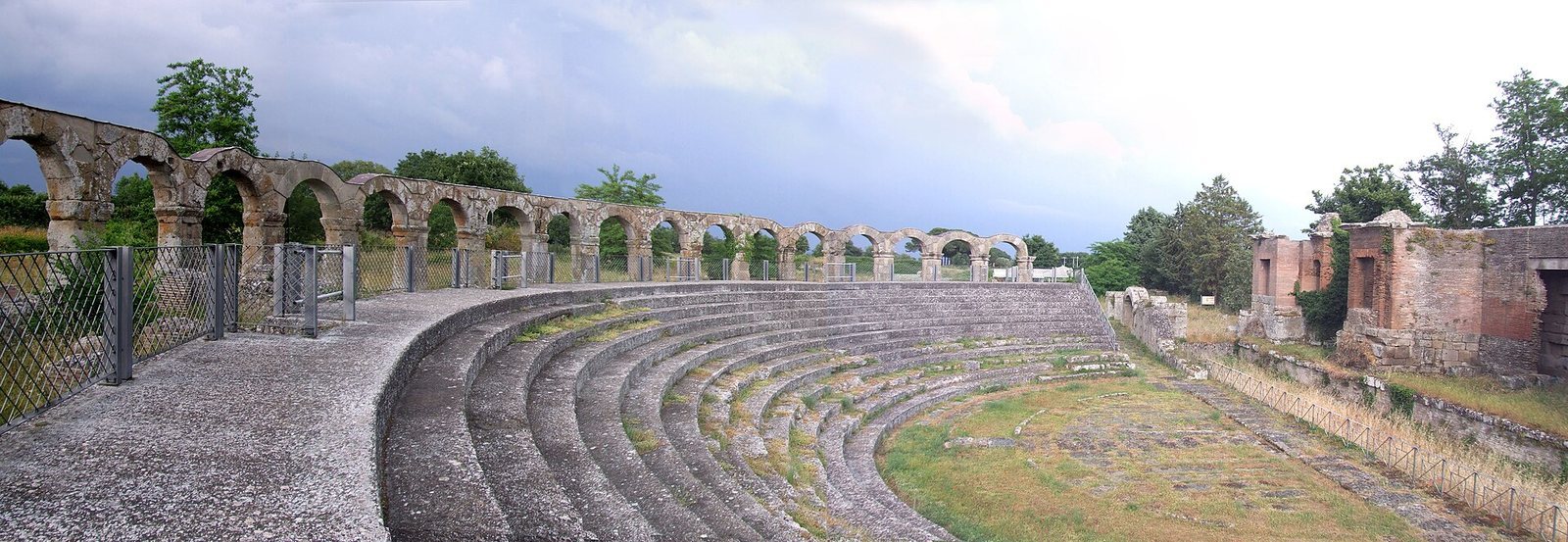
Ferentium may have functioned as a self-governing commune in the eleventh and twelfth centuries, when its population and economic importance recovered. Settlement extended east of the theatre, and artisans established workshops beneath its arches.
The conflict with Viterbo associated with 1169 is difficult to reconstruct. Ferentians may have sought Viterbo’s aid against Nepi before sacking the city; alternatively, Viterbo may have used the dispute with Nepi as a pretext to draw out Ferentium’s forces. The episode is linked to a massacre at Carnajola, also called Carnaio. Local tradition explained reddish marks in a nearby stream as blood, while iron-bearing deposits in the water stain the rocks red.
Viterbo had allied with Emperor Frederick I Barbarossa in 1158, then fought against castles in Tuscia without his approval. Frederick placed the city under a ban, which was lifted in 1174. In 1170 Viterbo attacked Ferentium, sacked it, and set it on fire. Ferentium submitted in 1171 but revolted later that year. On the night of 1 January 1172, Viterbo’s forces, allied with Celleno, attacked the sleeping town, using accusations of heresy as a pretext. They killed residents and burned the settlement.
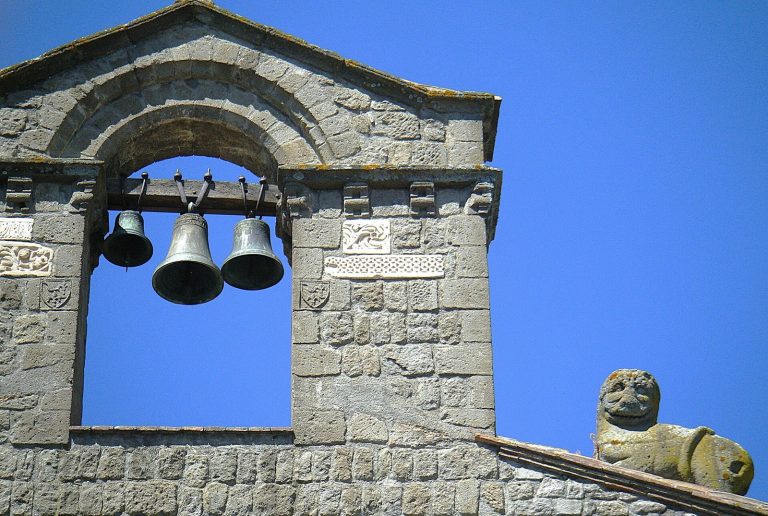
Viterbo spared some Ferentian nobles and gathered them near San Faustino in the city. Other survivors, away tending flocks, fled toward the Tiber valley, sheltered in caves, and settled there permanently, giving rise to Grotte Santo Stefano. Viterbo marked Ferentium’s defeat by combining the town’s palm emblem with its own lion.
In 1174 Christian, archbishop of Mainz, guaranteed that Ferentium would not be rebuilt and placed its territory under Viterbo’s jurisdiction. In 1202, the properties of Ferentium’s churches of San Bonifacio and San Gemini were assigned to Viterbo’s churches of Santo Stefano and San Matteo in Sonza. Viterbo’s statutes of 1237 to 1238 and 1251 to 1252 imposed severe penalties on attempts to resettle Ferentium and forbade cultivation there. The later statutes also ordered the theatre and its surroundings to be destroyed, but that order was not carried out.
Later use and excavation
Armies used Ferentium’s ruins as camps in the late fourteenth and fifteenth centuries. Pope Martin V commissioned Cristoforo D’Andrea of Siena to rebuild and repopulate the town, but Viterbo prevented the project. A small settlement called Borgo di Ferento grew along the main road in the sixteenth century.
Gustaf VI Adolf of Sweden excavated Roman and medieval remains over several years. Excavations supervised by the University of Tuscia followed between 1994 and 2009, and the university has promoted further campaigns.
Remains
Urban plan and roads
Ferentium occupied elevated ground at Pianicara, on the route toward the Tiber valley. In the Roman Republican period, its streets followed a regular grid organized around a principal street, the Via Ferentiensis, with cross streets. The Via Publica Ferentiensis connected the town with the Via Cassia, and sections of its paved surface survive. Excavation has exposed only a small part of the settlement; other investigated areas have been covered again.
Roman public buildings
Theatre
The theatre has been fully excavated and is among the extensive Roman remains, which also include domestic and municipal buildings. In the medieval period a watchtower was built within the theatre, while artisan shops occupied spaces beneath its arches. Marble statues depicting characters from Greek and Roman tragedy and comedy may once have stood along the theatre’s stage façade.
Forum and civic buildings
The forum’s location has been investigated, but the area was covered again and an agricultural business stands above it. The early imperial town also had public baths and an Augusteum, a building associated with the imperial cult.
Amphitheatre and fountain
The amphitheatre lay northeast of the settlement. Another public feature was a fountain surrounded by numerous statues.
Medieval defenses and expansion
The early medieval fortified area to the west covered about 30,000 square metres. During the eleventh and twelfth centuries, a new circuit of walls enclosed about 70,000 square metres as settlement spread east of the theatre. The Roman structure’s arches were also reused for workshops.
Finds
Some finds from Ferentium are held at the National Etruscan Museum at Rocca Albornoz in Viterbo. They include the marble theatre statues, a small wooden model of the Roman theatre, and reconstructed architectural remains.