Viterbo Cathedral: Episcopal Seat and Papal Church in Italy


Site at a Glance
- Rating
- 4.6
- Popularity
- Low
- Country
- Italy
- Primary era
- Medieval
- External website
- Open
- Eras represented
- Medieval, Early Modern, Modern
- Civilizations
- Papal States
- Site type
- Religious
- Remains
- Cathedral
On this page13 sections
History
Viterbo Cathedral, also known as the Cathedral of San Lorenzo, is the principal Catholic church of Viterbo, Italy, and the episcopal seat of the Diocese of Viterbo. Built toward the end of the twelfth century in the Romanesque tradition, it replaced a small seventh-century church dedicated to Saint Lawrence, the third-century Christian deacon and martyr to whom the cathedral is dedicated.
From Earlier Sanctuary to Cathedral
The earlier church stood over the ruins of a pagan temple associated by tradition with Hercules. Its identification with an Etruscan temple remains traditional, while Etruscan and Roman foundations can still be seen in buildings facing Piazza di San Lorenzo. The later cathedral was built on the hill in the final part of the twelfth century, establishing the site as a major religious landmark in the developing town.
In 1192, Pope Celestine III established Viterbo and its surrounding territory as a diocese. San Lorenzo then became the cathedral, giving the church a formal episcopal role. As Viterbo expanded northward down the hill, the cathedral became relatively isolated from the growing settlement. Local bishops sought to reinforce its religious position by granting it special privileges.
The Papal Residence and the Conclave
During the middle and later thirteenth century, the cathedral and the adjoining Papal Palace became a papal residence. The papacy had moved from Rome and had not yet settled in Avignon, while Viterbo remained a papal seat until 1281. The close relationship between the church and the palace placed San Lorenzo at the center of the town’s ecclesiastical and political life.
The death of Pope Clement IV in Viterbo led to the lengthy papal election of 1268 to 1271. The cardinals’ prolonged election helped shape the tradition of the conclave, the formal selection of a pope by the cardinals under restricted conditions. The cathedral and palace complex therefore became associated with an important stage in the development of papal elections.
Papal Burials and Later Transformation
Pope Alexander IV, whose secular name was Rinaldo di Jenne, sought refuge in Viterbo while fearing capture by Manfred of Sicily and was buried in the cathedral. His tomb is now lost. His remains may have been secretly reburied to protect them from vandalism by Ghibelline factions, or they may have disappeared during alterations carried out in the fifteenth and sixteenth centuries.
Pope John XXI, whose secular name was Pedro Juliao, was buried in the cathedral after his death in 1277. He died when the ceiling of his study in the adjoining Papal Palace collapsed, probably because of structural weakness. His tomb remains visible at the rear of the left nave. An honorary tomb was installed in the cathedral in May 2000 at the direction of Pope John Paul II.
A major transformation began under Cardinal Gambara, Bishop of Viterbo from 1568 to 1580. The work gave the exterior its Renaissance appearance and included the demolition of the original facade, roof, and central apse. New chapels were created, and much of the earlier interior art and decoration was replaced. Further changes in the seventeenth century included the construction of a barrel vault decorated in 1681 by Urbano Romanelli. A later intervention in the nineteenth century also replaced or lowered the ceiling.
A bomb struck the cathedral during the 1944 bombardment and caused extensive damage. The restoration that followed removed much of the later remodeling and attempted to recover the presumed Romanesque arrangement of the interior. Eight of the ten side chapels and the apse area were walled up. In March 1940, Pope Pius XII had raised the church to the status of a minor basilica. The cathedral remains part of the monumental complex known as Viterbo’s Cathedral Hill.
Remains
Cathedral Structure
Viterbo Cathedral retains a twelfth-century plan oriented toward the east. Its present appearance combines a Romanesque body, a Renaissance exterior, and a Gothic campanile, or bell tower. The building is directly connected to the Papal Palace, which stands above the town. The facade is reached through a short flight of steps, and the cathedral’s position gives it a central architectural role in Piazza di San Lorenzo.
Facade and Campanile
The original Romanesque facade had a central rose window. Surviving portions are preserved in the Museum of Cathedral Hill. The present facade belongs to the Renaissance transformation and is made from material different from the local stone used by many neighboring medieval buildings.
The upper part of the campanile is divided into tiers by paired bifora windows, each window being split into two openings. Horizontal bands alternate local white travertine with blue or blue-green basalt. The tower is the only original exterior work that remains clearly visible from outside.
Nave, Chapels, and Ceiling
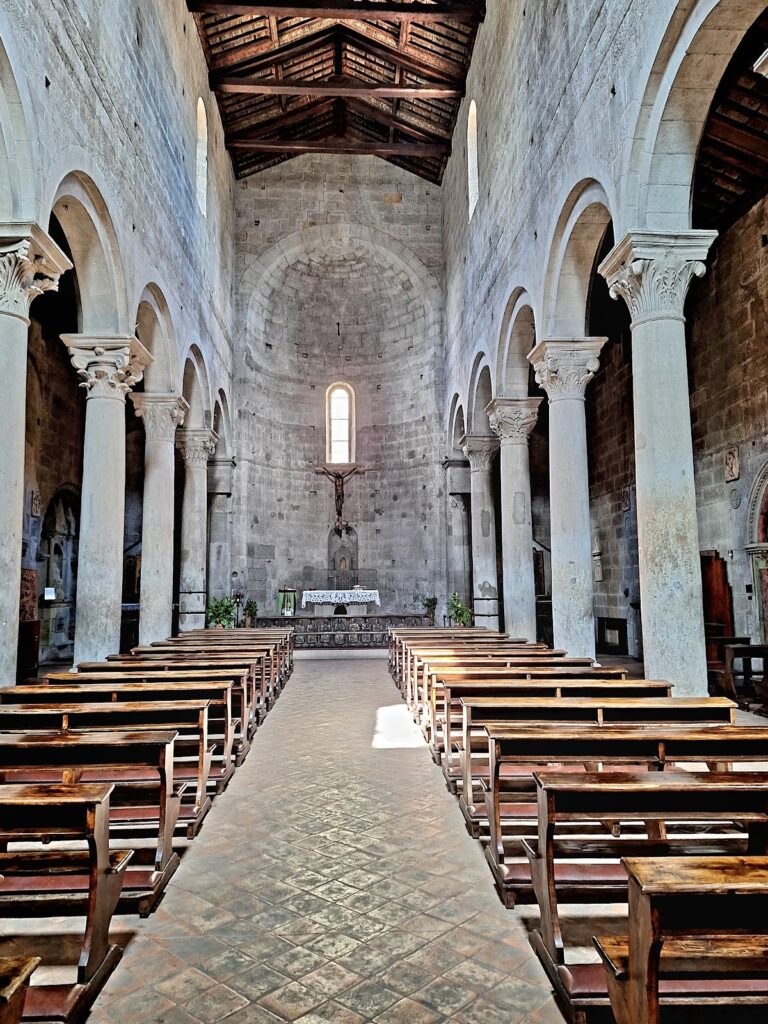
Inside, two orders of columns divide the three naves, which are linked by round arches. The floor includes a Cosmatesque pavement, a geometric inlaid surface made from colored stone and marble. The opening of ten chapels in the side walls during the sixteenth century led to the destruction of the wall frescoes where the chapels were created.
The seventeenth-century barrel vault, decorated by Urbano Romanelli in 1681, once concealed the decorated roof trusses and beams. These elements are visible today following the later restoration. During the same seventeenth-century phase, the central nave was lengthened and a Baroque apse was built. The Baroque apse is now concealed by a modern reconstruction occupying the position of the earlier Romanesque apse.
Organ and Furnishings
The cathedral organ stands on two wooden choir galleries at the ends of the transept. The Zenoni organ company of Pescara built it in 1964, and Maggiora of Florence restored and enlarged it in 2004. It has electric action, a console in the right nave, three keyboards of 61 notes each, and a concave-radial pedalboard of 32 notes. A compact portable liturgical organ made by F. Zanin of Codroipo was installed in December 2019. It has two 61-note keyboards and a 30-note pedalboard.
A marble baptismal font made by Francesco di Ancona in 1470 has a lion-legged base, a finely decorated circular basin, and a triangular tempietto above it. Later additions were incorporated into the font. The cathedral also contains a bust of Letizia Cristina Bonaparte by the Sienese sculptor Giovanni Dupré, made one year after her death in 1871.
Paintings and Sacred Images
A sixteenth-century fresco by Antonio del Massaro of Viterbo, known as Il Pastura, shows the Virgin and Child giving Saint Catherine the ring of her mystical marriage. Saints Barbara, Peter, Francis, Ambrose, and Bernardino appear with them. Giovanni Francesco Romanelli is represented by a painting of the Holy Family with Saint Bernardino and another of Saint Lawrence. Marco Benefial painted Saint Lawrence administering Communion and a second canvas of Saint Lawrence displayed in the opposite, left nave. Carlo Maratta painted Saint Lawrence with the poor.
An anonymous twelfth-century panel in the Byzantine style depicts the Madonna della Carbonara. It is placed on the left side of the apse and is regarded as an anticipatory version of the celebrated image in the Basilica of Santa Maria Maggiore in Rome. The panel was transferred to the cathedral from a local parish church.
Girolamo da Cremona painted in 1472 a panel of Christ blessing among Saints John the Evangelist, Leonard, Peter, and John the Baptist. Francesco Maria Settala, Bishop of Viterbo from 1472 to 1491, commissioned the work. Another image of the Risen Christ and Four Saints is attributed to Girolamo da Cremona or Liberale da Verona, while Giuseppe Passeri painted the frescoes in the Canons’ choir in 1683.
Buildings of Piazza di San Lorenzo
Piazza di San Lorenzo is dominated by the cathedral and its campanile. The former city hospital incorporates clearly visible Etruscan foundations at street level, linking the surviving medieval and later buildings with the earlier history associated with the hill.
House of Valentino della Pagnotta
On the south side of the piazza stands the thirteenth-century House of Valentino della Pagnotta. Its entrance rises by three steps to a portico with two round arches divided by a column. The upper story has two bifora windows. Bomb damage in 1944 was followed by reconstruction to the building’s original form.
Papal Palace and Loggia
The Papal Palace occupies the north side of the piazza. Its loggia was enlarged and rebuilt in 1266, connecting the palace, including the Conclave Hall, with buildings on the east side of the square. Around 1300, part of the loggia collapsed into the valley and was never repaired.
Nearby sites