San Silvestro: A Romanesque Parish Church in Viterbo


Site at a Glance
- Rating
- 4.1
- Popularity
- Very Low
- Country
- Italy
- Primary era
- Medieval
- Eras represented
- Medieval, Early Modern, Modern
- Civilizations
- Papal States
- Site type
- Religious
- Remains
- Church
On this page8 sections
History
San Silvestro is a Roman Catholic parish church in Viterbo, Italy, a small Romanesque-style building dedicated to Saint Sylvester I, pope, and documented as early as 1080. The church may date from before the year 1000 and predates the former Piazza del Mercato, now called Piazza del Gesù. Its history combines early religious foundations, changing institutional administration, and one of the most notorious murders to take place in a medieval church.
Early religious associations
San Silvestro was probably first associated with the Silvestrines, a Catholic religious order founded by Saint Sylvester Gozzolini, who was canonized in 1598. In 1622, Cardinal Scipione Cobelluzzi briefly entrusted the church to the Jesuits, the Society of Jesus, after they had been recruited to Viterbo. From 1630 to 1640, the building housed Discalced Carmelites, a reform branch of the Carmelite order.
In 1643, Bishop Francesco Maria Brancaccio assigned San Silvestro to the Confraternity of the Holy Name of Jesus. A confraternity was a lay religious association devoted to religious and charitable work. This group cared for poor orphans and used the IHS Christogram, a Christian monogram for the name of Jesus, set within a sun as its emblem. From the late seventeenth century until 1825, the monks of the Penitenza occupied rooms in a nearby palace belonging to the Di Vico family and used San Silvestro for religious services. After 1825, the Jesuits again administered the church.
The murder of Henry of Almain
On 13 March 1271, Guy and Simon de Montfort entered San Silvestro during Mass and killed their cousin Henry of Almain, son of Richard, Earl of Cornwall. Two clergymen were murdered with him. Henry supported Edward I of England and had accompanied Charles I of Anjou, to whom he was bound as a liege and mercenary.
The attack was revenge for the deaths and mutilation of the Montforts’ father and brother after the Battle of Evesham in 1265. That battle was a decisive royal victory in the Barons’ Revolt, a rebellion by English barons against King Henry III. Guy dragged the dying Henry to the church doorway and impaled him there before the brothers fled Viterbo. A plaque in the church commemorates the killing, the violation of the sanctuary, and the hospitality offered to strangers.
Charles I of Anjou and Philip III of France were in Viterbo while returning from the Eighth Crusade after the Treaty of Tunis. They had stopped in the city as they awaited the conclusion of the papal election, whose conclave lasted from 1268 to 1271. A papal conclave is the formal election of a pope by the College of Cardinals. In 1273, Pope Gregory X, chosen by that conclave, excommunicated Guy de Montfort. Guy remained at large for about a decade before the Angevins captured him during a naval battle near Naples; he later died in prison at Messina.
Henry’s burial ceremony took place at San Francesco in 1273, attended by Pope Gregory X, Charles I of Anjou, Edward I of England, and Edward’s queen consort. The murder caused a major scandal in medieval society, and Dante Alighieri later placed Guy in a river of boiling blood in Inferno.
Later condition and administration
By 1971, San Silvestro was seriously dilapidated, and parts of its roof had collapsed. Restoration efforts were pursued in 1987, with some patronage from the Cassa di Risparmio Bank of Viterbo. In 2024, responsibility for the church was assigned to the Catholic society of Knights and Dames of the Equestrian Order of the Holy Sepulchre, an order associated with support for the Church of the Holy Sepulchre and Christian communities in the Holy Land.
Remains
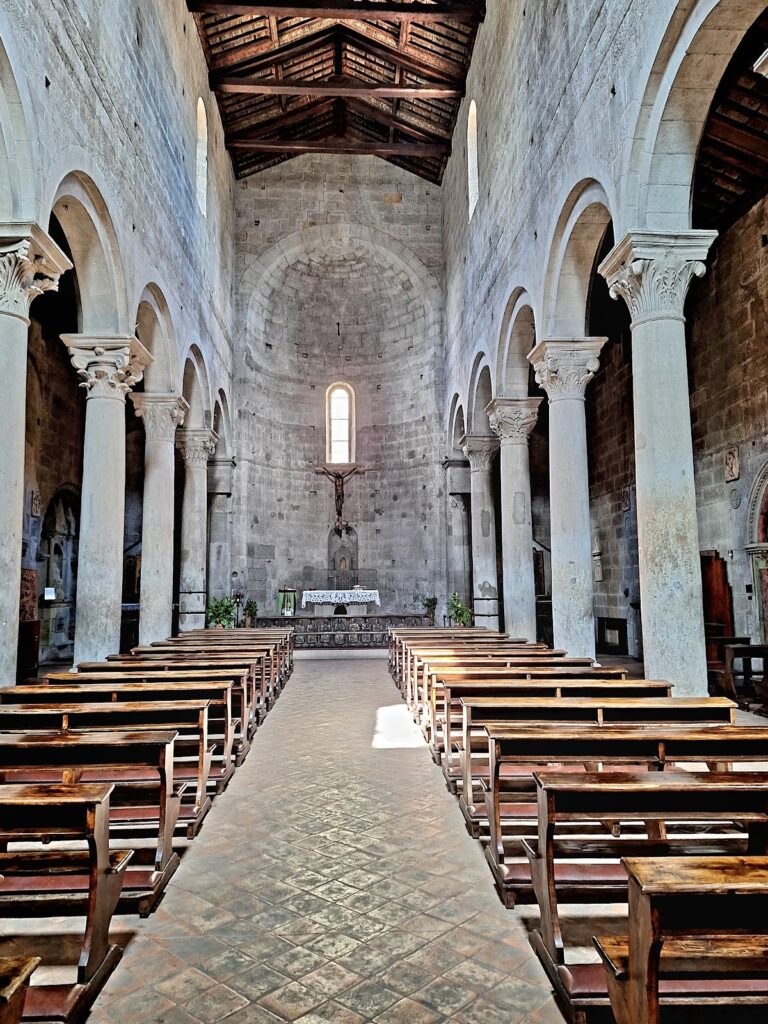
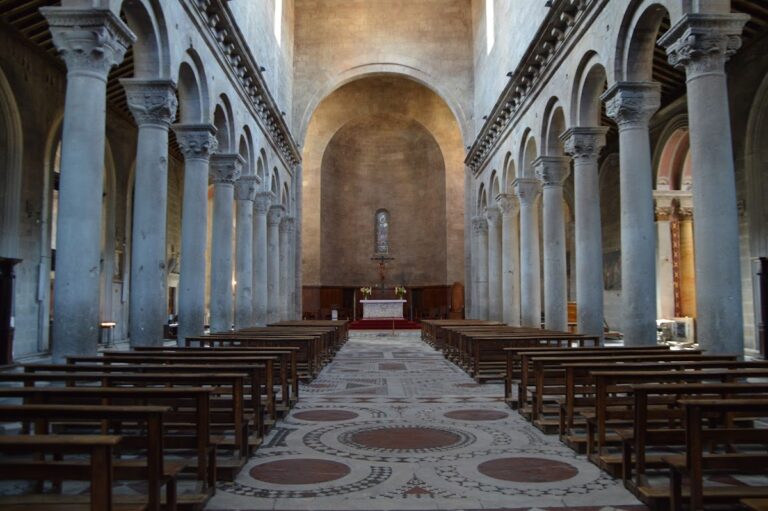
San Silvestro is a compact Romanesque church at the intersection of Via dei Pellegrini and Piazza del Gesù. Its simple stone exterior, sail-like bell gable, medieval sculpture, later frescoes, and interior works preserve evidence of the building’s long religious history.
Facade and exterior sculpture
The flat stone facade ends in a sail-like bell gable, a wall rising above the roofline with openings for bells. Above the portal is a damaged sixteenth-century fresco of the Madonna with two saints. The facade also carries the IHS Christogram inside a sun, positioned above a narrow window, and a frescoed semicircular tympanum, the curved field above a doorway. Three stones beneath the monogram represent mountains.
Two medieval Romanesque lions stand along the roofline. They functioned as Viterbese symbols and were associated with the coat of arms of the Ghibelline Tignosi family. The Ghibellines supported imperial authority in medieval Italian political conflicts and were often opposed to the papacy and its allies.
Apse and interior artworks
The small apse has a dome frescoed in 1540 with Noli me tangere, the biblical scene in which the risen Christ appears to Mary Magdalene. The scene lies between Saint Andrew and Saint Sylvester and is surmounted by an image of God the Father among the celestial choir. The presbytery, the part of the church reserved for the clergy around the main altar, contains a seventeenth-century wooden crucifix reportedly transferred from Santa Maria Nuova.
San Silvestro also retains remains of a fifteenth-century fresco showing Saint John the Baptist and Saint John the Evangelist. Enzo Mattioli created a mosaic in 1981 depicting the murder of Henry of Almain, bringing the church’s best-known medieval event into its modern interior decoration.
Piazza and adjoining features
A hospital stood beside the church. In front of the facade, the Fountain of the Gesù in the piazza was assembled from pieces of a fountain formerly located in a Dominican convent. Across the piazza stands the medieval Torre di Borgognone.