Feistritz Castle: A Medieval Hilltop Fortress in Austria


Site at a Glance
- Rating
- 4.8
- Popularity
- Very Low
- Country
- Austria
- Primary era
- Medieval
- Eras represented
- Medieval, Early Modern, Modern
- Civilizations
- Duchy of Austria, Habsburg, Holy Roman Empire
- Site type
- Military
- Remains
- Castle
On this page12 sections
History
Feistritz Castle is a medieval hilltop castle in Austria above Feistritz am Wechsel, generally dated to the twelfth century, when ministerials probably erected its earliest stone fortifications in the Romanesque period. Ministerials were dependent nobles who served rulers and powerful lords as administrators and military retainers. The castle formed part of a defensive system intended to protect the region from invasions arriving from the east, particularly from Hungary.
Medieval origins and early lords
The first reliable reference to the settlement around Feistritz dates to 1170. In that year, Gerhard von Gleissenfeld transferred a farm at Wüstritz to Admont Abbey, a Benedictine monastery in Styria. This record establishes activity in the surrounding settlement but does not by itself provide a firm construction date for the castle.
From the beginning of the fourteenth century, Feistritz was held by the Pottendorf family and administered through custodians. After the death of the last male member of the family, the castle passed by marriage to Christian IV von Zinzendorf. The Zinzendorf family retained it until 1537 and carried out a major reconstruction that modernized the fortifications.
Ottoman attacks and early modern rebuilding
Feistritz resisted three Ottoman sieges, in 1485, during the Ottoman advance connected with the First Siege of Vienna in 1529, and during the Second Siege of Vienna in 1683. The two sieges of Vienna were major Ottoman campaigns against the Habsburg capital, placing fortified sites in the surrounding region within a wider military setting.
In 1537, the castle passed to Christoph Rabenessel von Schönegg, a nobleman from southern Styria. Ten years later it became the property of the von Rottal family, who held it for almost a century and a half. In 1681, ownership passed to the von Pergen family. After 1685, the new owners undertook extensive rebuilding, altering the entrance and adding defensive and residential elements.
From aristocratic residence to museum
During the Napoleonic Wars, fought across Europe between 1796 and 1815, Feistritz changed owners several times. Joseph, Baron Dietrich von Dietrichsberg, acquired the castle in 1815, and it remained a residence of his descendants for approximately the following century. The complex declined during the second half of the nineteenth century, and a substantial part of its art collection was sold.
After 1815, the castle was remodeled according to Romantic ideals. Romanticism was a nineteenth-century movement that often idealized the medieval past and encouraged historically inspired architectural restoration. Under Joseph Dietrich, the buildings were also repaired and restored in a Romanesque style.
Maximilian Mautner purchased Feistritz in 1922 and commissioned the architect Marischka to carry out a comprehensive reconstruction. Completed between 1922 and 1924, the work sought to recreate the historic complex closely, using a 1672 engraving by Georg Matthäus Fischer and other older representations as models. Mautner converted the castle into a military museum with a large collection of historic weapons and documents. Most of these exhibits later entered the holdings of Vienna’s Heeresgeschichtliches Museum, the Austrian military-history museum.
War, occupation, and continued use
After the Nazi seizure of power in Austria in 1938, Mautner fled to the United States. The castle first came under temporary municipal administration and was later sold to Ernst Mahle and Reinhard Turnwald. During the Second World War and the subsequent Soviet occupation, the complex stood in the Red Army occupation zone. The Red Army was the armed force of the Soviet Union. The castle was not destroyed or looted and included a mess for Soviet officers. The Austrian owners recovered the property in 1955.
The Reichhold family has owned Feistritz since 1965. After 1960, the complex was adapted as a conference center and is used for seminars, conferences, celebrations, and hotel accommodation. The entire castle complex is privately owned and protected as a state monument.
Remains
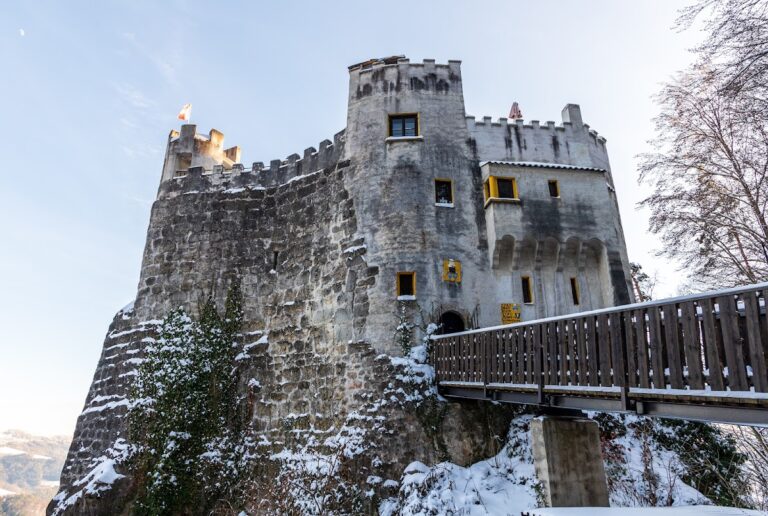
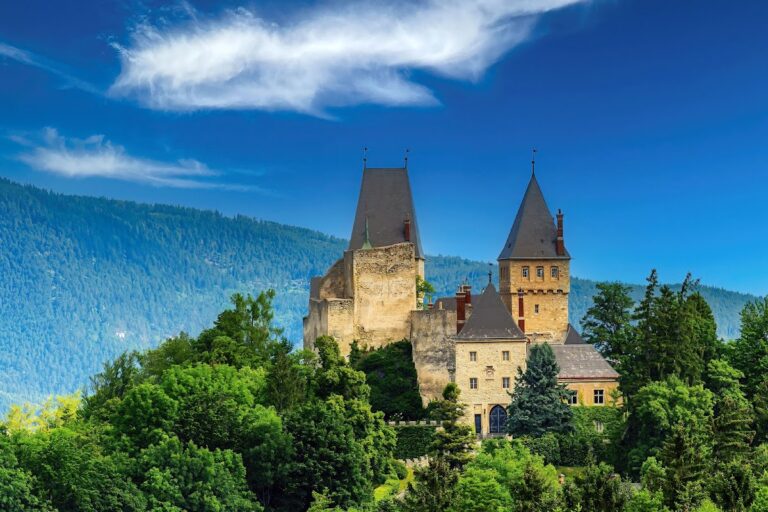
Feistritz Castle occupies a hilltop above the settlement. Its elongated, narrow enclosure forms an irregular rectangle aligned broadly from north to south. A continuous high ring wall, meaning an enclosing defensive wall, surrounds the complex. The buildings are constructed of stone and brick and combine Romanesque, late-Gothic, early modern, and reconstructed elements.
Enclosure and defensive works
Ring wall and towers
The Romanesque residential palace occupies the northern short side of the enclosure. A square-based keep projects externally toward the northeast and is partly separated from the surrounding structure by masonry. A keep is a strongly fortified tower that could serve as both a defensive and residential center.
The Hunger Tower and the southern palace were added at a later stage. The southern buildings date from no earlier than around 1500 and belong to a substantial late-Gothic rebuilding phase. Three round corner towers from this rebuilding survive, while the main tower retains its square ground plan.
Western entrance
Before the rebuilding that followed 1685, the principal entrance lay on the eastern side. It was later moved to the west, where builders constructed a gate tower and drawbridge. A gate tower protects an entrance, while a drawbridge can be raised to restrict access.
Residential and commemorative features
Residential wings
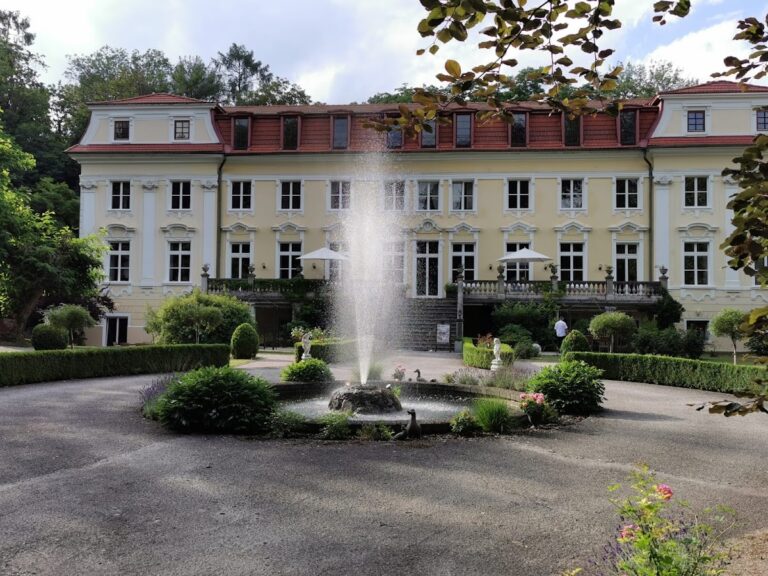
A multistory wing stands outside the northwestern section of the ring wall and has three large dormer windows. The northern wing also contained a space for a palace theater, and a park was laid out beyond the castle.
Rottal family tombstones
More than a dozen stone tombstones belonging to members of the von Rottal family survive around the castle complex. They preserve a material connection with the family that owned Feistritz from 1547 for almost a century and a half.
The restored complex remains in use, with rooms for conferences, seminars, celebrations, and guest accommodation. Two additional manor houses nearby provide further lodging.