Ruinen Thernberg: The Ruins of Thernberg Castle and Palace in Austria


Site at a Glance
- Rating
- 3.9
- Popularity
- Very Low
- Country
- Austria
- Primary era
- Medieval
- Eras represented
- Medieval, Early Modern, Modern
- Civilizations
- Habsburg, Holy Roman Empire
- Site type
- Military
- Remains
- Castle
On this page8 sections
History
Ruinen Thernberg is the ruin of Thernberg Castle and its neighboring palace in Austria. The castle stands among Lower Austria’s oldest fortified residences, with construction probably dating to the first quarter of the thirteenth century. Both the castle and palace belonged to the Lordship of Thernberg, a territorial estate whose holder exercised specified rights of administration and jurisdiction.
Early records and the medieval castle
The Thernberg family appears in records before the castle itself. Emerich de Terrenberch is named in a court record from 1108, while Rapoto of Thernberg appears in a document issued by Reichersberg Abbey in 1150. The family was related to the Lords of Pitten. The castle was first recorded in 1227, and later research has rejected the earlier idea that it originated as a continuously occupied castle of the eleventh century. Its construction instead probably belongs to the first quarter of the 1200s.
In 1310, Ulrich and Nikolaus of Thernberg sold the castle, then their free property, to Duke Friedrich. The site later served as a place of confinement. Konrad Vorlauf, mayor of Vienna, was held there in 1408 and released after a ransom was paid. In 1412, the castle was granted as a fief, meaning property bestowed by a superior in return for service or allegiance, to Hertnid of Pottendorf. When the Pottendorf family died out, the holding returned to the territorial ruler and became available for pledging again.
Renaissance residence and changing military role
Around 1510, Thernberg came into the possession of Wolfgang I Thonradl. The castle was allegedly used for a time as a refuge by the robber captain Franz Magusch. Under Wolfgang I Thonradl, it was renovated and adapted more fully for residential use. In 1587, it was designated as a refuge for people from the surrounding area.
During the seventeenth century, the castle’s military importance declined. The Thonradl family retained the property despite being proscribed as Protestants. After the childless marriage of Baron Georg Christoph von Thonradl and Sidonia Elisabeth, the widowed Sidonia Elisabeth sold the heavily indebted estate to Johann Paul von Pleyern in 1679.
The palace and Archduke Johann
Wilhelm, Count of Wurmbrand, owned the property from 1707 to 1712. Ownership then passed to Franz Wilderich von Mensshengen, who remodeled the castle and built a Baroque palace nearby. Baroque was a seventeenth- and eighteenth-century European style known for dramatic forms and elaborate decoration.
Joseph, Count of Pergen, who also owned nearby Seebenstein Castle, acquired Thernberg Castle and Palace in 1791. Archduke Johann acquired the Lordship of Thernberg in 1807. An archduke was a high-ranking member of the Habsburg dynasty, the ruling family associated with the Austrian hereditary lands. Archduke Johann withdrew to Thernberg after falling out of favor with his brother, Emperor Franz I, because of his liberal views.
Archduke Johann renovated the palace to accommodate his important art collection. The collection later formed the foundation of the Joanneum in Graz, a major museum and cultural institution founded from his holdings. His library was also transferred there, while a chemical laboratory was established at Thernberg. He returned to Styria in 1822 and sold the lordship in 1828 to Johann I, Prince of Liechtenstein.
Neglect and decline
The Liechtenstein family retained the property until 1916 but never lived there. The palace and the already ruined castle consequently received less care. The palace remained inhabited until 1938 and was temporarily used as a children’s home. After the Second World War, it too increasingly fell into decay, leaving the castle and palace as a connected but endangered historic complex.
Remains
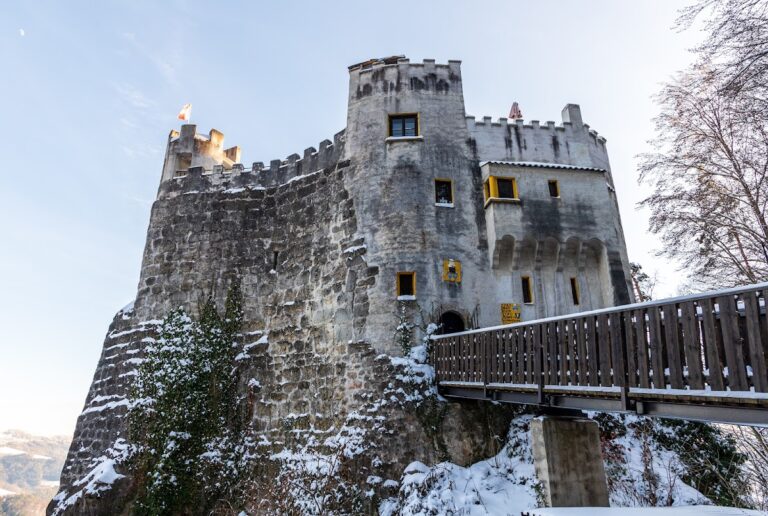
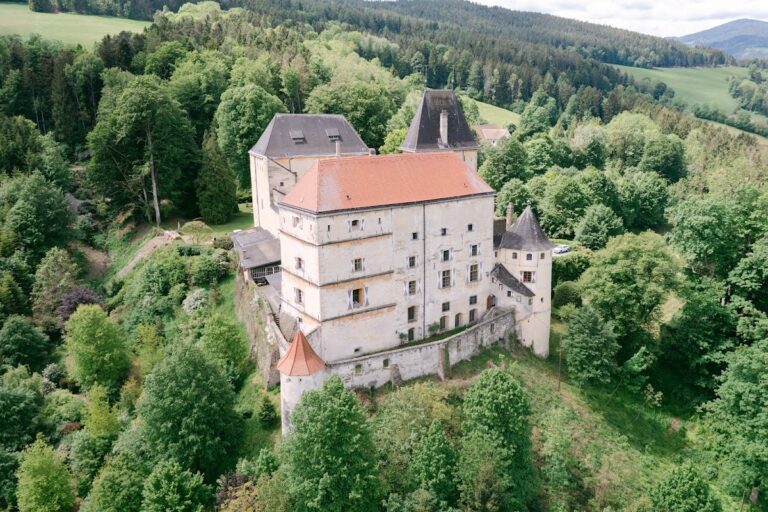
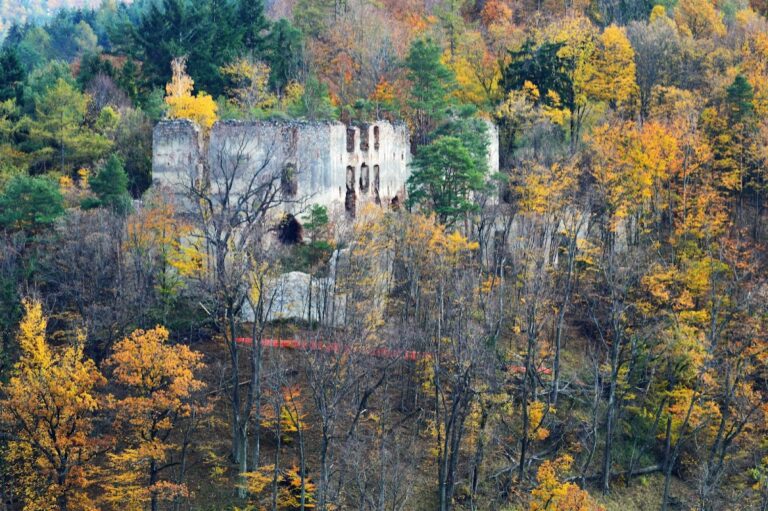
The hilltop complex lies southeast of Thernberg, slightly above the road to Lichtenegg. An old castle wall encloses the site, which contains the medieval castle ruin and the palace built beside it. The terrain is heavily overgrown, and the building ruins are at risk of collapse. The surviving structures therefore form a fragile historic landscape rather than an intact residence.
Castle ruins
The castle occupies the elevated part of the enclosed complex. Its keep, the principal fortified tower of a medieval castle and often both a residence and final defensive position, was converted into a lookout point during Archduke Johann’s ownership. The surviving castle fabric reflects the site’s medieval origins, later residential remodeling, and long decline. The ruins remain within the old wall and are physically connected with the grounds of the adjacent palace.
Palace and grounds
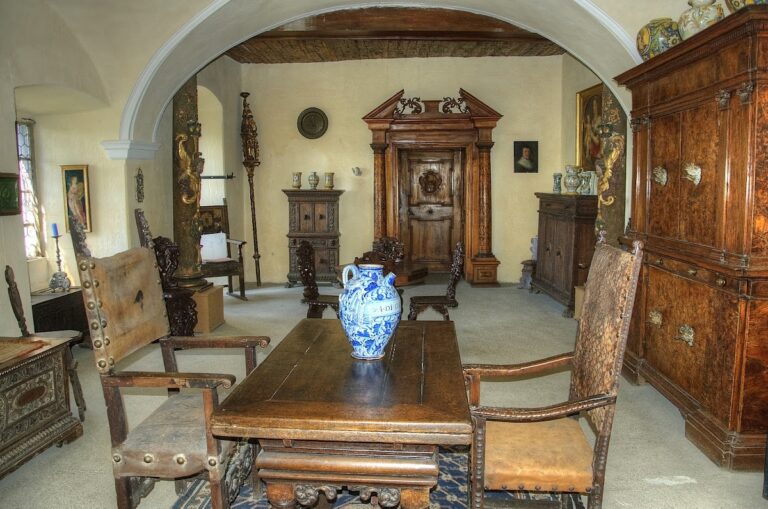
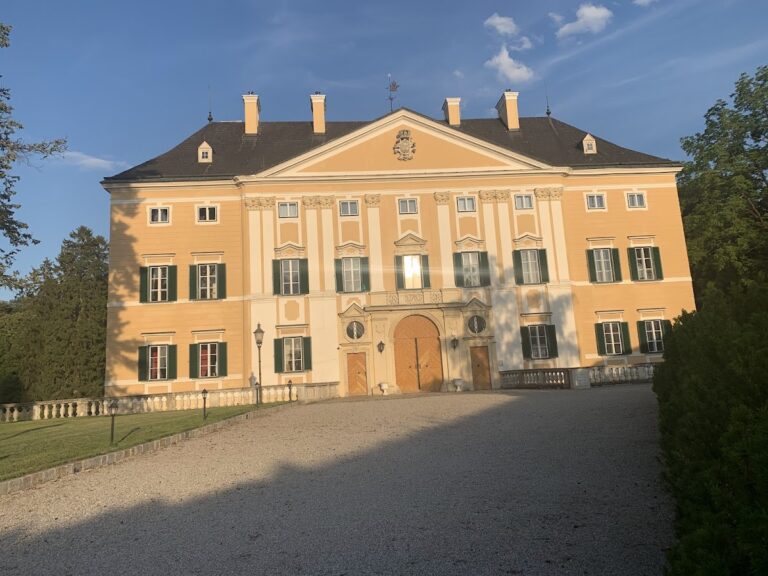
Franz Wilderich von Mensshengen built the palace near the castle, and Archduke Johann later remodeled it for his collections and research. Its large hall contained paintings by Karl Ruß depicting the history of the Habsburgs. Rooms housed Archduke Johann’s art collection and library, while a chemical laboratory occupied another part of the residence.
A landscape garden surrounded the palace, with waterfalls and exotic plants forming part of its designed setting. The palace itself later deteriorated, particularly after the Second World War, when the building increasingly fell into decay along with the castle ruins.
Nearby sites