Fayaz Tepe: A Kushan Buddhist Archaeological Complex in Uzbekistan
Site at a Glance
- Rating
- 4.6
- Popularity
- Very Low
- Country
- Uzbekistan
- Primary era
- Classical
- External website
- Open
- Eras represented
- Classical
- Civilizations
- Kushan
- Site type
- Religious
- Remains
- Monastery
On this page11 sections
History
Fayaz Tepe is a Buddhist archaeological complex in Uzbekistan, near the ruins of Old Termez in the Termez oasis. Its foundations date to the first century CE, and the site developed during the Kushan period, an era when the Kushan Empire controlled much of Central Asia and northern South Asia and supported Buddhist institutions and art. Fayaz Tepe lies in the ancient Bactrian region, a cultural crossroads centered on the upper Oxus River and extending across parts of present-day Uzbekistan, Afghanistan, and neighboring lands.
The Kushan period
Activity at Fayaz Tepe reached its height in the third and fourth centuries CE. The complex functioned as a Buddhist religious and educational center, with a temple, monastic quarters, and supporting buildings. Inscriptions from the Kushan and Kushano-Sasanian periods are associated with Fayaz Tepe and the nearby Kara Tepe Buddhist complex. One inscription names the Kushan ruler Huvishka, while two coins of Kanishka and one coin of Vasudeva connect the temple with successive phases of Kushan rule. Kanishka is especially associated with the expansion of the empire and Buddhist patronage; Huvishka and Vasudeva belonged to later phases of Kushan power.
Decline and reuse
The complex declined sharply around the fifth century, probably in connection with a Kushano-Sasanian invasion. The Sasanians ruled the Iranian Empire from the third to the seventh century CE, and their invasions left Fayaz Tepe in ruins. During the fifth and sixth centuries, Ephthalites, a Central Asian power also known as the Hephthalites or White Huns, used the temple ruins as a hut. The site was completely destroyed during the Arab invasion and later became buried beneath shifting sands.
Rediscovery and investigation
In 1968, Absadom Beknaev discovered an alabaster Buddha sculpture in the dunes surrounding Fayaz Tepe. The sculpture was transferred to the local history museum, and L. I. Albaum studied the find between 1968 and 1976. Once the sand dunes had been cleared, architectural investigation began. The complex yielded numerous Buddhist frescoes, wall paintings executed on plaster, and reliefs, which are images modeled or carved to project from a surface. Many of the recovered works are now held by the State Museum of History of Uzbekistan in Tashkent. The site is about 15 kilometers west of Termez and approximately 1 kilometer northeast of the Kara Tepe Buddhist complex, near the Al-Hakim al-Tirmidhi area.
Remains
Layout and construction
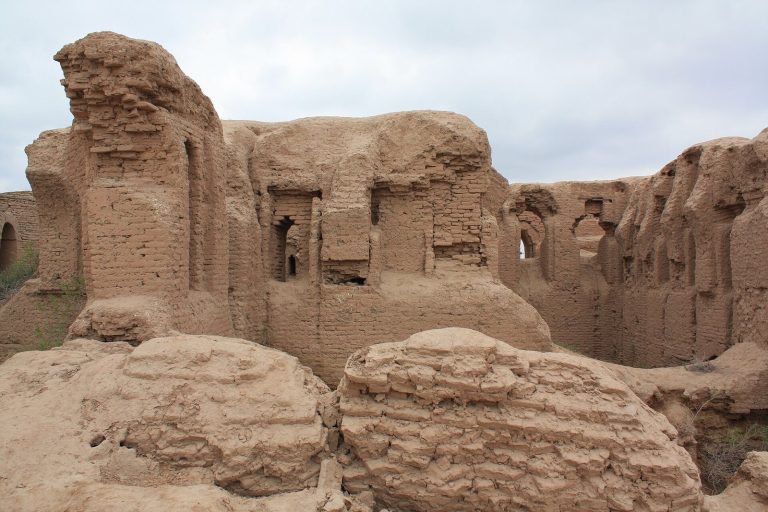
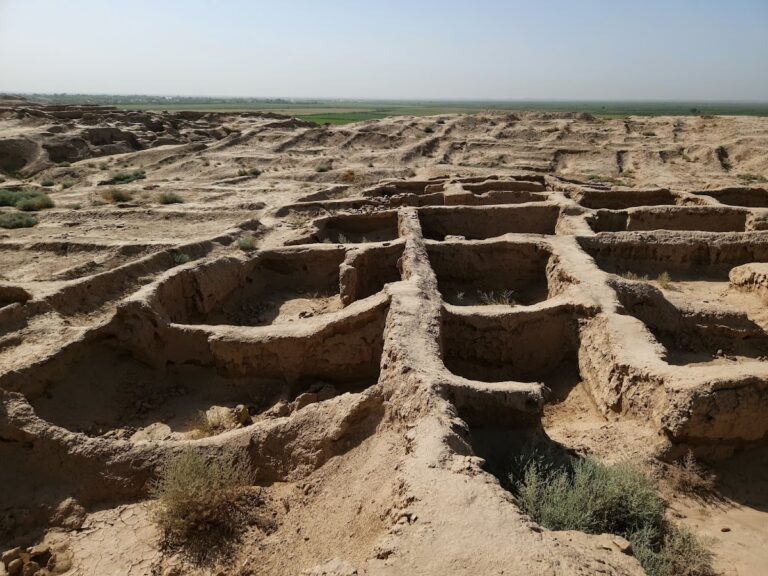
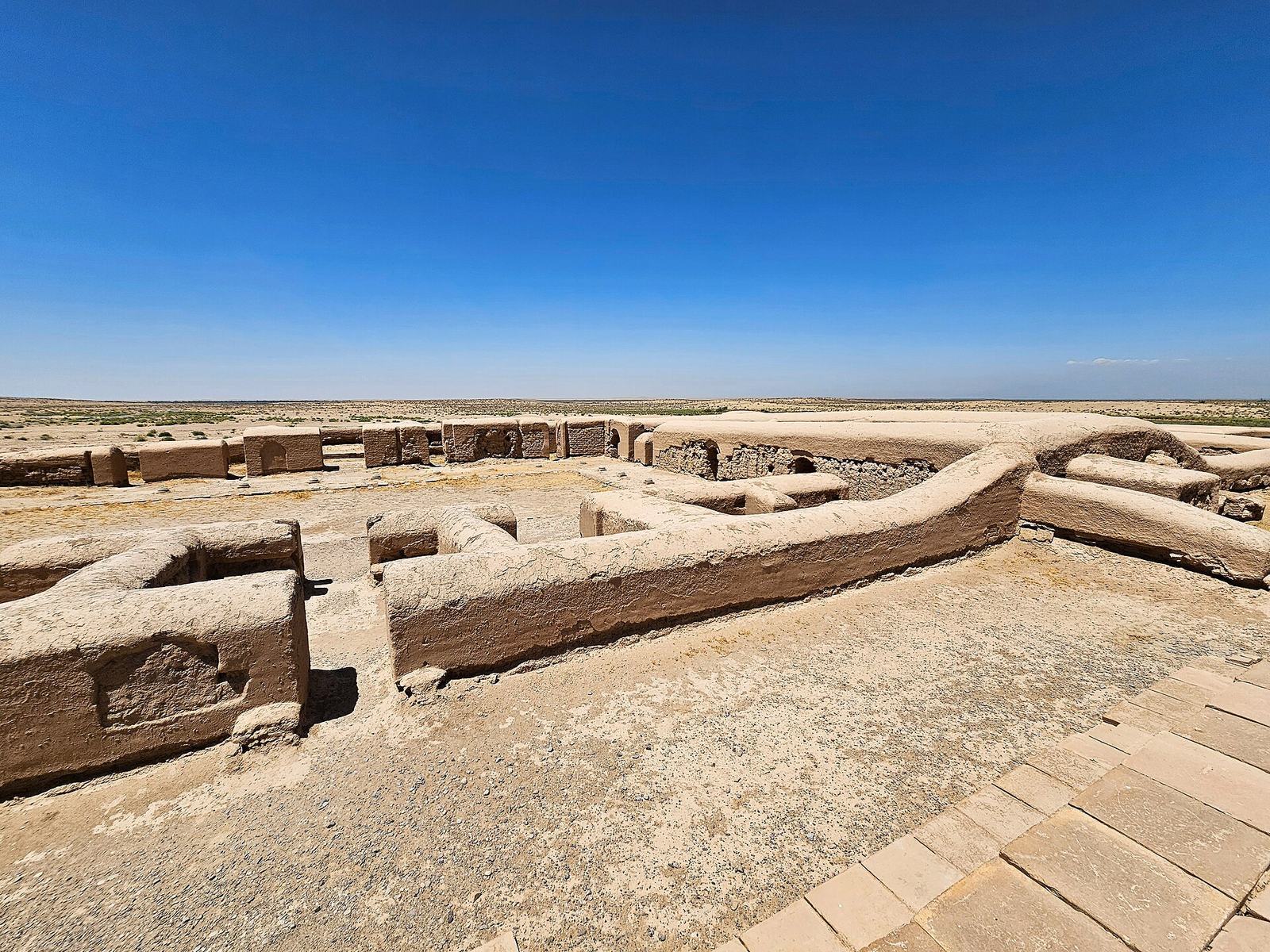
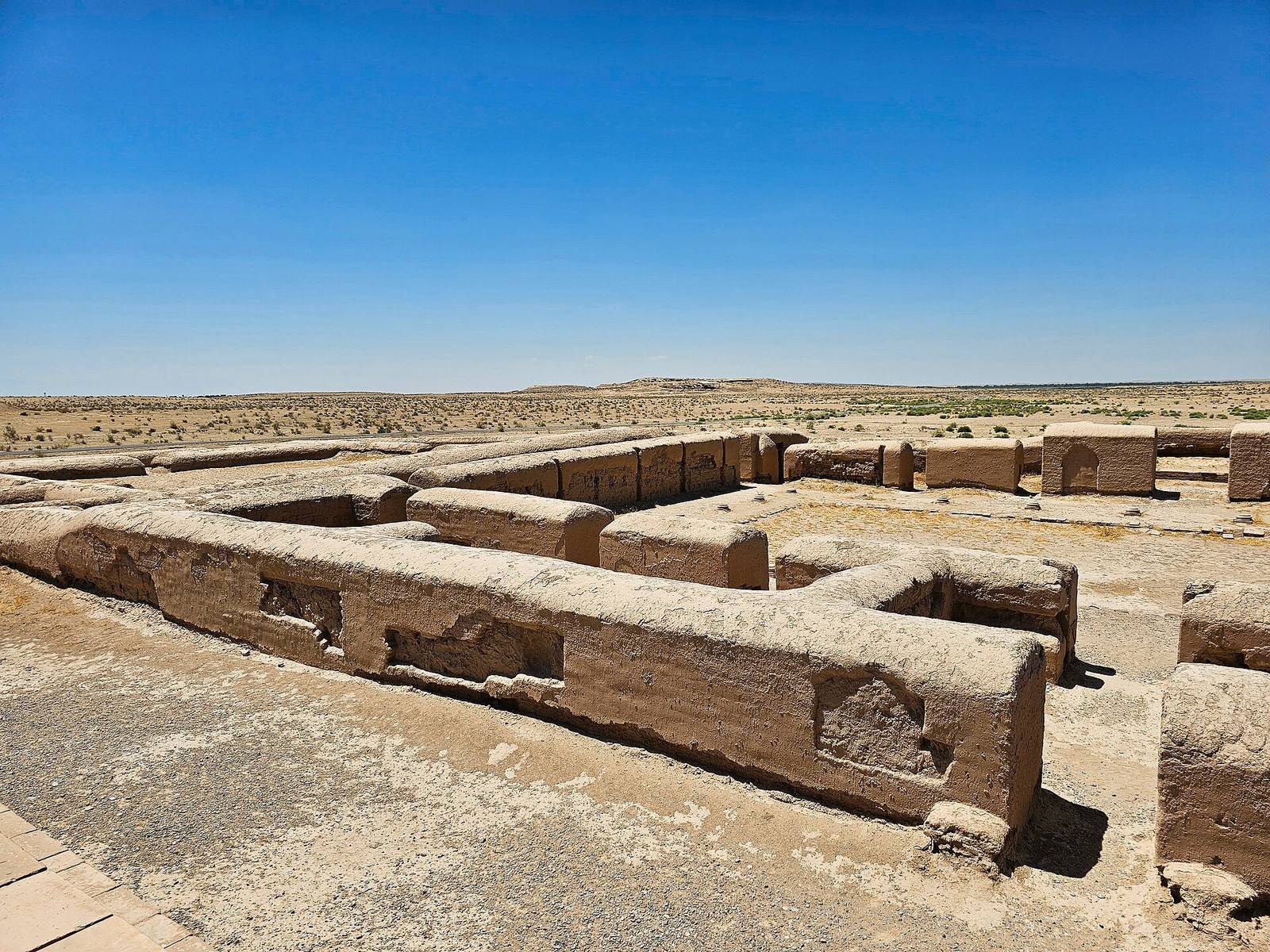
Fayaz Tepe covers approximately 1.5 square kilometers and is arranged in three monumental sectors. A temple occupied the central area, a monastery stood to the northwest, and utility buildings lay to the southeast. The complex also included a stupa, a Buddhist monument associated with relics, commemoration, and ritual practice. Unlike a centrally placed stupa, this one stood outside the main area, parallel to the sacred altar. A path made of brick and stone crossed the square and connected these features.
Central temple
Shrine and sculptures
The southern part of the temple contained an image of Buddha in red robes. Two long-robed figures stood beside him, their shoulders marked by buckles, and one was shown bowing to Buddha. Traces of paintings survived on the eastern wall of the shrine. Clay fragments from an interior room include human faces and a fragment measuring 60 by 80 centimeters that shows two men facing and worshipping a Bactrian Buddha. The imagery presents Buddha as an object of worship within the temple.
The same room contained many gypsum fragments from statues. A pedestal along its eastern wall was made from fired brick and covered evenly with stone fragments. Many statues used a mixture of clay and straw beneath an outer gypsum coating. Heads were formed separately in molds, while hands and feet were made independently and attached to the bodies. The upper portion of an alabaster Buddha, with gathered black hair framing the face, is an especially notable example and the first known example of this type of finish in Kushan-period art.
Courtyard and water feature
The temple courtyard has a regular quadrilateral plan measuring 33 by 20 meters. Doors to rooms for monks open onto all four sides. A large continuous hall occupied the courtyard, with multicolored paintings surviving on its lower walls, and a stupa stood beside it. In the courtyard’s northwest part, a small trapezoidal pond was constructed from marble fragments. Its base had a water outlet shaped like an open lion’s mouth. The water was intended for drinking, while the lion motif, associated with Kushan-period art, represented a strong and powerful Buddha.
Monastery
A doorway connected the monastery to the temple courtyard. Its rooms accommodated monks and students, while classrooms and offices also served as dormitories for pilgrims. Shelves built into the walls held wick-burning lanterns, and some rooms had pedestals for Buddha statues along their walls.
Artistic remains
A well-known niche showing Buddha with two monks dates to the third or fourth century CE. Other recovered works include a group of courtiers, a seated Buddha, a horned devotee possibly reflecting a Kushano-Sasanian motif, a miniature vessel, pottery bearing an Indian inscription, and an image of a sun deity. Murals also show men wearing caftans and boots and a horned deity. A rare marble triad carved from one block depicts Buddha seated on the branches of the sacred bodhi tree, the tree associated with his enlightenment, with two monks worshipping him at either side.