Fanum de Pupillin: A Gallo-Roman Temple in France
Site at a Glance
- Popularity
- Very Low
- Country
- France
- Primary era
- Classical
- Eras represented
- Classical
- Civilizations
- Roman
- Site type
- Religious
- Remains
- Temple
On this page10 sections
History
Fanum de Pupillin is a pagan Gallo-Roman temple in Pupillin, France. A fanum was a type of temple in Roman-era Gaul, where Roman rule and local Gallic traditions shaped the culture. The sanctuary comprised two partially overlapping temples built in succession, the first in the first century CE and the second in the second century CE. It stood in Germania Superior, a Roman province associated with the upper Rhine region.
Discovery and archaeological investigation
Alphonse Guichard, a local priest and archaeologist, found the temple in woodland near Pupillin in the late nineteenth century while excavating a Gallo-Roman villa between 1887 and 1890. Its position overlooking the Jura plain led him initially to consider it a lookout post or Roman watchtower. Coins from the reign of Augustus, Rome’s first emperor, who ruled from 27 BCE to 14 CE, point to the earlier temple’s date; second-century coins are associated with the later building.
After Guichard’s work, the site fell into neglect and its location was gradually forgotten. Mathieu later rediscovered it after noticing three walls that still rose clearly above ground. Jean-Louis Odouze led excavations from 1969 to 1975 and identified the two temples. Since Guichard had already dug around a hollowed stone he thought was a sarcophagus, Odouze concentrated on the surrounding building.
A further excavation campaign in 1985 and 1986 examined the eastern terrace, deposits on the slope and the temple’s access routes, while also addressing restoration and presentation. The ruins have been listed as a historic monument since 2 November 1987.
Remains
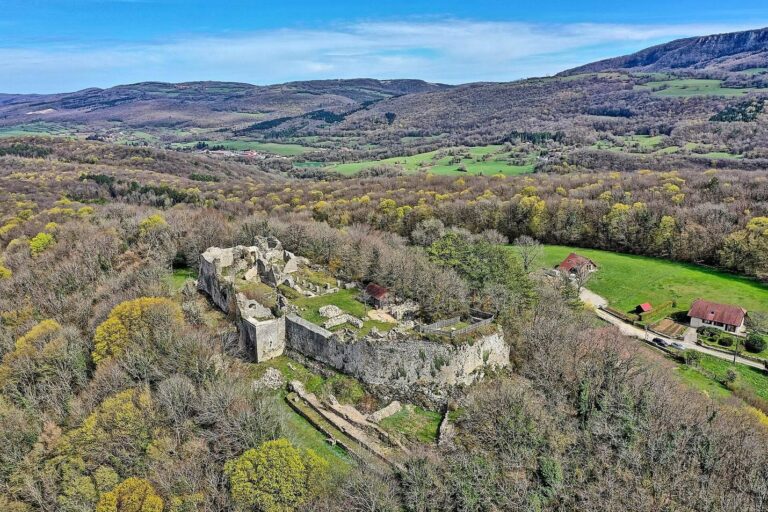
The remains occupy woodland about 540 m above sea level, on the western edge of the Jura massif along the flank of the Lons-le-Saunier plateau. They overlook the Arbois vineyards and lie about 1.5 km south-southwest of Pupillin and 2 km east of Buvilly. The temple complex was built on loose slope debris over limestone and marl associated with the Lias and Dogger, subdivisions of the Jurassic Period. The ground block lies between a southwest-to-northeast fault several hundred metres to the east and a second, presumed fault beneath the slope debris to the west.
Temple buildings
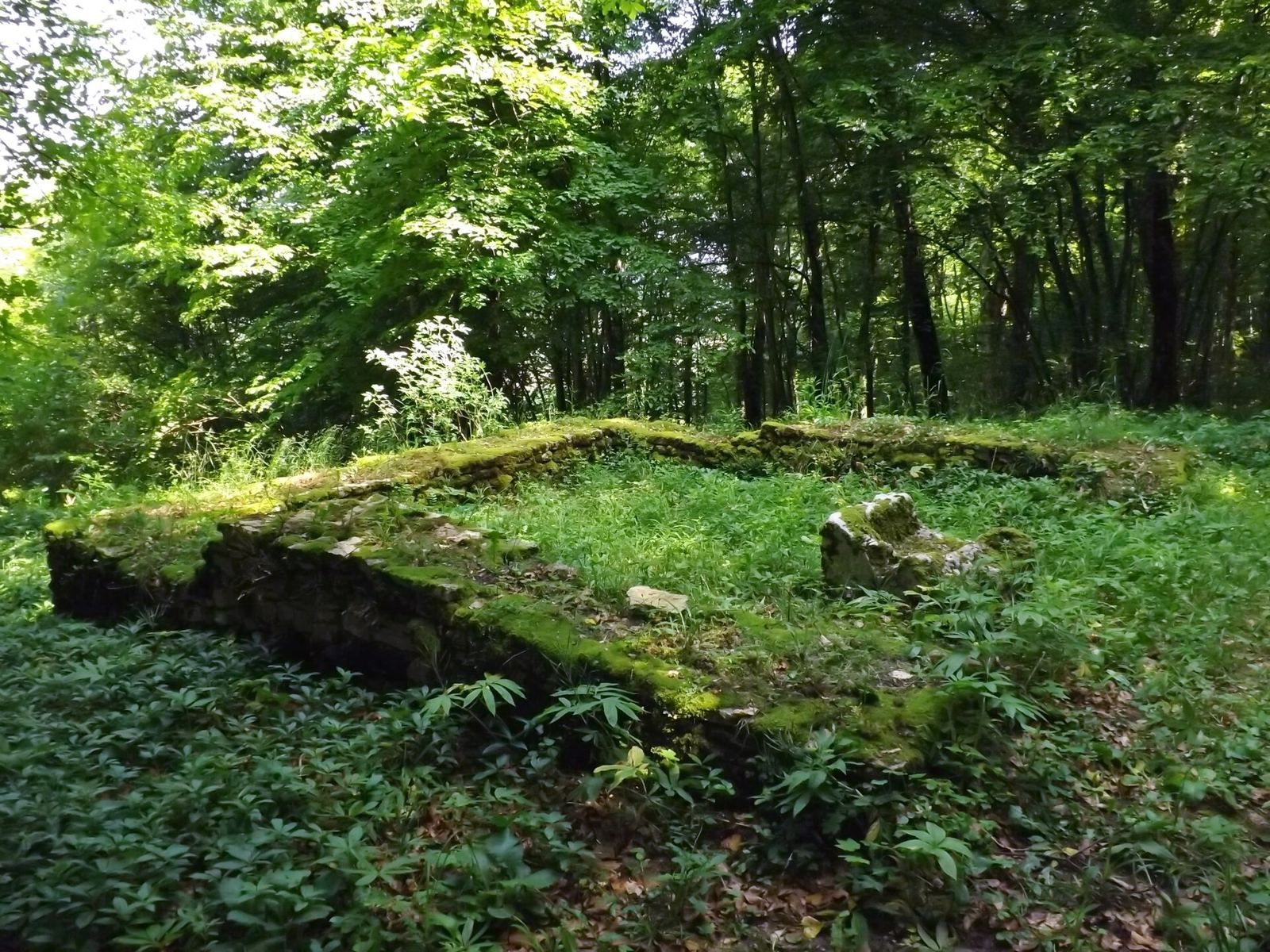
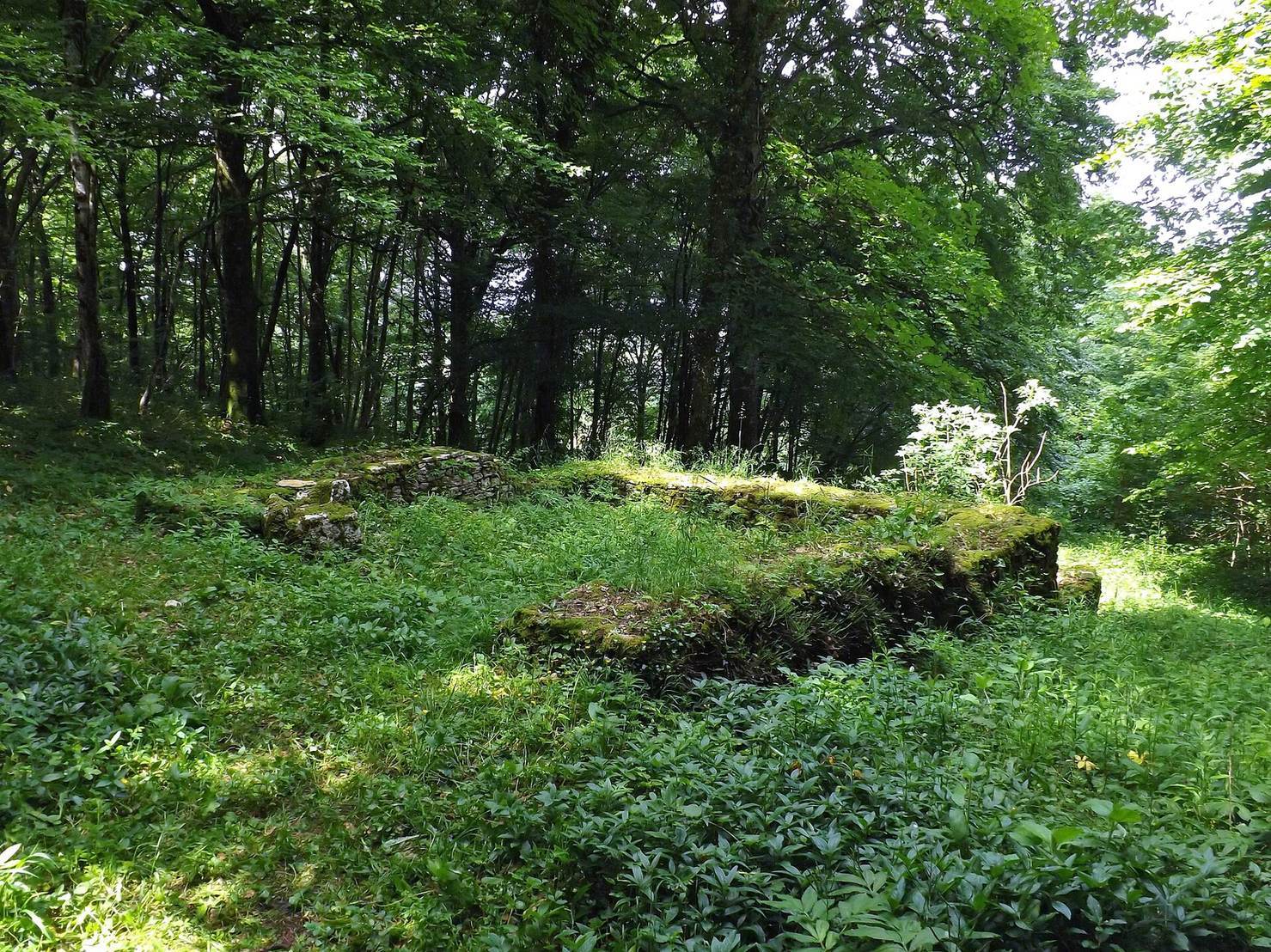
The two square temples partly overlapped and followed a similar general arrangement, with an enclosed central shrine room and an outer gallery. Masonry and dry-stone walls, together with evidence for wooden supports, indicate how the buildings were constructed.
Earlier temple
The central shrine room of the earlier temple measured 7 m on each side and had masonry walls. Its surrounding gallery had dry-stone walls, which suggest that wooden posts supported it.
Later temple
Smaller than the first building, the later temple reused some of its walls. Its square shrine room measured 5.4 m on each side. A trench dug in the late nineteenth century badly disturbed its remains. The building had a tiled roof; wooden gallery posts probably rested on a low timber sill supported by a dry-stone wall, helping carry the roof frame. A posthole in the north gallery is thought to relate to the temple’s construction, while numerous nails suggest that the east gallery may also have had a wooden structure.
Terrace and archaeological finds
Eastern terrace
A terrace measuring 6 by 18 m was cut into bedrock about 5.5 m east of the temples to reduce the slope. Its floor was covered with stones and heavily crushed roof tiles.
Hollowed stone
A hollowed stone within the temple remains measures 35 by 30 cm and is 20 cm deep. A fastening on one side suggests that it had a lid, supporting its interpretation as an offering chest rather than a sarcophagus, as Guichard first believed.
Other finds
Guichard recovered several hundred coins and small bells, which he interpreted as lamp snuffers. Finds from near the temples also include an iron knife 19 cm long and a weight probably used as a plumb bob.