Prajou-Menhir Gallery Grave: A Late Neolithic Tomb in France
Site at a Glance
- Popularity
- Low
- Country
- France
- Primary era
- Stone Age
- Eras represented
- Stone Age
- Civilizations
- Unclassified
- Site type
- Burial
- Remains
- Tomb
On this page12 sections
History
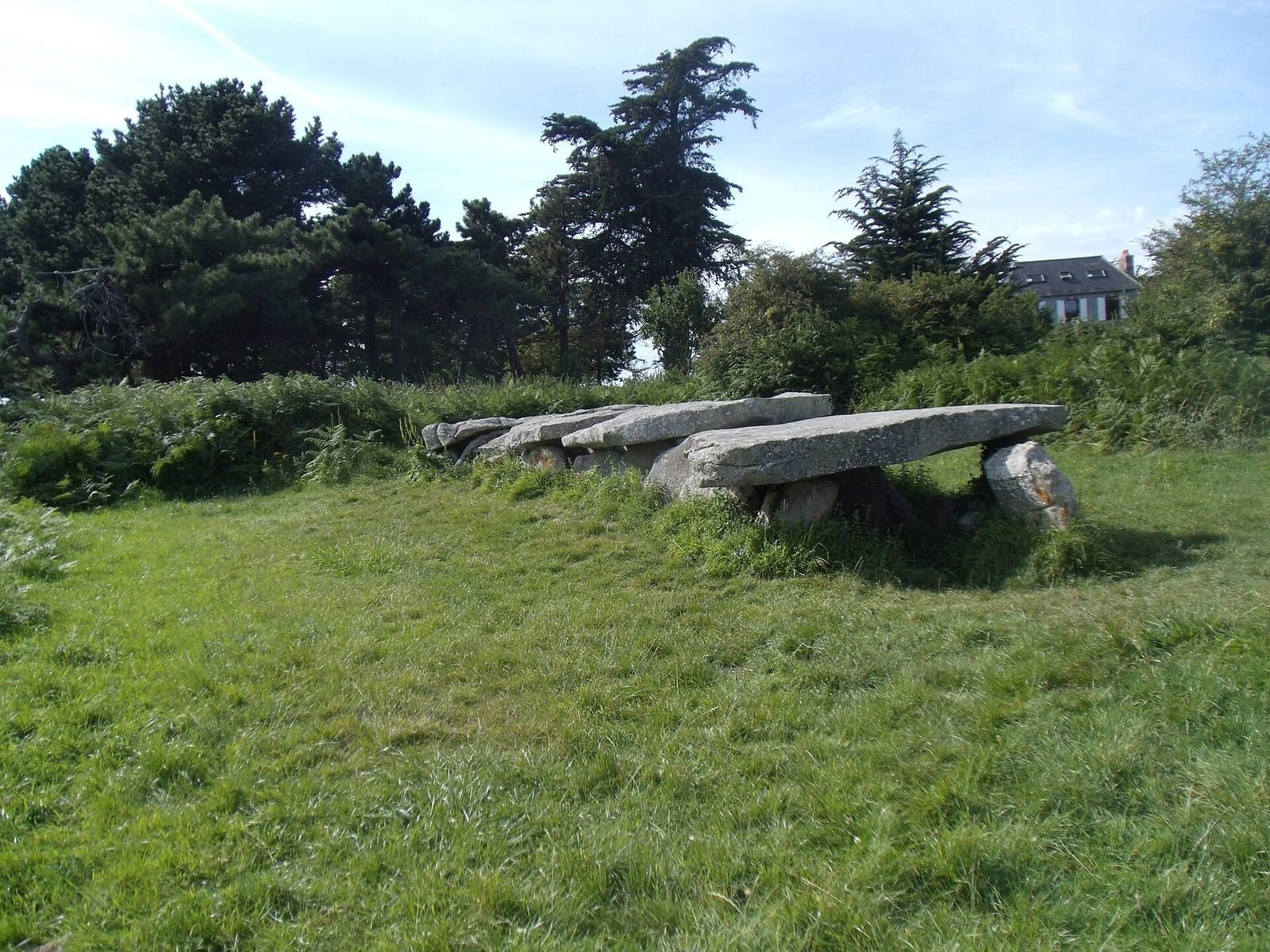
The Prajou-Menhir gallery grave, a long megalithic tomb with a covered chamber, is a Late Neolithic burial monument at Trébeurden in Brittany, France. Its precise date remains uncertain: pottery and decoration suggest about 2100 ±100 BCE, while bottles with projecting collars around their necks may point to a date 200–300 years earlier.
Most of the pottery is associated with the Seine-Oise-Marne culture, a prehistoric tradition of northern France, supporting an attribution to the Final Neolithic, the closing phase of the Neolithic. The grave goods also indicate a clear Nordic influence. Neolithic communities along this coast used natural resources alongside farming and animal husbandry, fishing, gathering seaweed and shellfish, and making salt from seawater on the beach. France classified the monument as a historic monument, a legal heritage-protection designation, in 1956. Archaeological investigation took place in 1965, followed by restoration.
Remains
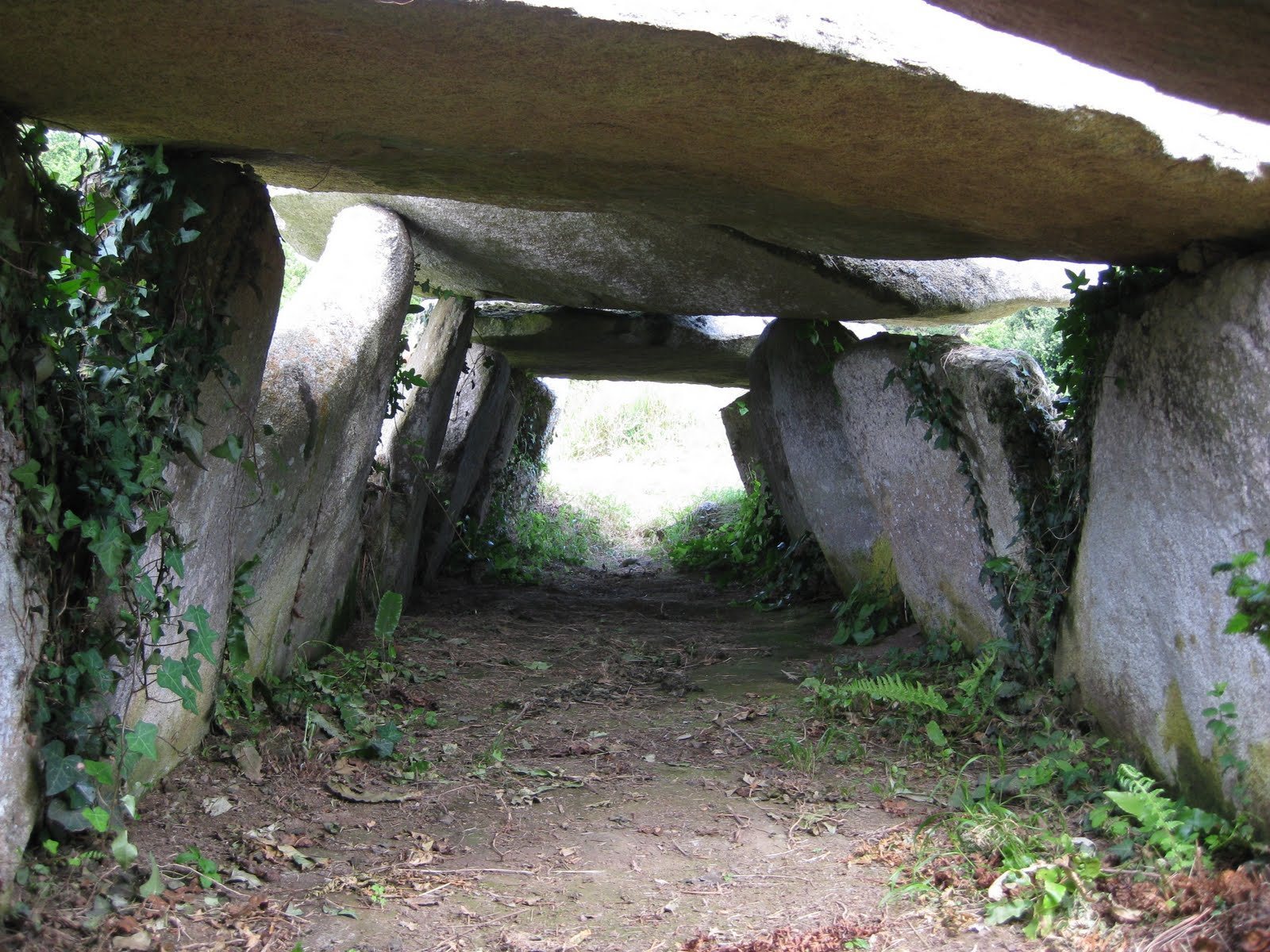
The grave stands on a gentle slope on a peninsula southeast of the tidal island of Île Grande. Its long axis runs east–west. The monument measures about 12–13 m long and 2 m wide, with an interior height averaging 1.8 m, and survives nearly complete.
Plan and construction
Entrance and vestibule
The entrance is at the eastern end and is oriented at 105 degrees from north. A passage 0.60 m wide leads to a vestibule measuring 1.75 m by 1.80 m. A crosswise stone divides the vestibule from the main chamber, with an opening about 1 m wide on its southern side.
Main chamber
The main chamber is 9.5 m long and 2 m wide. Parallel rows of upright stones form its sides, with nine along the south and ten along the north, and a large slab closes the western end. Three substantial roof slabs cover the chamber. One is a replacement for the carved original and bears traces of stone-cutting; another slopes south, while the third is broken in two. The original carved slab is now in the National Archaeology Museum at Saint-Germain-en-Laye.
Terminal cell
Beyond the western end slab is a smaller, trapezoidal cell, with its walls roughly in line with those of the main chamber. Two massive roof slabs cover it. Across the whole monument, seven stones serve as covers, including two especially large stones at the eastern entrance.
Carved decoration
Main chamber carvings
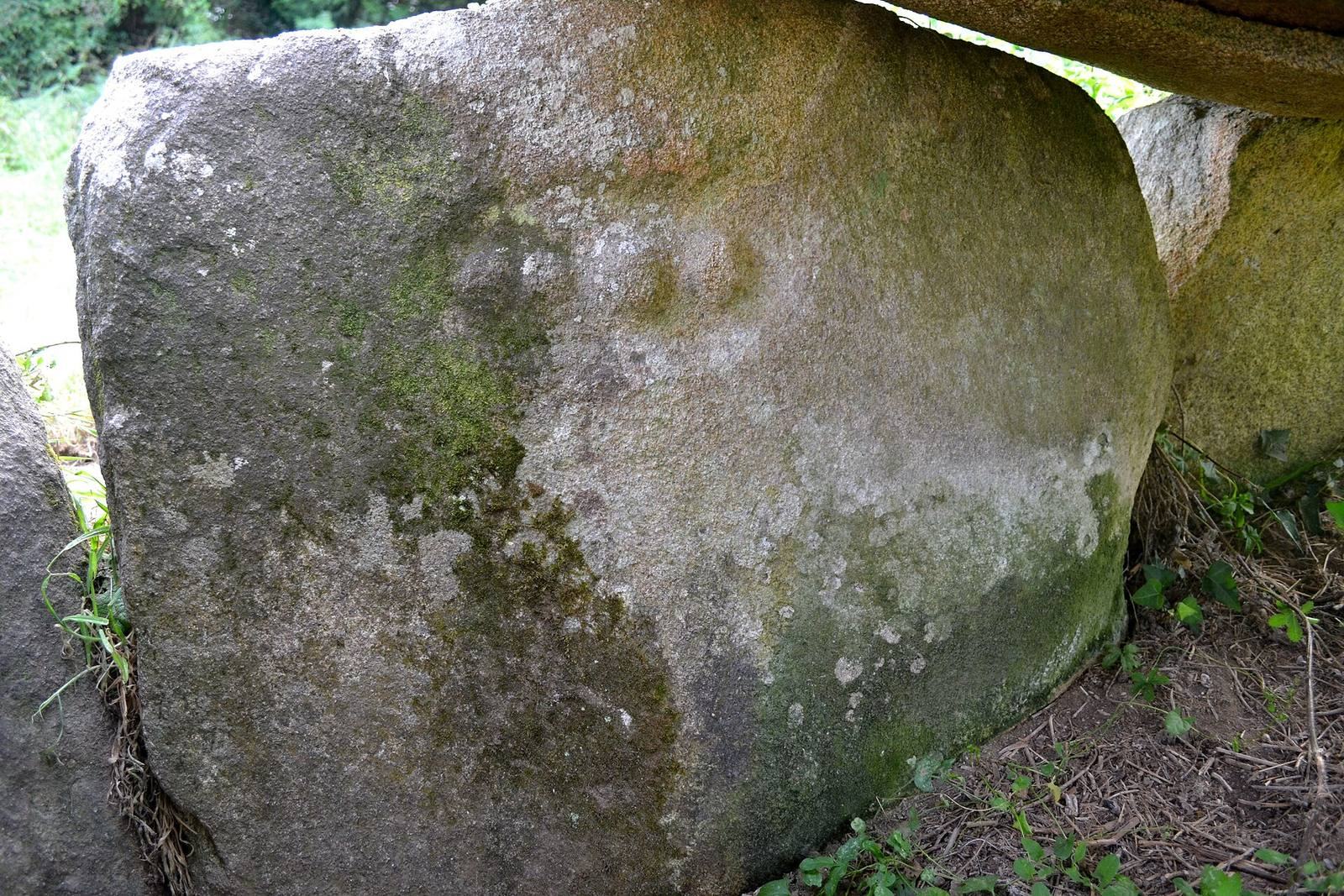
Three upright stones in the main chamber have sculpted pairs of breasts on their inward-facing surfaces. Two stand opposite one another near the rear, just before the end slab.
Terminal-cell carvings
Four stones in the terminal cell carry decoration, including the reverse side of the end slab. A southern stone bears two adjacent pairs of breasts within an oval recessed border. Across from it, a northern stone has a square-like design, 420 mm across, with rounded corners and an extension that turns at a right angle. Small cup-shaped hollows, averaging 15 mm in diameter, trace the square’s inner edges, with two more at the base of the extension. The design has been interpreted as a schematic figure, with the hollows representing breasts and the extension a neck and head turned at a right angle.
Another northern stone shows a sculpted pair of breasts above an engraved necklace, with a 700 mm spear point carved above a hollow. The end slab carries a large panel with two square figures, one topped by a headless projection and the other by a crook-shaped one, along with two more spear points. The decoration also includes three raised pairs of breasts with necklaces below them, one pair smaller than the others. Some weapon-like signs have been interpreted as daggers or funerary biers.
Archaeologist Jean L’Helgouach interpreted the repeated, orderly carvings as evidence that the terminal cell served as a sanctuary. The breast forms have also been understood as images of a mother goddess, perhaps connected with protection of the dead. The square figures are the only known examples of their kind among covered gallery graves, and the repeated use of cup-shaped hollows as decoration is unusual. The spear-point designs have parallels at Mougau-Bihan and have been compared with Cypriot spearheads with long extensions for fastening them to shafts. Breast-pair carvings are comparable to those at La Maison des Fées at Tressé; the breast-and-necklace design has a parallel at Crec’h Quillié. Related motifs also occur at Kergüntuil, Mougau-Bihan, and La Bellée.
Finds and associated standing stone
Excavated objects
Excavations yielded two arrowheads with broad cutting edges set crosswise to their shafts, a flint scraper, several pebble tools with bevelled ends, and a circular quartz bead. Most of the pottery consists of undecorated, roughly made, flat-bottomed vessels with coarse inclusions and poor firing. Other sherds date to the Bronze Age, medieval, and modern periods. Two intact bottles with projecting collars around their necks were also found; comparable vessels occur at the covered gallery graves of Kergüntuil and Mélus.
Menhir
A menhir, or large upright standing stone, stands 14 m east of the grave entrance, aligned with the tomb’s northern wall. Excavation revealed its installation pit and small packing stones. The stone is 2.20 m high overall, with 0.80 m below ground; it measures 2 m across at the base and 1 m at the top. It has been interpreted as a marker for the tomb.