Fanefjord Church: A Medieval Parish Church on Møn


Site at a Glance
- Rating
- 4.6
- Popularity
- Low
- Country
- Denmark
- Primary era
- Medieval
- External website
- Open
- Eras represented
- Medieval, Early Modern
- Civilizations
- Danish
- Site type
- Religious
- Remains
- Church
On this page8 sections
History
Fanefjord Church is a Church of Denmark parish church in Denmark, located on the island of Møn. Its original nave dates from the second half of the thirteenth century, and the building was later enlarged in the Late Gothic period. The church is historically important for its medieval and around-1500 frescoes, its preserved interior, and its connection with the coastal community around Fanefjord.
Medieval foundation and enlargement
When the original nave was built, the parish had only about 300 inhabitants. Its unusually large scale may reflect substantial trade through Fanefjord with ports of the Hanseatic League, a medieval commercial network linking towns and merchants around the North and Baltic Seas. Merchants may have supported the construction with money and labor, although the surviving evidence does not establish the precise extent of their contribution.
The church was probably vaulted from an early stage, and cross vaults were added to the nave around 1300. After 1500, the building was extended in the Late Gothic style. This phase included the construction or addition of the western tower and northern porch, as well as changes to the windows and other parts of the church. The original choir was narrower than the present one, and its position remains identifiable east of the triumphal arch. It was later replaced, with the current choir generally dated to around 1660.
Ownership and recovery of the paintings
In 1825, the Klintholm Estate purchased Fanefjord Church and retained ownership for almost a century. The church’s wall paintings had been covered with plaster after the Reformation. They were rediscovered by the early twentieth century, and campaigns between 1929 and 1934 brought them back into view. Work carried out from 1932 to 1934 took place under the guidance of the National Museum. A further restoration in 2008–2009, completed in 2009, recovered much of the paintings’ original colour and visual effect.
Churchyard and later associations
The churchyard contains the graves of several notable figures. They include Johan Paludan (1756–1821), a writer, journalist, editor, and priest; Bent Barfoed (1920–2007), a film director, producer, and animator; Eva Gredal (1927–1995), a politician; Henning Christiansen (1932–2008), a composer, professor, and artist; and Kaj Otto Gredal (1925–1992), a civil servant.
Several hundred metres south of the church stands Grønsalen, an unusually long barrow measuring nearly 100 metres. Local tradition identifies it as the burial place of Queen Fane and her husband Grøn Jæger, who folklore held to have lived about 4,000 years ago.
Remains
Building and setting
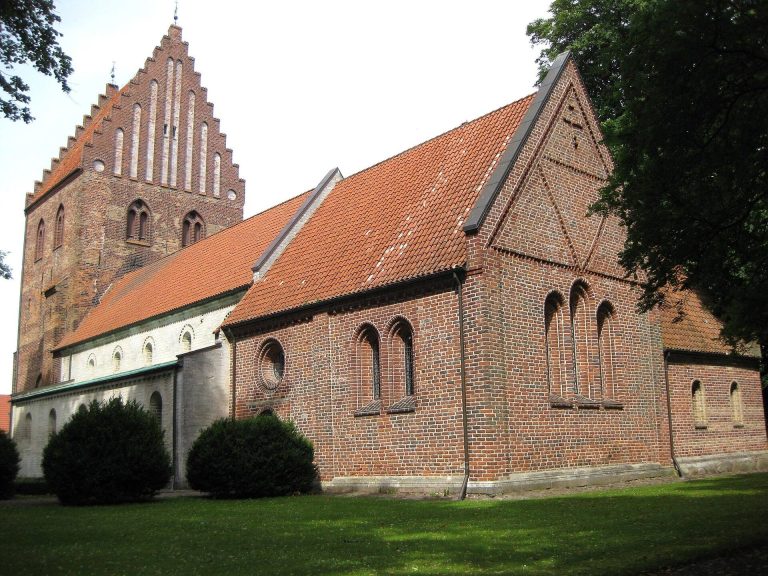
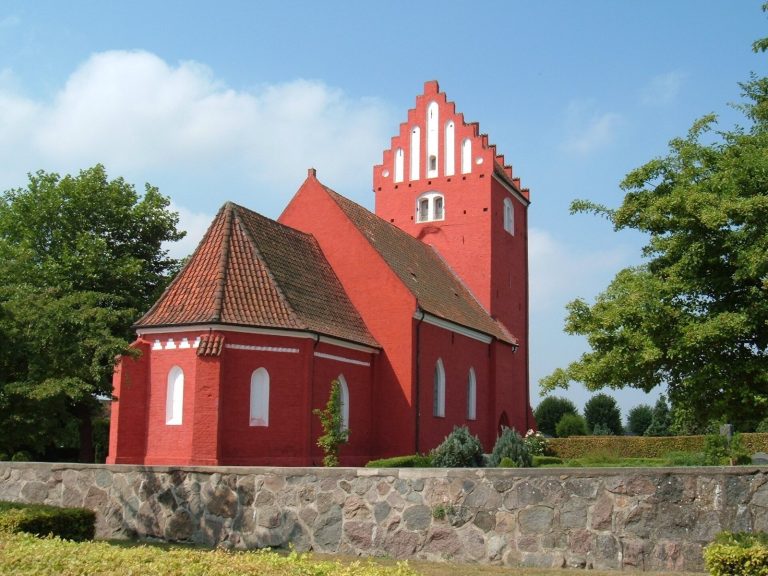
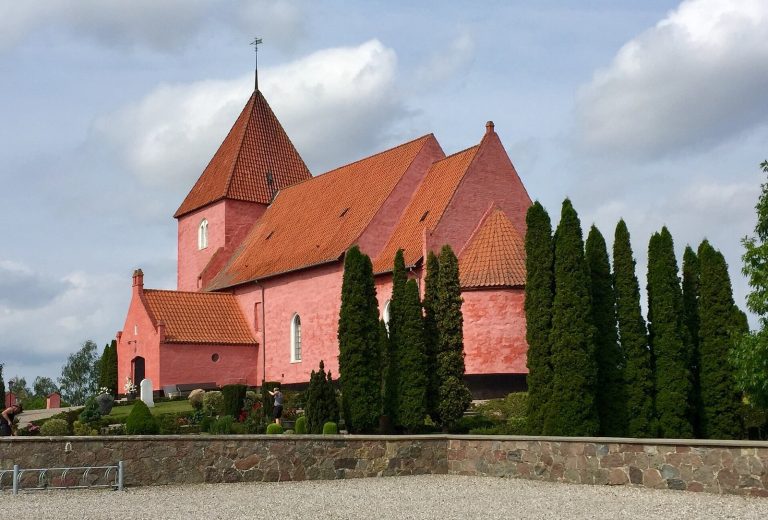
Fanefjord Church is a brick building standing on a small hill in an open setting between Store Damme and Hårbølle, overlooking the Baltic Sea inlet of Fanefjord. Its whitewashed exterior walls and red-tiled roofs can be seen from considerable distances. The building comprises a nave, a western tower, a northern porch, and a choir. The nave has a side wall approximately seven metres high, an older western section, and a later eastern section closed on three sides.
Three piers divide the nave into two sections and four bays. Its cross vaults are generally dated to around 1300. The nave and tower have tall, straight stepped gables. The tower rises through three storeys, with two narrow sound openings on each side of its bell stage. The church’s later windows belong to the Late Gothic rebuilding, while an original window survives in the western bay of the northern section.
Medieval frescoes
The earliest surviving frescoes are on the triumphal arch and date from around 1350. They show the symbols of the four evangelists enclosed in circles, together with Saint Christopher and Saint George. The triumphal arch itself separates the nave from the choir, making the paintings part of the visual boundary between the main congregational space and the area associated with the clergy and altar.
A larger cycle from about 1500 covers extensive areas of the vaults, upper walls, and piers. The paintings are associated with the Elmelunde Master, the conventional name for the unidentified painter linked with frescoes at Elmelunde, Fanefjord, and Keldby churches, and with a workshop that may have included several artists. Their scenes draw on the Biblia pauperum, or “Bible of the Poor,” a picture-based Christian teaching tradition, presenting narratives from the Old and New Testaments. The imagery also reflects the Bible, legends, apocryphal writings, Dutch or German picture prints, and other illustrations.
The frescoes use warm colours, including dark red, russet, yellow, green, grey, and black. Their figures commonly have expressionless, sleepy-eyed faces turned to one side while their bodies face forward. Stars, plants, trees, and other ornaments fill the surrounding painted stonework. The paintings appear originally to have extended across the entire church, including the lower walls. Traces remain beneath the present whitewash, while the recovered sections preserve the principal visual effect of the decoration.
Interior furnishings
The choir contains a Late Renaissance retable, a decorated structure placed behind an altar, dating from 1634. It stands with original candlesticks and a new altar. Together, these elements preserve layers of the church’s later interior arrangement within the medieval building.
An ornate pulpit from 1645 bears the emblem of King Christian IV. Its carved figures include Christ, Jacob, Saint Peter, and one of the apostles. The church also has a late Romanesque baptismal font from Gotland with a trefoil-shaped basin, accompanied by a baptismal dish dating from 1956.
A new organ built by Frobenius & Sønner was installed in 1998. It has ten stops, two keyboards, and a pedalboard, adding a modern instrument to an interior that retains medieval paintings and seventeenth-century furnishings.