Tingsted Church: A Romanesque Parish Church in Denmark


Site at a Glance
- Rating
- 4.4
- Popularity
- Very Low
- Country
- Denmark
- Primary era
- Medieval
- External website
- Open
- Eras represented
- Medieval, Early Modern
- Civilizations
- Danish
- Site type
- Religious
- Remains
- Church
On this page8 sections
History
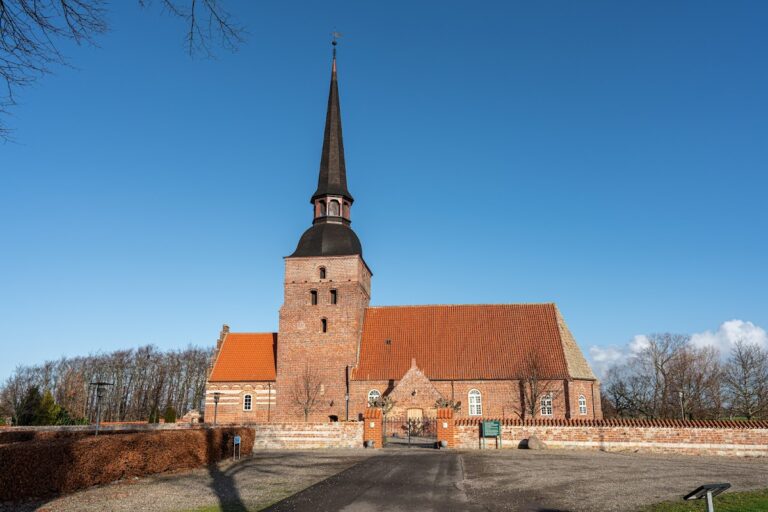
Tingsted Church is a Romanesque church in Tingsted, Denmark, dating from around 1200. Built with a nave, chancel, and apse, it was dedicated to Saint Peter at an early stage and remains part of the Church of Denmark, Denmark’s established Lutheran church. The church stands on Falster and has also been connected with the island’s medieval political and legal life.
Medieval church and civic setting
The name Tingsted implies an early association with local lawmaking. In 1511, Falster’s regional council met in the churchyard. The following year, King Hans presided there over a dispute between his vassal and the bishop. These events place the churchyard within the island’s public and political setting during the late fifteenth and early sixteenth centuries.
In 1329, King Christopher II reached an agreement with Marsk Ludvig Eberstein after Eberstein surrendered at Hammershus, a medieval fortress on Bornholm. Christopher II also made peace that year with Count Johann of Holstein. The agreement with Eberstein involved the marsk, a high military office associated with command of the armed forces, while Johann belonged to the ruling house of Holstein.
Reformation-era and modern religious history
Jacob Christian Lindberg became the parish pastor in January 1844. A Danish theologian and Bible translator, Lindberg worked with Grundtvig, a theologian and pastor who became an influential figure in nineteenth-century religious and educational reform. Their activity connected Tingsted’s parish with wider changes in Danish religious life.
The church’s late-fifteenth-century frescoes were found beneath whitewash in 1877. They are attributed to the Elmelunde Master and his workshop. The Elmelunde Master is the conventional name for an unidentified late-medieval painter whose workshop produced frescoes in Danish churches.
Remains
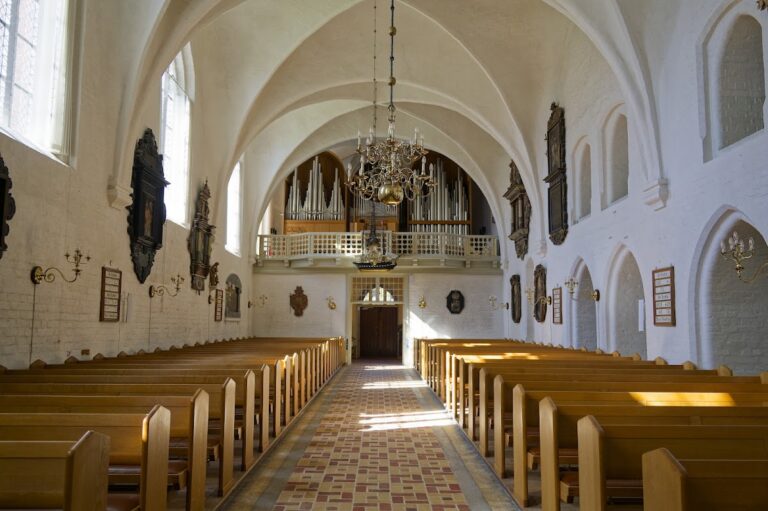
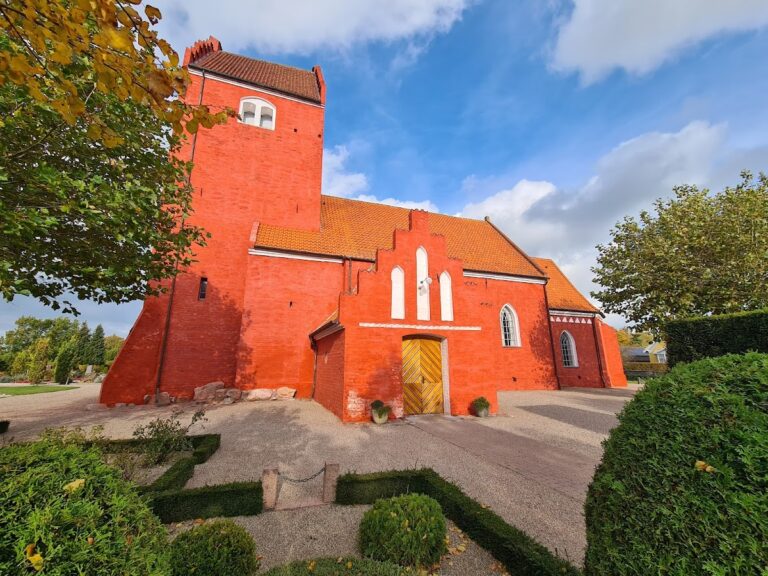
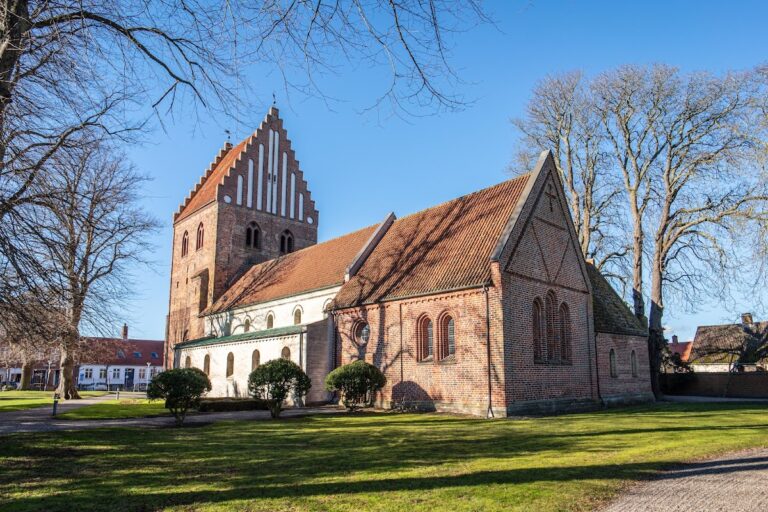
Tingsted Church stands on high ground in the village and is covered with pink plaster. Its original Romanesque structure was built from local fieldstone, with limestone framing around the doors and windows. The surviving building combines this early Romanesque fabric with later Gothic additions. Around 1500, builders added a Late Gothic tower and porch, replaced the nave’s flat ceiling with cross-vaulting, and adapted the windows to the position of the new vaults.
Church fabric
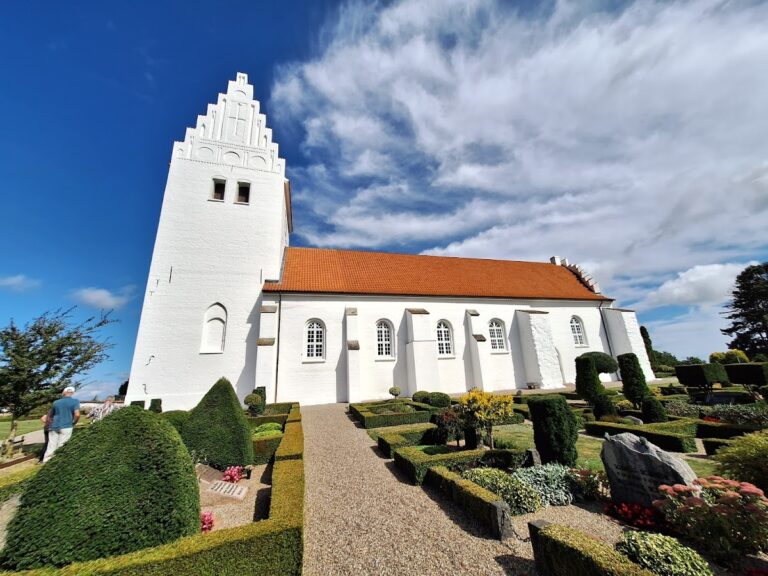
Traces of the original rounded windows remain high in the nave and apse. The apse is the rounded eastern end of the church. The tower probably first had stepped gables before receiving its pyramid-shaped spire. The nave roof is relatively steep, a form thought necessary to accommodate the tops of the intersecting vaulted arches.
Furnishings and painted decoration
Altar and pulpit
The elaborately carved Renaissance altarpiece is dated 1616 and contains a painting of the Last Supper. A seventeenth-century altar panel was made by Antonius Clement, court painter to Queen Sophia. Its three niches contain female figures representing Faith, Hope, and Charity, the three theological virtues in Christian tradition. Slender figures representing Temperance, Justice, Prudence, and Fortitude, the four traditionally recognized cardinal virtues, frame them.
The Baroque pulpit dates from 1633. Jørgen Ringnis made it, and Antonius Clement decorated it with paintings. Its design resembles the pulpit in Kippinge Church. The Romanesque baptismal font has a broad, rounded bowl.
Late-medieval frescoes
Frescoes in the chancel and nave show scenes including Jesus’s baptism, Judas’s suicide, the rich man and the poor man, the Fall, the Expulsion, and the Annunciation. In the scene of the rich man and the poor man, the rich man kneeling before Christ wears a long-tailed hood, a garment associated with affluent people of the period.
Two frescoes present subjects outside the Biblical sequence. One shows the wheel of life, a moralizing image of the rise, rule, decline, and death of worldly power. Its captions, characteristic of the Elmelunde Master, accompany three kings around a cartwheel. The rising king says “I will rule,” the king at the top says “I rule,” and the king on the right says “I have ruled.” Beneath the wheel lies a dead king with folded hands and a banner declaring that he is without a kingdom and that worldly glory passes away. The other non-Biblical fresco depicts the churning of butter.