Iselingen: A Historicist Manor House and Estate in Denmark


Site at a Glance
- Rating
- 4.6
- Popularity
- Very Low
- Country
- Denmark
- Primary era
- Modern
- Eras represented
- Modern
- Civilizations
- Danish
- Site type
- Domestic
- Remains
- Manor House
On this page8 sections
History
Iselingen is a manor house and estate in Denmark near Vordingborg, created in 1774 after the Crown divided the former Vordingborg Cavalry District into 12 estates and sold them at auction. Reinhard Iselin, a Swiss-born merchant, bought the estate, including the ruined former Vordingborg Castle and its tenant farms, and named it Iselingen. He was ennobled as a baron in 1776.
From entailed estate to family trust
After Iselin died in 1781, his widow, Anna Elisabeth Iselin, established Iselingen as an entailed estate for their elder daughter, Marie Margrethe Iselin. An entailed estate was a legally restricted hereditary property that could not be freely sold or divided among heirs. The former castle home farm, Vordingborg Ladegård, was separately made into the Rosenfeldt entailed estate for the younger daughter.
Marie Margrethe Iselin was married to Christian Frederik Ernst Rantzau. Their divorce in 1793 was regarded as highly unusual for the period. In 1802, she began building a new main residence northeast of the old castle ruin. The date of the present main building remains uncertain, since construction of a new building is recorded as beginning in 1802 while the building is also dated to 1792.
The Iselingen entailed estate was dissolved in 1803 and replaced by a family trust, a form of property arrangement tied to a specified succession rather than ordinary sale or inheritance. The estate was sold to ship captain Jens Lind, who transferred it after about a year to district manager H. H. P. Reiersen. Reiersen soon sold Iselingen to a Copenhagen consortium consisting of Just Michael Aagaard, Peder Bech, Iver Qvistgaard, and Hans Wassard. Aagaard became sole owner in 1806.
The Aagaard and Hammerich years
In 1810, Aagaard sold the Marienlyst farm to Hans Wassard and made it an independent manor. Holger Halling Aagaard managed Iselingen from an early stage and inherited it in 1819. He retained ownership until 1866, and the estate gained a reputation as one of the best-managed estates in Denmark.
Iselingen also became associated with an active intellectual circle. Holger Halling Aagaard’s visitors included the Ørsted brothers, Grundtvig, Bertel Thorvaldsen, Adam Oehlenschläger, and Christian Winther. Aagaard’s son Georg, a National Liberal politician and member of the Constituent Assembly that prepared the Danish constitution adopted in 1849, died before his father. Iselingen therefore passed to Holger Aagaard’s son-in-law Martin Hammerich, a scholar of Norse linguistics, culture, and history. Hammerich’s home at the estate became a meeting place for prominent Nordic intellectuals.
Later ownership and alterations
After Martin Hammerich, ownership passed to Anna Hammerich, née Mathea Aagaard, from 1881 to 1905; Johannes Hammerich from 1905 to 1912; Carl Moresco from 1912 to 1918; Th. Wessel from 1918 to 1923; P. Lind from 1923 to 1945; E. Bille-Hansen from 1945 to 1958; and Tove Ahlefeldt-Laurvig from 1958 onward. Niels Otto Hansen acquired Iselingen on 1 January 1997 and is its current owner.
The main building was renovated or adapted between 1869 and 1874 under the supervision of Jens Vilhelm Dahlerup and Fr. Bøttger. Dahlerup was a prominent Danish architect associated especially with large public and institutional buildings in Historicist styles. Historicism was a nineteenth-century approach that drew on and recombined forms associated with earlier historical styles.
Remains
Buildings and grounds
Main building
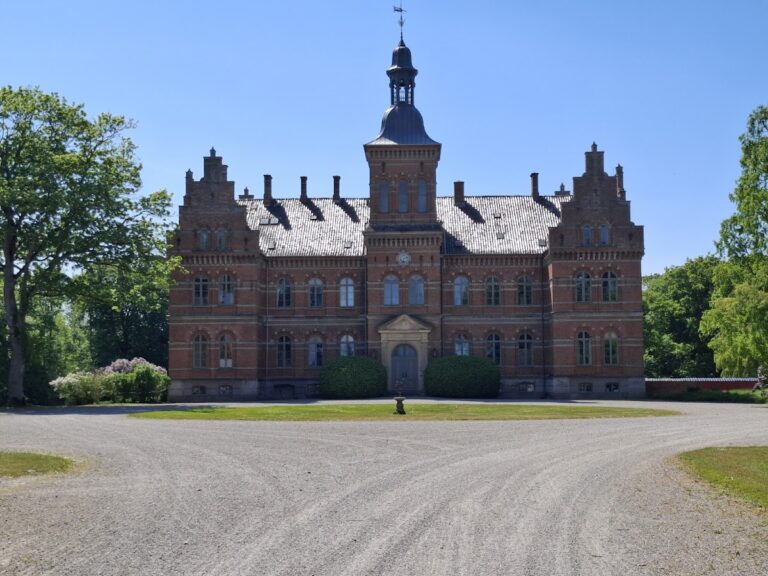
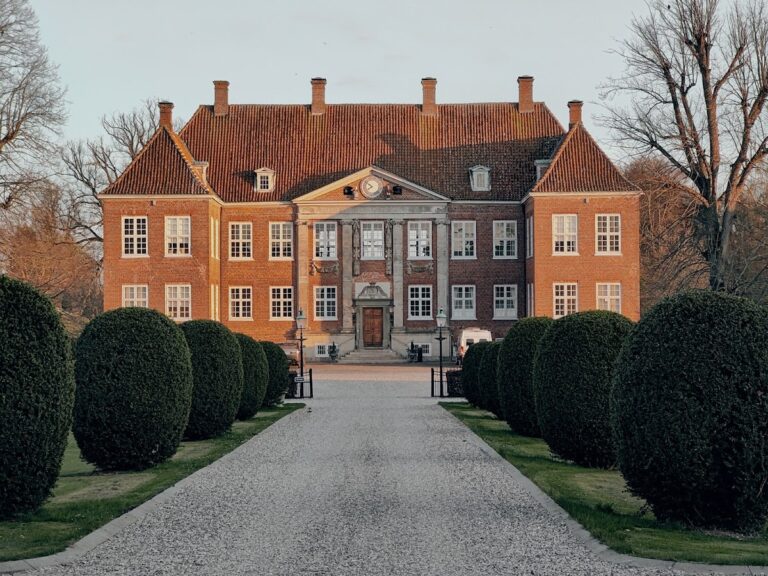
The main building is associated with the Historicist architectural style and was partly constructed using materials taken from the ruins of Vordingborg Castle. It consists of a two-storey main wing flanked by two one-storey side wings. A tower topped by a spire was added in 1920, giving the building an additional vertical feature. Renovations or adaptations carried out between 1869 and 1874 contributed to its present form.
Estate landscape
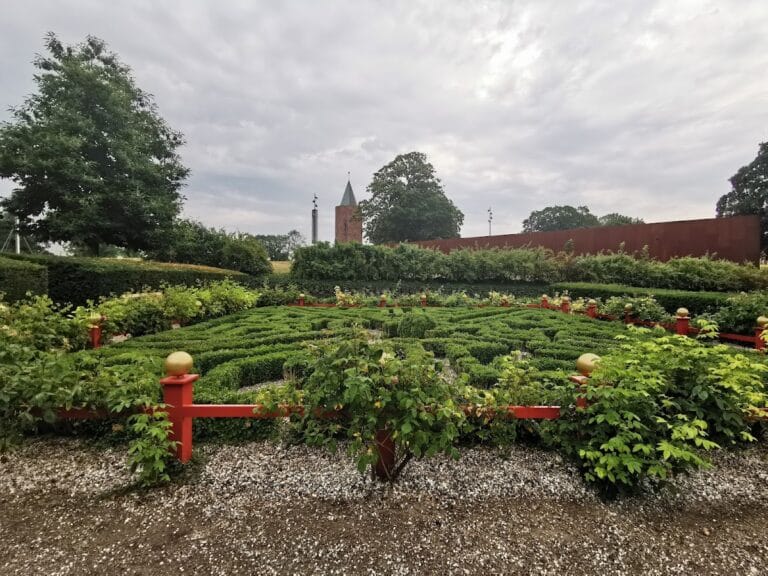
Iselingen covers 526 hectares. The estate includes 290 hectares of farmland and 145 hectares of woodland, while the garden covers five hectares. These grounds form the agricultural and wooded setting associated with the manor house.
Nearby sites