Nørre Alslev Church: A Medieval Lutheran Church in Denmark


Site at a Glance
- Rating
- 4.3
- Popularity
- Very Low
- Country
- Denmark
- Primary era
- Medieval
- External website
- Open
- Eras represented
- Medieval, Early Modern, Modern
- Civilizations
- Danish
- Site type
- Religious
- Remains
- Church
On this page15 sections
History
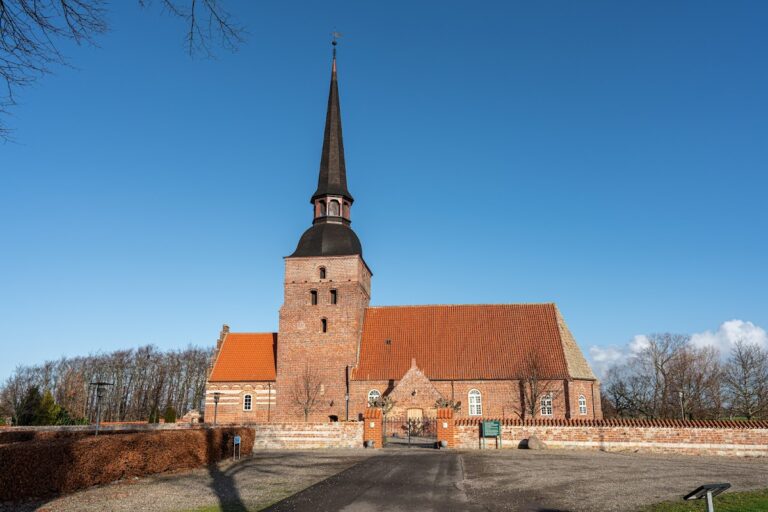
Nørre Alslev Church is a medieval Lutheran church in Nørre Alslev, Denmark, on the northern part of Falster. Its Early Gothic chancel and nave belong to the medieval building, which existed by at least 1308, the date recorded on one of its early frescoes. Before the Reformation, the church was dedicated to Saint Nicholas. It now belongs to the Church of Denmark, the Diocese of Lolland-Falster, Falster Deanery, and Nørre Alslev Parish.
Medieval paintings
The church preserves wall paintings from several periods. Frescoes dating from around 1400 were uncovered in the nave but were later covered with whitewash because their fragile condition made preservation difficult. A further cycle, painted around 1500 to 1520, once covered the entire nave. Many of these paintings were again whitewashed, although parts of the decoration in the western bay remain visible. The early sixteenth-century paintings are attributed to the Elmelunde Master and his workshop. The Elmelunde Master is the conventional name for the medieval painter associated with a group of late Gothic church frescoes on the Danish islands.
A death-dance fresco was painted around 1480. This type of allegorical scene shows death leading people of different social ranks in a dance, expressing the universal reach of mortality and becoming especially associated with the social and religious effects of plague in Europe. The painting was covered with whitewash during the seventeenth century and rediscovered and uncovered in the early twentieth century. Death-dance imagery is unusual in Danish churches, with other cited examples at Egtved and Jungshoved.
Discovery and restoration
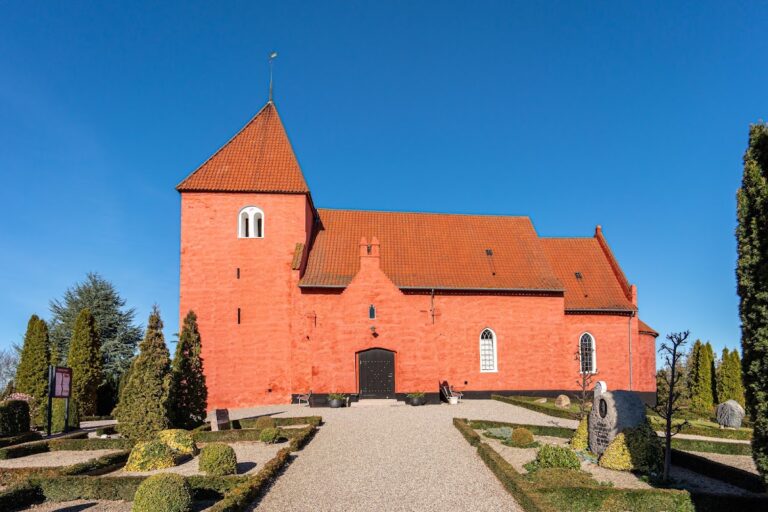
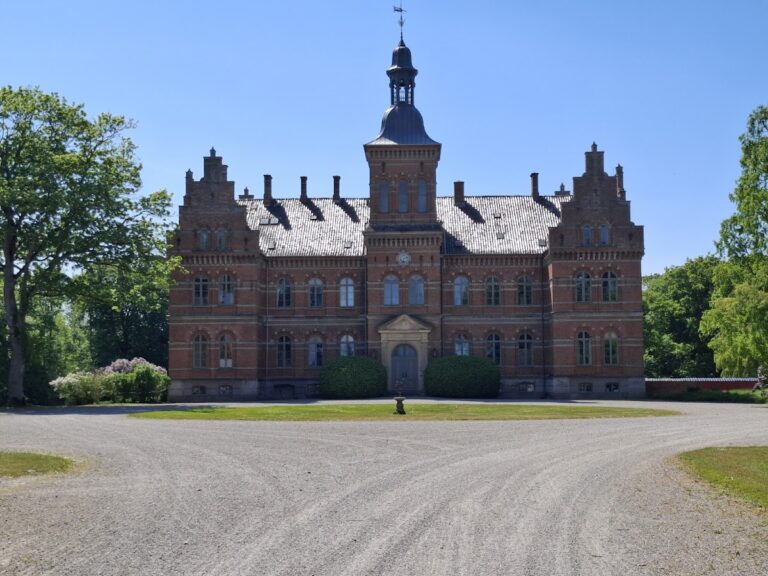
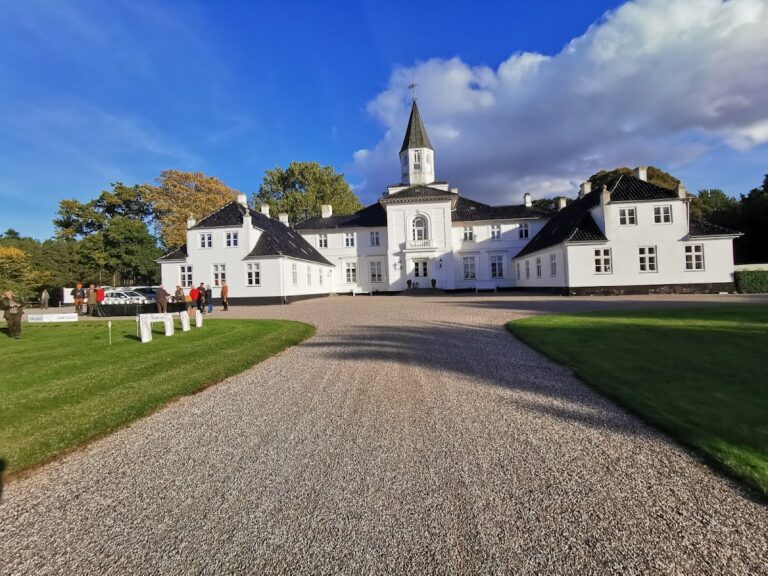
Jacob Kornerup discovered the frescoes in 1895. Eigil Rothe restored them in 1911, followed by further restoration by Harald Borre in 1941. The paintings retain substantial traces of Kornerup’s heavy restoration, but their iconography remains important for interpreting the decoration. The church has also been associated with the local tradition that its exterior is painted pink.
Remains
Medieval building
Chancel and nave
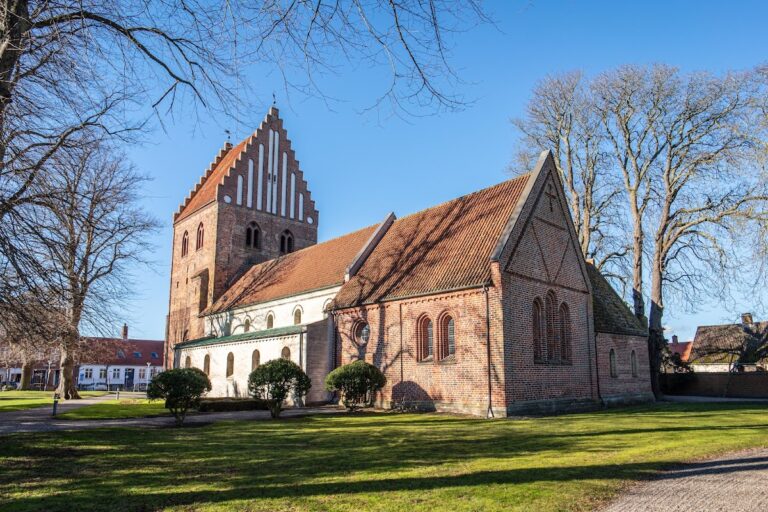
The Early Gothic chancel and nave are built of brick on a sloping foundation approximately 60 centimetres high. The chancel ends in three sides and has a stepped frieze. Its domed vault has semicircular ribs resting on short columns. A pointed chancel arch separates it from the nave, whose humped vault has clover-shaped ribs and webbing. Evidence for a former, higher vault suggests that the present vault may have received additional masonry support after a collapse.
Tower and porch
The tower and porch are Late Gothic additions to the medieval church. The tower has a stepped gable and five pointed-arch blind niches, while the porch has three. Both moulded pointed-arch entrances survive. The southern entrance remains in use.
Interior furnishings
Altarpiece and pulpit
Jørgen Ringnis made the altarpiece in 1653, and it has since been restored. Its central panel contains an alabaster relief made by Henry Luckow-Nielsen in 1948. Ringnis also made the pulpit, dated 1643. Four apostle statues that once belonged to the pulpit’s sounding board are now arranged together on the nave’s north wall.
Baptismal font
The baptismal font is made of limestone from Gotland.
Wall paintings
Apse frescoes
The apse, or eastern termination, contains a Deesis fresco dating from approximately 1310 to 1320. A Deesis shows Christ in glory, usually accompanied by Mary and John the Baptist as intercessors. Here, Christ appears within a mandorla, an almond-shaped aureole surrounding a sacred figure, with an unusually large head and hands. The lion of Mark and the ox of Luke appear beneath him. Mary and John the Baptist flank Christ, while a kneeling monk is placed beside Mary and a woman prays directly to Christ before John. A haloed saint stands behind Mary, and a bishop stands behind John the Baptist. The Lamb appears above John.
Beneath the Deesis is a row of apostles carrying ribbons with their names. Peter and Paul also carry their traditional attributes. The lower zone contains a dragon, lion, horse, deer, fantastical creatures, and a shield divided vertically into white and blue fields with a star.
Last Judgment
Above the chancel arch is a large Last Judgment fresco dating from around 1350. A Last Judgment depicts Christ judging the living and the dead at the end of time. Christ is shown with two swords emerging from his mouth and is flanked by the apostles with their attributes. The uncertain, trembling lines and numerous corrections may indicate that the artist was elderly.
Death dance
The western wall contains the death dance, arranged from left to right. It begins with a partly preserved seated dead figure playing a wind instrument, followed by four living figures: a king, a bishop, a nobleman, and a peasant. Arabesques and stylized flowers fill the background, while the figures are fully clothed rather than shown as skeletons.
The scene has no accompanying text, making the identities of the figures accompanying the living difficult to interpret. They may be demons rather than dead people. Close examination indicates that apparent horns and a protruding tongue are worms or snakes emerging from bodily openings, intensifying the frightening and repulsive effect.
Nave frescoes
The surviving nave paintings include the Creation of Eve in the northern vault section, the Fall in the eastern section, the expulsion from Paradise in the southern section, and Adam and Eve after the expulsion in the western section. These scenes form part of the early sixteenth-century decoration attributed to the Elmelunde Master and his workshop.