Falkenstein Castle: A Medieval Territorial Lordship in Germany


Site at a Glance
- Rating
- 4.7
- Popularity
- Very Low
- Country
- Germany
- Primary era
- Medieval
- Eras represented
- Medieval
- Civilizations
- Holy Roman Empire
- Site type
- Military
- Remains
- Castle
On this page8 sections
History
Falkenstein Castle is a hilltop castle ruin in Germany, near Gerstetten, whose origins are generally dated to around 1150. It became the centre of the Falkenstein lordship, a noble territorial lordship within the Holy Roman Empire, the medieval and early-modern political framework that included much of central Europe. The lordship also belonged to the Swabian Circle, one of the Empire’s regional administrative and military groupings.
Origins of the Falkenstein lordship
After 1050, the surrounding region belonged to the Count Palatine based at Heidenheim. Parts of the territory later passed by inheritance to Diebold, Margrave of Giengen-Vohburg. His daughter Adela married Frederick I Barbarossa, the twelfth-century German king and Holy Roman Emperor, in 1147. Their marriage ended in divorce in 1153, but Frederick retained Adela’s dowry.
Around 1160, Gotebert, probably a retainer of Frederick Barbarossa who had originally come from the Upper Palatinate, acquired the Falkenstein lordship. He adopted the name Gotebert von Falkenstein, establishing the connection between his family and the territory. Members of the Falkenstein family are documented from the middle of the twelfth century. Rudolf and Swigger von Falkenstein were the last recorded members of the family, in 1258.
Inheritance and transfer of the lordship
Around 1260, the heiress Adelheid von Falkenstein married Walter von Faimingen. Their heiress, also named Adelheid, later married Heinrich Spät. He adopted the name Speth von Faimingen and became lord of Falkenstein.
In 1331, Hermann Speth von Faimingen secured the Helfenstein family’s renunciation of its forest rights in the Falkenstein estates. This document contains the first recorded mention of Falkenstein Castle itself. After Hermann’s death, the inheritance was intended for the daughters of his deceased son Friedrich von Faimingen. They were placed under the guardianship of Emperor Louis the Bavarian and later under that of his son Louis of Brandenburg.
During the middle of the fourteenth century, Louis of Brandenburg pledged Falkenstein to Duke Conrad of Teck. He later redeemed the pledge, then granted the lordship to Ulrich the Elder and Ulrich the Younger of Helfenstein, probably as compensation for claims they held against him. Falkenstein subsequently passed to the Helfenstein family.
In 1356, the Helfenstein family divided its lordship. The Brenz Valley and Falkenstein with Faimingen went to Ulrich the Younger, who gave Falkenstein to his daughter Anna as a marriage portion. Her marriage to Duke Frederick of Teck-Owen transferred Falkenstein to the dukes of Teck around 1359.
Late medieval rule and decline
Duke Frederick of Teck received market rights and high criminal jurisdiction for nearby Dettingen from Emperor Charles IV. High criminal jurisdiction, also called high justice, allowed its holder to hear serious criminal cases and impose severe penalties, including capital punishment.
In 1390, Frederick sold Falkenstein, together with a mill and associated goods in Dettingen, Heuchlingen, Ballendorf, and Mehrstetten, to Albrecht von Rechberg zu Staufeneck. A prolonged legal dispute followed over the villages belonging to Falkenstein. In 1531, high jurisdiction passed to the lordship of Heidenheim.
A fire damaged the castle in 1570. In 1592 and 1593, Baron Konrad IV von Rechberg zu Staufeneck sold Falkenstein Castle and its lordship to Duke Ludwig of Württemberg. The castle complex was partly destroyed during the Thirty Years’ War, the major European conflict of 1618 to 1648, in 1634. Further sections were demolished in 1740 and again in 1818, leaving the site in ruins.
Remains
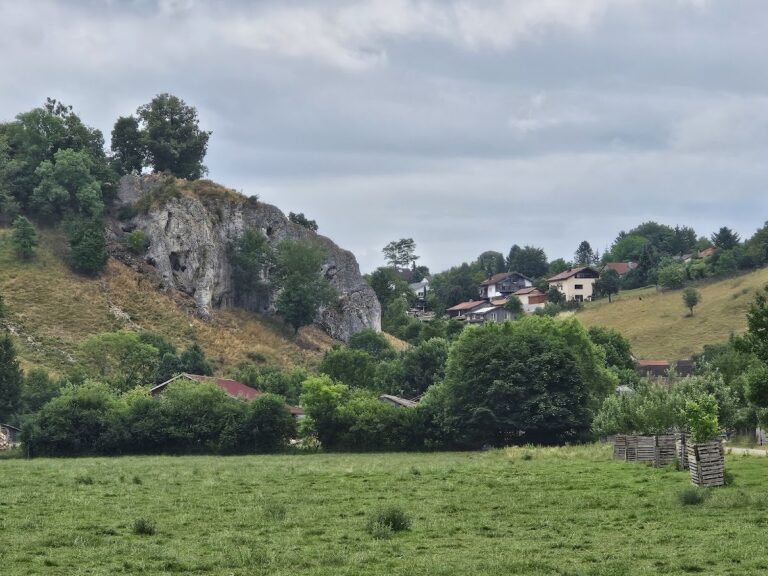
Falkenstein occupies the western slope of the Eselsburg Valley in the Brenz Valley near Dettingen am Albuch. The main castle stood on the summit of a rock at approximately 510 metres above sea level, while the outer bailey occupied the western edge of the adjoining upland toward Dettingen. The surviving site therefore consists of two distinct elements, the former main-castle rock and the remains of the outer bailey.
Castle rock and outer bailey
Main castle rock
The main castle was built on the summit of the rocky height. Its position formed the upper part of the castle complex, alongside the outer bailey on the adjoining upland. The rock and the fragmentary remains around it reflect the destruction of 1634, followed by demolitions in 1740 and 1818.
Outer bailey complex
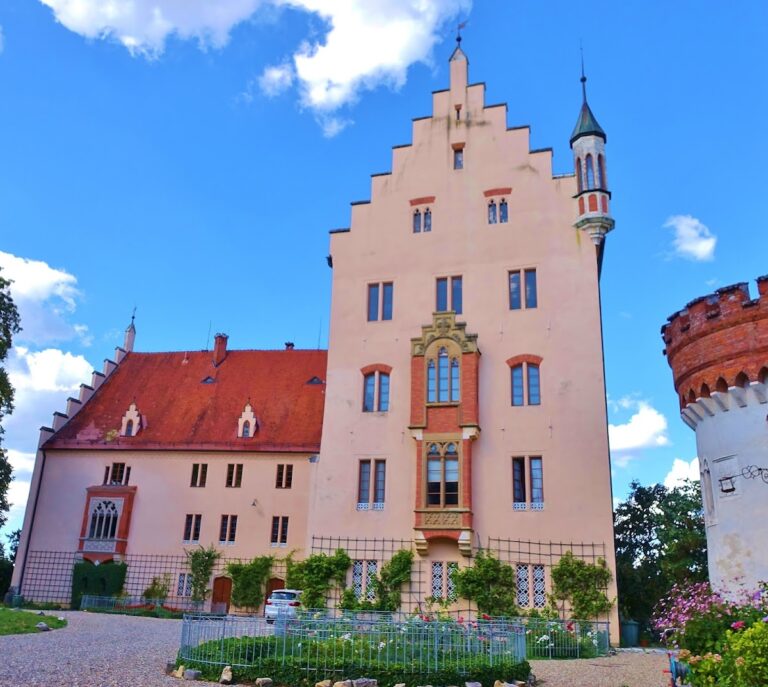
The outer bailey was newly built in the middle of the fifteenth century, and the castle was expanded approximately between 1430 and 1450. Parts of this fortified complex survive and belong to the Falkenstein domain. Surviving features include a building with a round corner tower and the Anna-Magdalena Chapel on the eastern side of the outer bailey.
The castle site lies about 2,500 metres south-southwest of Herbrechtingen and about 2,700 metres east of Dettingen am Albuch. It is also approximately one kilometre below Bindstein Mill in the Eselsburg Valley toward Eselsburg. These spatial relationships place the main rock and outer-bailey remains within the valley landscape in which the Falkenstein lordship developed.