Hellenstein Castle: A Medieval Fortress and Württemberg Palace in Germany

Site at a Glance
- Rating
- 4.7
- Popularity
- Very Low
- Country
- Germany
- Primary era
- Medieval
- Eras represented
- Medieval, Early Modern
- Civilizations
- Duchy of Württemberg, Holy Roman Empire
- Site type
- Military
- Remains
- Castle
On this page16 sections
History
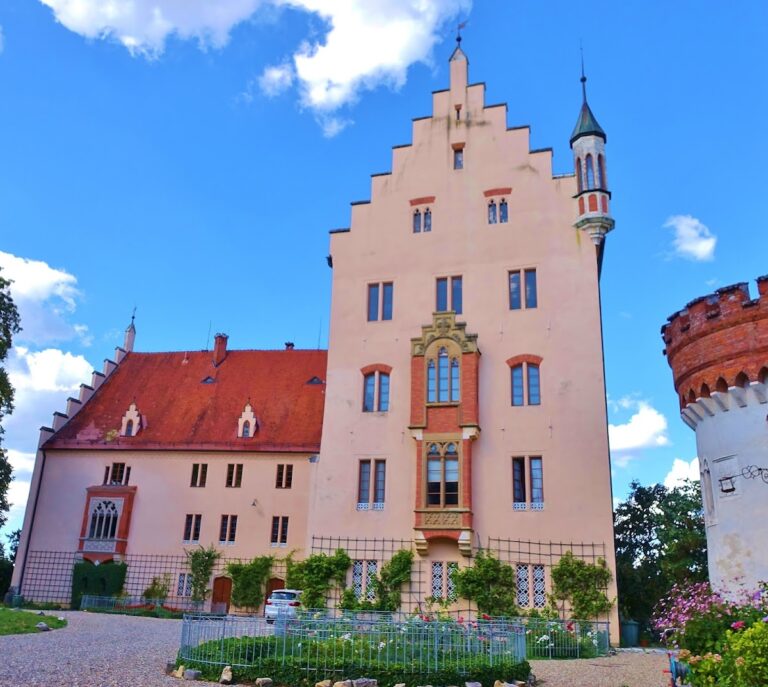
Hellenstein Castle is a medieval fortress and later palace above Heidenheim in Germany, built initially by the Hohenstaufen nobleman Gozpert de Halensteine in 1096. It became the seat of the Lords of Hellenstein, later an administrative center of the Heidenheim lordship under Württemberg, and eventually a princely residence shaped by repeated rebuilding and expansion.
Hohenstaufen origins and changing lordship
Construction began under Gozpert de Halensteine, whose grandson Degenhard von Hellenstein substantially enlarged the fortress. Degenhard followed Emperor Frederick I Barbarossa, the twelfth-century Holy Roman Emperor, placing the early Hellenstein family within the political sphere of the Hohenstaufen, or Staufer, dynasty.
The Hellenstein line ended in 1273, after which the castle passed through several hands. The Counts of Helfenstein controlled it from 1351 to 1448. It became Bavarian property after 1450 and passed to the dukes of Württemberg in 1503, when it also became the administrative center of the Heidenheim lordship.
Fire, reconstruction, and Württemberg expansion
A major fire on 5 August 1530 almost completely destroyed the old castle. Duke Ulrich of Württemberg ordered its reconstruction, which took place between 1537 and 1544.
After Duke Frederick I of Württemberg came to power in 1593, he decided to extend the medieval fortress eastward with a new palace representing Württemberg authority. Heinrich Schickhardt, a prominent Württemberg architect and master builder, received the planning commission in 1598. The project added towers and bastions and continued until 1611.
The former castle church was built in 1605 by Elias Gunzenhäuser in Renaissance style. Its design followed the transverse-church arrangement and was modeled on the church of Stuttgart’s Old Castle. The building later became secularized and was converted into a museum in 1901.
War, residence, and decline
During the Thirty Years’ War, the castle suffered damage and its water-supply system was destroyed. A new supply had to be created before the complex could be occupied again. Miners from Königsbronn excavated the Kindlesbrunnen between 1666 and 1670 to provide water within the fortress.
Hellenstein reached its greatest importance as a princely residence during the seventeenth and early eighteenth centuries. Its guests included Albrecht von Wallenstein in 1630, Prince Eugene of Savoy in 1702, Archduke Charles of Austria-Teschen in 1796, and Napoleon Bonaparte in 1805. In 1704, during the War of the Spanish Succession, a French force of about 10,000 men considered attacking the castle but withdrew when its commander judged the assault too costly.
The complex lost importance during the eighteenth century. From about 1762, the ducal treasury no longer financed its renovation, and the buildings deteriorated. Demolition was authorized in 1797. The upper storey of the battery tower was removed in 1810, and in 1820 the Ministry of Finance authorized the sale and demolition of the old castle. After a fire at the Völter paper factory in 1821, parts of the castle were used as building material until the royal building administration prohibited further removal of stone in 1837.
Museums, cultural use, and modern installations
The former castle church became a museum in 1901 when the Heidenheim Folk and Ancient History Society established a local-history collection there. Its founder, Eugen Gaus, contributed artifacts and excavation finds from his private collection. Alfred Meebold’s donation of an Indian collection led to the use of additional rooms, including the Obervogteisaal, upper tower rooms, coach house, and cellar.
The museum was redesigned in three stages between 1956 and 1960. The former arsenal was later restored and converted for museum use, and the complex has housed the Iglau Homeland Room since 1977. The city of Heidenheim took over the museum from the Folk and Ancient History Society in 1993. Between 1982 and 1986, the city restored the Fruchtkasten, a grain-storage building, and opened a branch museum of the Württemberg State Museum there in 1987. This museum presents carriages, coaches, carts, and the development of transport during the previous two centuries.
The ruined Knights’ Hall has served as a cultural performance space since 1964, including for the annual open-air Heidenheim Opera Festival. The youth musical project JuMP, which developed from earlier castle serenades, has been held there since 1998. A Südwestrundfunk broadcasting installation also operates at the castle. Until November 1993, a 100-watt medium-wave transmitter broadcast on 1413 kHz through a long-wire antenna stretched across the courtyard.
The castle’s wider setting also preserves evidence of much earlier human activity. Hermann Mohn discovered the prehistoric rock shelter called the Heidenschmiede in 1928. The site became recognized as an important Middle Paleolithic location in the prehistory of Baden-Württemberg, and the Hermann-Mohn-Weg, established in 1990, leads from the former Mohn family house toward the castle and the shelter.
Remains
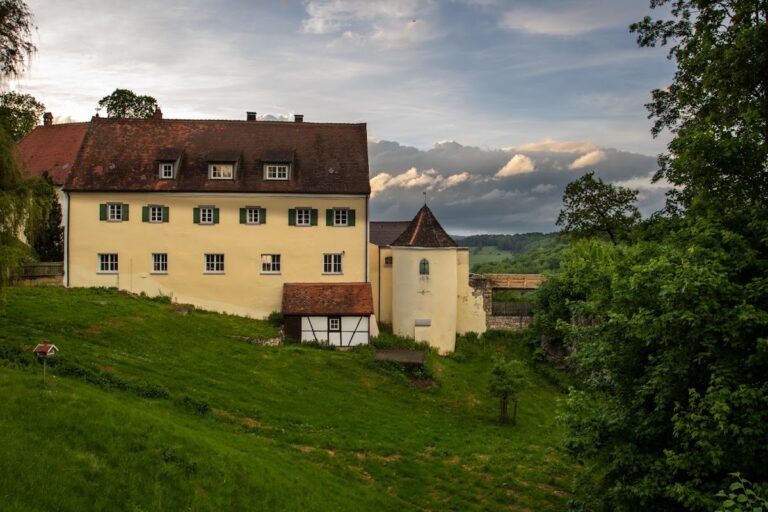
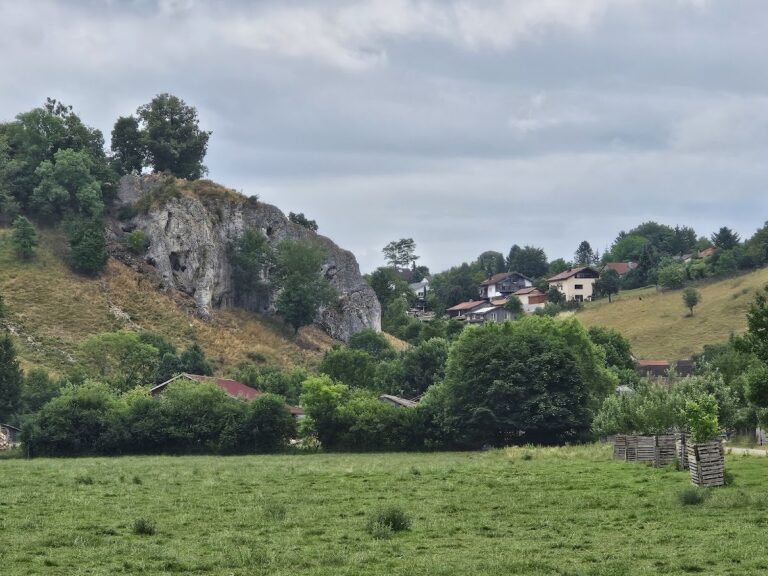
Hellenstein Castle occupies a limestone rock massif approximately 70 meters above Heidenheim. Its surviving layout combines a medieval core fortress with a palace and fortified extension on the eastern side. The older masonry includes many buckel stones, dressed blocks with rough or rounded projecting faces, while the eastern complex is marked by towers, bastions, entrance structures, and buildings later adapted for museums and cultural use.
Medieval fortress and waterworks
Knights’ Hall
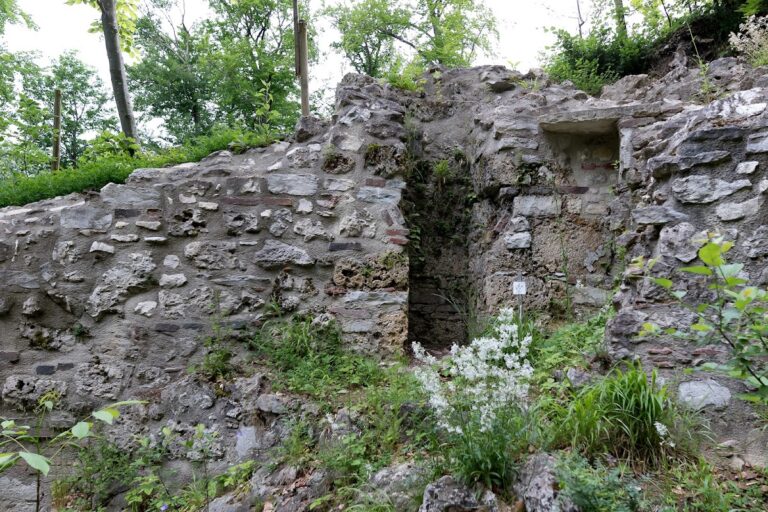
The ruined Knights’ Hall contains part of the medieval core, including numerous squared blocks with projecting outer faces. Many of these buckel stones are associated with the Hohenstaufen-period building phase. The hall survives in a ruined condition and functions as an open-air performance venue. Wall and ceiling paintings by the Bavarian court painter Friedrich Sustris once decorated the upper storey, but they were lost when the upper floor of the battery tower was removed in 1810.
Water supply and Kindlesbrunnen
The earlier water system drew water from the Brunnenmühle spring, approximately 80 meters below the fortress. Elias Gunzenhäuser constructed the system, which was destroyed during the Thirty Years’ War. A later arrangement is described as lifting water approximately 90 meters to the castle.
The Kindlesbrunnen is a 78-meter-deep well in the southern part of the fortress, within the Brunnengärtle. Miners from Königsbronn excavated it through the underlying rock between 1666 and 1670. Its name is linked to a local legend that newborn children from Heidenheim were taken from the well rather than delivered by storks.
Eastern palace and fortified extension
Palace approach and defenses
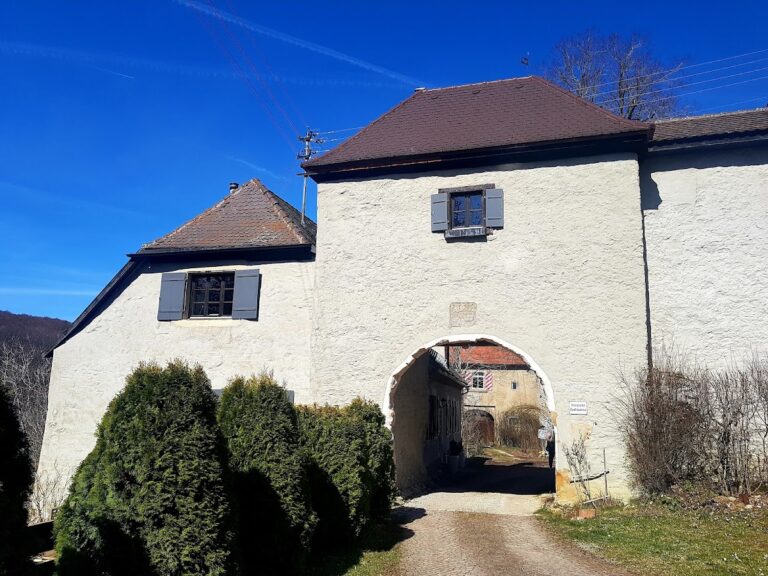
The eastern extension enlarged the fortified area with towers and bastions. Two large entrance towers, decorated with columns and heraldic ornament, formed the approach to the palace. Gun towers flanked the side facing the city, adding defensive structures to the residential expansion.
Former castle church
The former castle church, built in 1605 by Elias Gunzenhäuser, is a Renaissance building arranged as a transverse church. It has a three-sided gallery and an altar apse, a semicircular or polygonal sanctuary end. Now deconsecrated and secularized, it has housed the municipal museum since 1901.
Surviving buildings and collections
Fruchtkasten and museum rooms
The Fruchtkasten, dating from 1470, is a surviving building of the complex and houses the transport museum. Other museum spaces occupy the former arsenal, the Obervogteisaal, upper tower rooms, the coach house, and the cellar. The collections include regional historical and cultural objects, archaeological finds, religious art, antique toys, and Alfred Meebold’s Indian Collection. A taxi formerly belonging to the Daimler Motor Company was also displayed there.
Heidenschmiede
The Heidenschmiede is an abri, or shallow natural rock shelter, in the southeastern limestone massif on which the castle was built. Neanderthals visited it approximately 70,000 to 50,000 years ago during the Late Acheulean, a later phase of the Acheulean Stone Age tradition associated with handaxe-making cultures. The shelter was probably used for brief episodes of tool production.
Broadcasting installation
A Südwestrundfunk broadcasting facility remains part of the castle complex. The former medium-wave installation used a long-wire antenna suspended across the castle courtyard and operated with a power of 100 watts on 1413 kHz until November 1993.
Nearby sites