Kaltenburg Castle: A High Medieval Fortress in Germany
Site at a Glance
- Rating
- 4.5
- Popularity
- Low
- Country
- Germany
- Primary era
- Medieval
- External website
- Open
- Eras represented
- Medieval, Early Modern, Modern
- Civilizations
- Holy Roman Empire
- Site type
- Military
- Remains
- Castle
On this page12 sections
History
Kaltenburg Castle is a High Medieval hilltop fortress in Germany, above the Lone Valley near Giengen an der Brenz. Its construction probably took place between 1150 and 1180, when the site formed a fortified seat associated with the political order of the medieval German Empire. Tradition connects the castle’s name with Heinrich von Kalden of Pappenheim, a Marshal of the Empire under Emperor Frederick I Barbarossa, although this association concerns the site’s traditional foundation history.
Hohenstaufen lordship
Under the Hohenstaufen dynasty, which supplied several medieval German kings and emperors, the lordship of Kaltenburg was directly subordinate to the Empire rather than to an intervening territorial prince. The castle was probably held by ministeriales, servants of noble or imperial authorities who could exercise administrative and military functions. Dietmar is connected with Kaltenburg in 1240, followed by Otto von Kaltenburg in 1265.
The Counts of Helfenstein owned Kaltenburg by 1332, when their bailiff Heinz Vetzer held office there. From 1357, the Lords of Riedheim occupied the castle. At different times they held it as a fief of the Duchy of Bavaria or served as bailiffs for the Imperial City of Ulm. From the fifteenth century, other noble families, including the von Grafeneck and Stadion families, held shares in the property.
Destruction and rebuilding
Troops from the Imperial City of Nuremberg besieged and damaged Kaltenburg in 1435. The fortress suffered further destruction during the Thirty Years’ War, the wider European conflict that devastated much of the German lands between 1618 and 1648. The Riedheim family rebuilt it between 1677 and 1677? No, reconstruction began in 1677 after the destruction of 1632–34.
The southwest section collapsed in 1764, and its rubble was taken to Reuendorf for a farm building. Kaltenburg was described as dilapidated in 1800, while its chapel was demolished in 1804. Partial repairs followed in 1806. Five families lived in the castle in 1820, the year ownership passed to the Counts of Maldeghem, and thirty inhabitants were recorded in 1837. By 1897, the gatehouse apparently remained the principal intact and occupied part.
Conservation and present ownership
Initial conservation work took place in 1938 and 1940, followed by further measures in 1980–83. These interventions repaired and enlarged the two square towers on the valley side. The Kaltenburg Interest Group acquired the castle in December 2015. Conservation work closed a gap in the wall in March 2017 and secured the shield wall between December 2017 and March 2018. Baden-Württemberg designated Kaltenburg its Monument of the Month for March 2017.
Remains
Kaltenburg stands at about 510 metres above sea level on a promontory in the Lone Valley, approximately 60 metres above the confluence of the Hürbe and Lone rivers. The fortress developed through four main building phases. A twelfth-century tower house on a rocky outcrop formed the first castle. The complex reached approximately its later size during the thirteenth and fourteenth centuries, expanded again between 1450 and 1560, and was rebuilt after 1677.
Outer defenses
Walls, towers, and moat
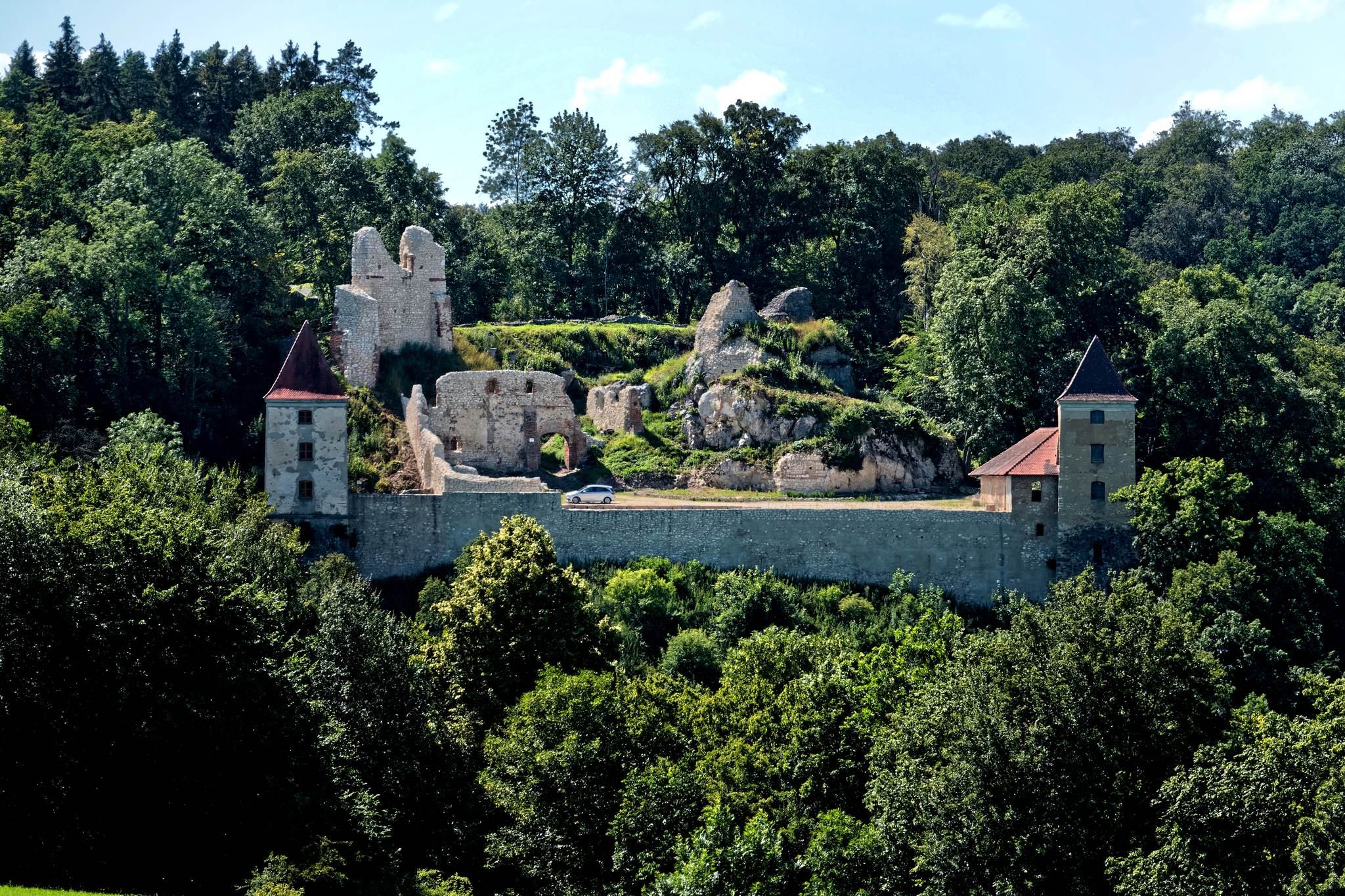
The outer enceinte, or enclosing defensive wall, formed an irregular pentagon. Two square towers and three, possibly once four, projecting round towers strengthened its perimeter. An angular moat protected the flatter approach, measuring about 5 metres deep and between 10 and 16 metres wide. The entrance lay on the southern side near a steep drop. The uphill outer defenses and the bases of the round towers have been extensively restored and supplemented, while their present arrangement probably reflects the fifteenth- and sixteenth-century expansion.
Shield walls
A surviving section of the earlier moat lies northwest of the fortress beneath the outer wall. On the plateau, a section of shield wall, a particularly strong wall facing the most exposed approach, rises about 4 metres high and extends for approximately 16 metres. The shield wall of the second tower house stands at the southwest corner above the moat. It measures just under 10 metres in length, 7 to 8 metres in height, and about 2.2 metres in thickness.
Central fortress
First tower house
The first castle’s shield wall is approximately 3.4 metres thick and appears to have formed the eastern side of a rectangular tower house. It surrounded an almost square rocky outcrop rising as much as 13 metres. Individual stone blocks from the first and second building phases remain around this rock, while the later main hall probably stood west of the tower house at the lower edge of the outcrop.
Second tower house and fighting gallery
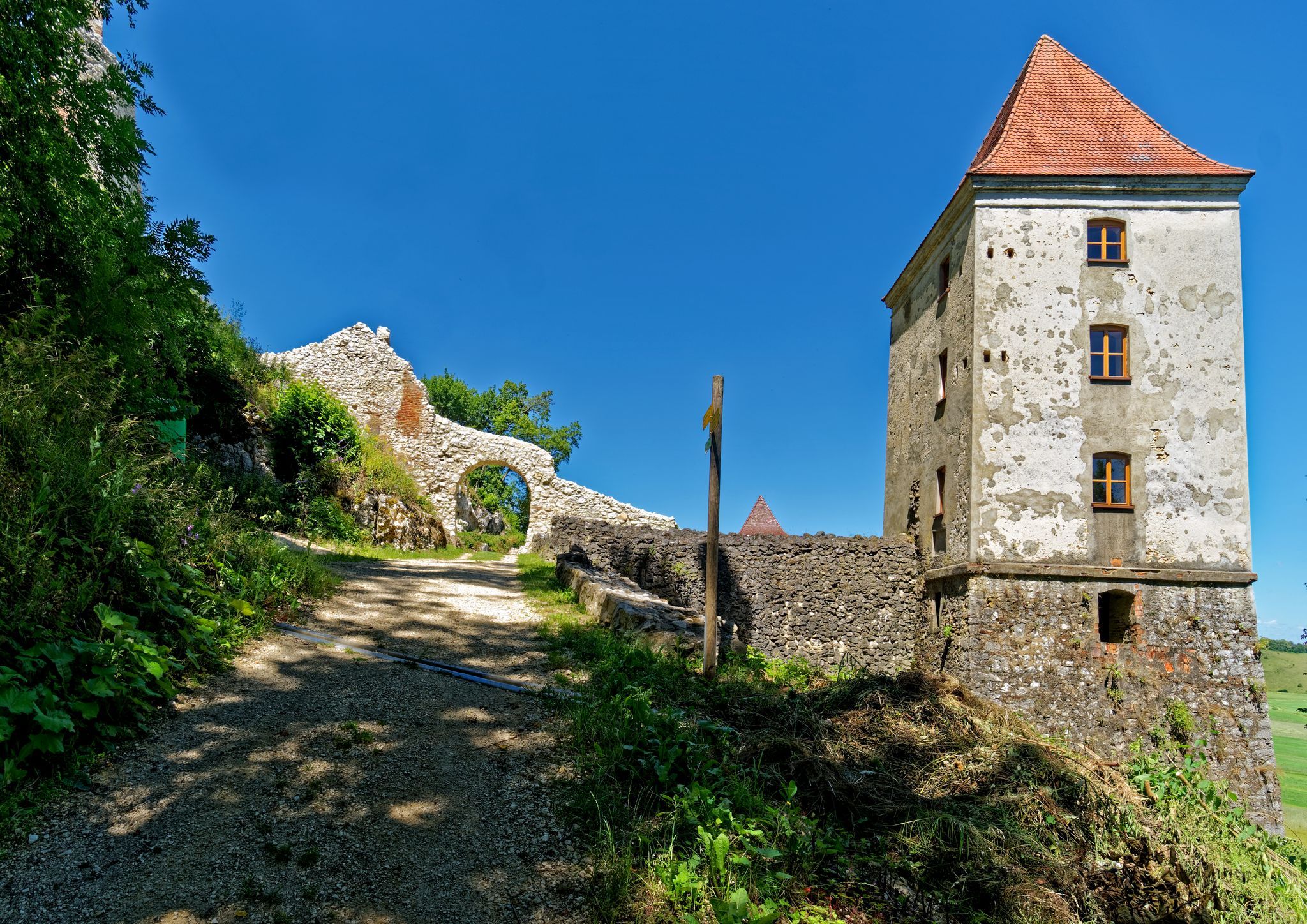
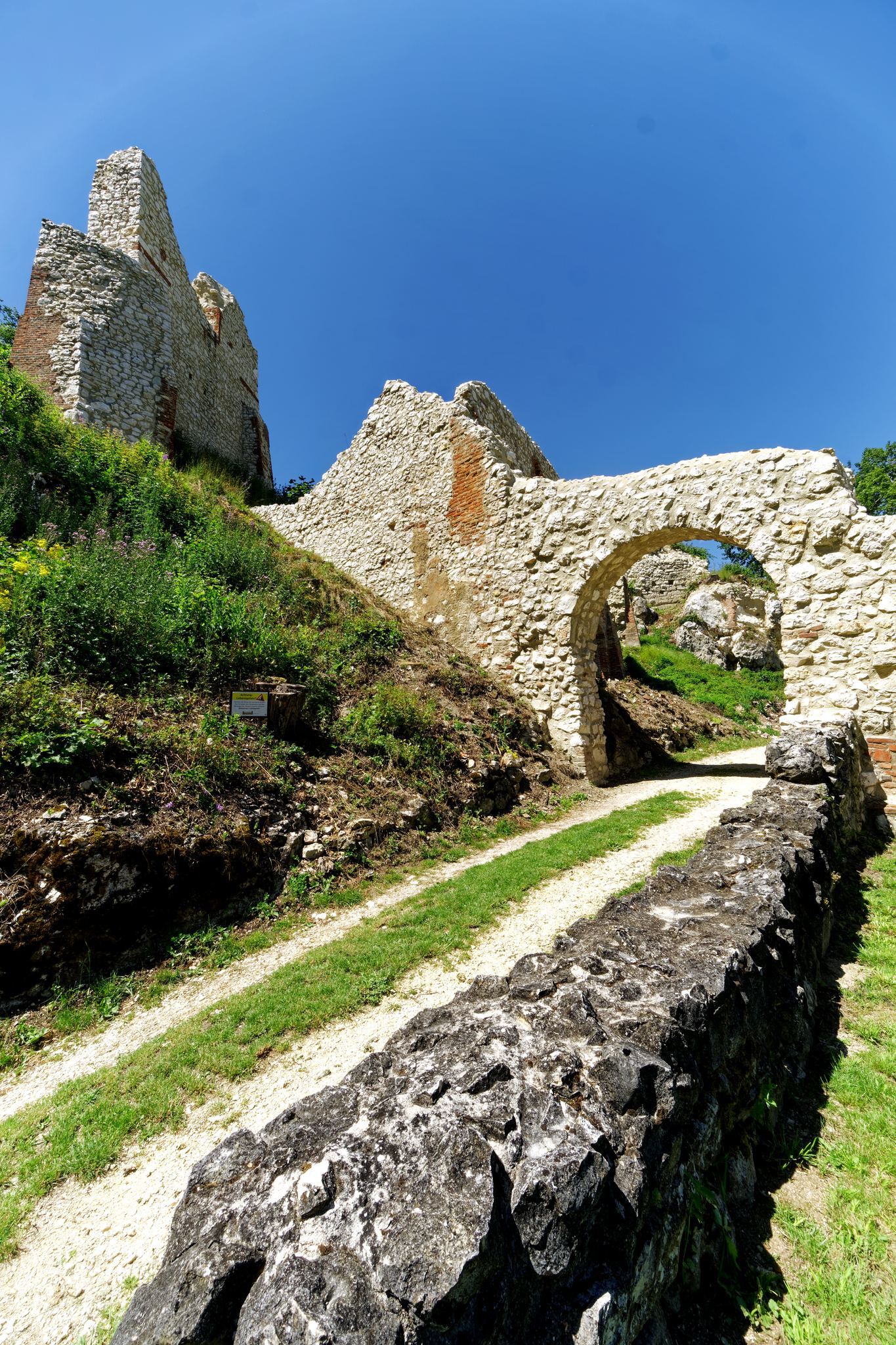
The southern side retains part of the thirteenth- and fourteenth-century enclosing wall, including the gate structure. A vaulted passage about 5 metres above ground level and six openings on the outer face indicate that the second tower house carried a projecting wooden hoarding, a fighting gallery from which defenders could attack enemies below the wall. The later expansion associated with the Lords of Riedheim stood beneath it, and sections of its enclosing walls survive.
Late rebuilding
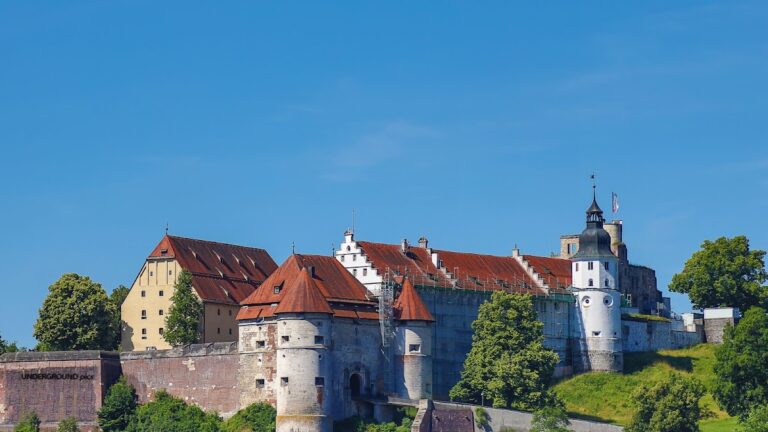
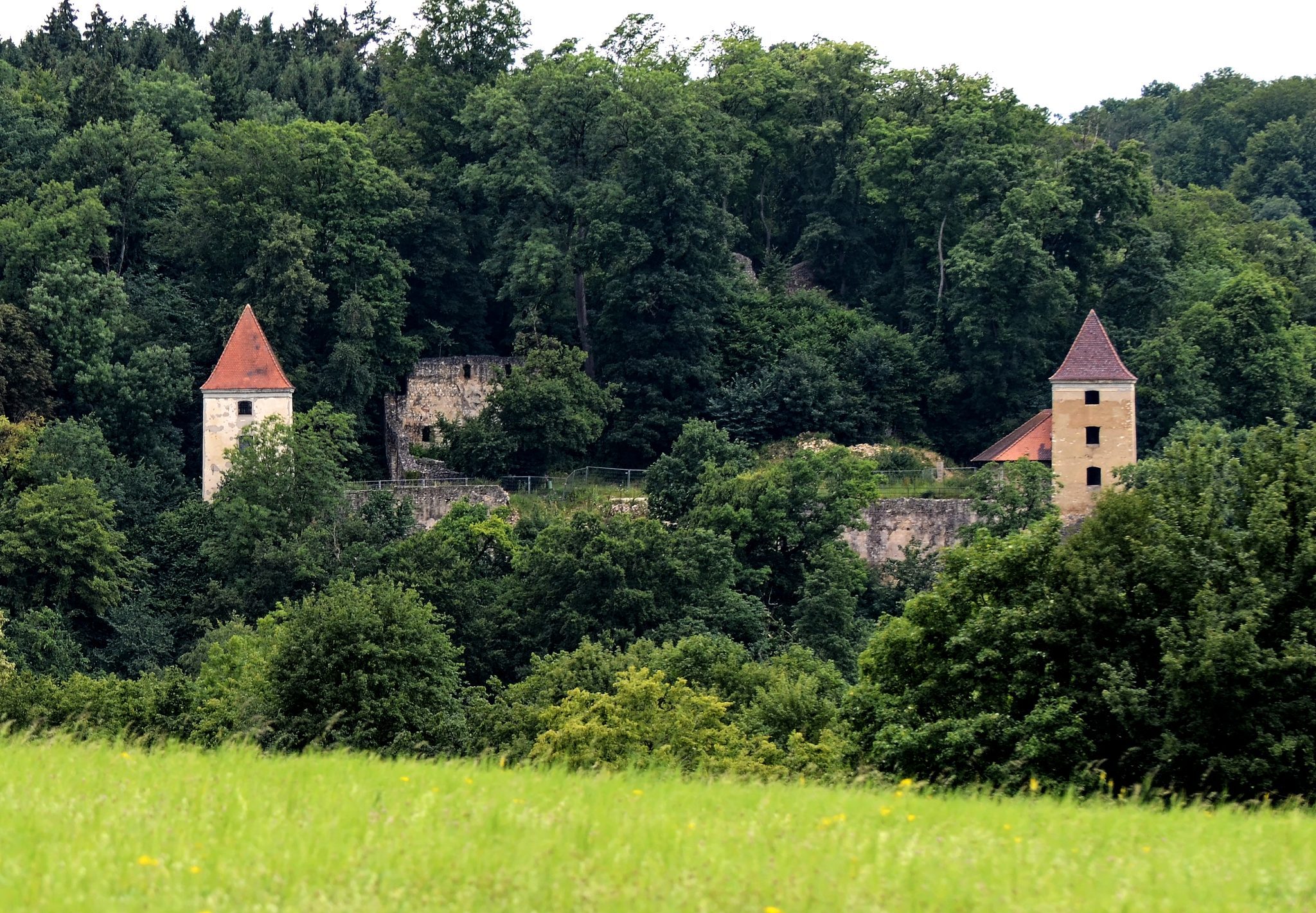
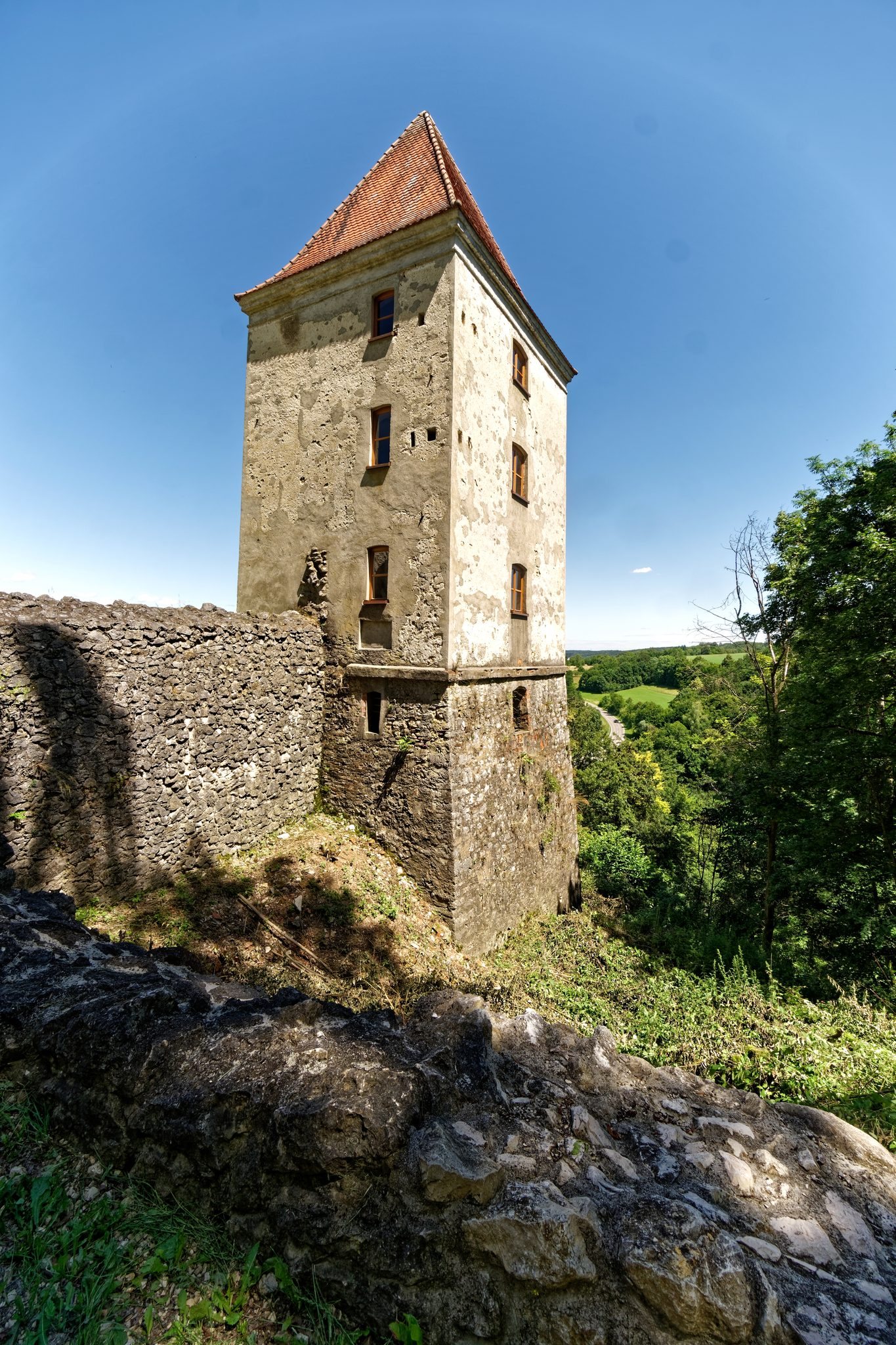
The two tall, plastered square towers on the valley side date from the rebuilding around 1677. Their pyramidal roofs give them a distinctive later appearance and make them the dominant surviving elements when the castle is viewed from the valley. Kaltenburg is preserved as a substantial ruin, with wall remains, isolated masonry, and fragments from its successive building phases. The southwest building’s materials were removed to Reuendorf after its collapse, while the surviving structures preserve the fortress’s changing form from the twelfth century through the postwar rebuilding of the late seventeenth century.