Schloss Maurach: A Baroque Monastic Estate on Lake Constance


Site at a Glance
- Rating
- 4.7
- Popularity
- Very Low
- Country
- Germany
- Primary era
- Early Modern
- External website
- Open
- Eras represented
- Medieval, Early Modern, Modern
- Civilizations
- Holy Roman Empire
- Site type
- Economic
On this page8 sections
History
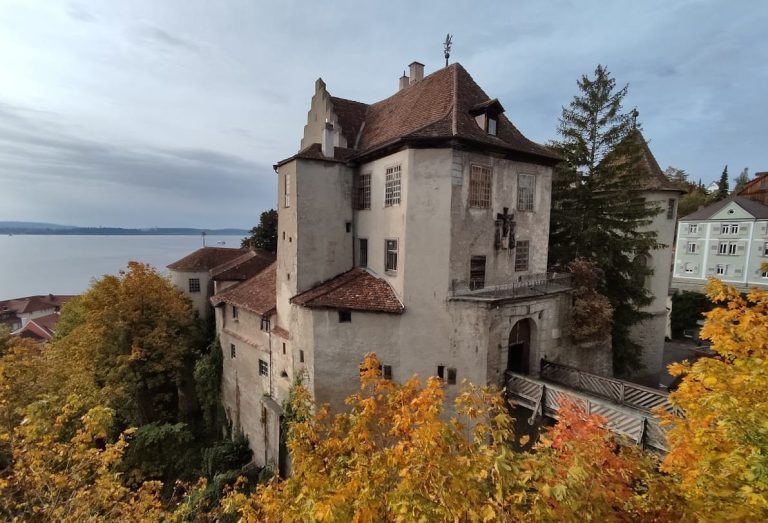
Schloss Maurach is a Baroque building complex in Germany at Uhldingen-Mühlhofen, on the shore of Lake Constance below the Birnau pilgrimage church. It was developed by Salem, a Cistercian Imperial Abbey whose territory was held directly from the Holy Roman Emperor. Despite its name, Schloss Maurach was never an aristocratic residence, but an agricultural and service estate supporting the abbey.
Early Salem Estate
The first economic buildings at Maurach, including a ship landing place and a granary, were documented in 1155. The site served Salem as a farm estate and a landing place for ships. In this role, it handled goods brought to the estate or sent away by water. Goods transported from Maurach to the lake were not subject to a road toll.
Maurach was connected to Salem by the Prälatenweg, a route used by the abbots as well as for moving goods between the estate and the abbey. A grange, meaning a monastic agricultural estate managed away from the main monastery, allowed Salem to organize farming, vineyards, storage, and related work at the lakeshore. The permanent population consisted of staff needed to cultivate the surrounding vineyards, while many abbots used Maurach as a summer residence.
Baroque Transformation
After 1722, Abbot Stephan I Jung, who led Salem from 1698 to 1725, gave the estate its representative Baroque appearance. The enlarged complex brought together residential quarters for the abbot, a chapel, agricultural and service buildings, and a garden. Its ceremonial appearance therefore served the needs of a working monastic estate rather than those of a noble household.
Secularization and Later Changes
In November 1804, the secularization of Salem transferred the abbey and its possessions to secular authority. Secularization was the transfer of church property and institutions to governments or other secular owners. Maurach consequently passed to the Margraviate of Baden.
In 1919, the Cistercian Territorial Abbey of Wettingen-Mehrerau in Bregenz bought Maurach together with the nearby Birnau pilgrimage church. A destructive fire in February 1979 then led to a major change in the site’s recent history. The complex came under the control of L-Bank, the development bank of Baden-Württemberg, and was restored, structurally modernized, and expanded between 1985 and 1992 under the direction of Karlsruhe architect Heinz Mohl. It subsequently served for business and municipal conferences and continuing-education events. Since 2026, the house has been a hotel.
Remains
Estate Layout and Buildings
Schloss Maurach occupies the lakeshore beneath the Birnau pilgrimage church. Its surviving arrangement reflects the combination of representative Baroque architecture and practical estate functions established after 1722. The complex brings together the abbot’s residential wing, a former chapel, agricultural and service buildings, a garden, and the earlier farm facilities associated with Salem.
Abbot’s Quarters and Chapel
The residential wing was created as part of the post-1722 expansion and provided quarters for the abbot. A former chapel also belongs to the complex, preserving the religious character of an estate connected to Salem Abbey. Together, these spaces formed the representative and devotional side of Maurach’s Baroque layout.
Farm and Lakeshore Facilities
The agricultural and service buildings incorporate the practical functions that shaped Maurach from the medieval period onward. The former Salem farm buildings included a granary, while the ship landing place supported the movement of goods by water. The courtyard was crossed by Bundesstraße 31 until approximately 1950, adding a later transport use to the site’s long history as a place of movement and supply.
Nearby sites