Haughley Castle: A Medieval Motte-and-Bailey Fortress in Suffolk
Site at a Glance
- Rating
- 3
- Popularity
- Very Low
- Country
- United Kingdom
- Primary era
- Medieval
- External website
- Open
- Eras represented
- Medieval
- Civilizations
- Norman
- Site type
- Military
- Remains
- Castle
On this page8 sections
History
Haughley Castle was a medieval castle in Haughley, United Kingdom, built by the Norman nobleman Hugh de Montfort in the late eleventh century. It served as the principal stronghold, or caput, of the Honour of Haughley, a feudal holding administered from a central seat. The castle became involved in the political and military struggles between the English Crown and powerful baronial families during the twelfth century.
The Honour of Haughley
Hugh de Montfort became a monk in 1088, after which the castle remained in his family until the middle of the twelfth century. The Honour of Haughley was also known as the Honour of the Constable because its holder was required to provide soldiers and knights for castle guard at Dover Castle, a feudal duty involving the defence of a specified stronghold.
Near the end of King Stephen’s reign, which lasted from 1135 to 1154, Haughley Castle was granted to Henry of Essex, one of Stephen’s supporters. Henry later lost royal favour after being accused and convicted of cowardice during the 1157 Welsh campaign. Henry II, who succeeded Stephen and ruled England from 1154 to 1189, seized the castle from him in 1163.
The revolt of 1173–1174
By the late twelfth century, the Bigod family, whose head held the title Earl of Norfolk, had become a powerful force in Suffolk and was competing with the Crown for control of the region. By the middle of the 1170s, Henry II’s representatives had placed Haughley Castle under the command of Ralph de Broc with a garrison of 30 soldiers.
During the revolt of 1173–1174, a rebellion against Henry II led by several major nobles, Robert de Beaumont, Earl of Leicester, landed on the East Anglian coast. An ally of the Bigods, he marched west and besieged Haughley Castle. Ralph de Broc surrendered, after which Robert’s forces smoked the castle out. The revolt ultimately failed, but the siege destroyed Haughley Castle.
Rebuilding and archaeological investigation
The castle was rebuilt after the 1173 siege. A manor house was later constructed within the Inner Bailey, while the Outer Bailey gradually became occupied by later development. In 1760, Richard Ray removed the remaining parts of the keep tower. A major excavation in 2011 cleared the site, exposed extensive foundations, and recovered numerous fragments of intricately carved and dressed stone. Haughley Castle is now a Scheduled Monument.
Remains
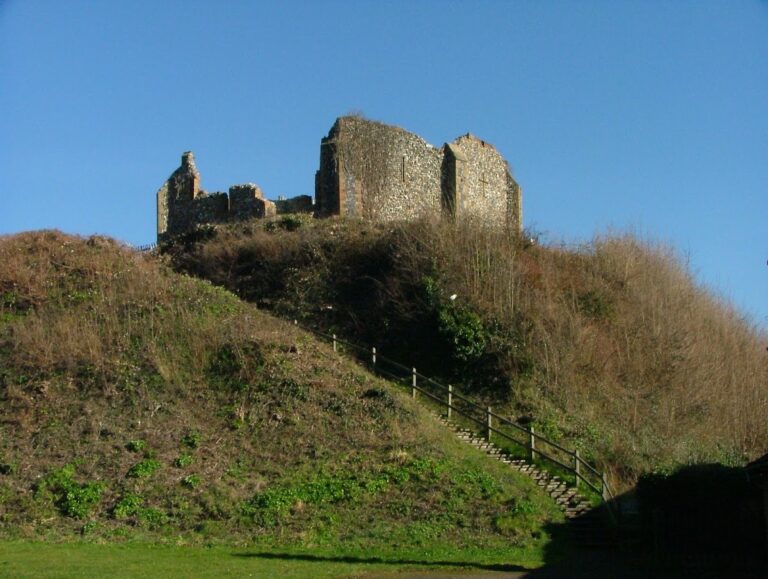
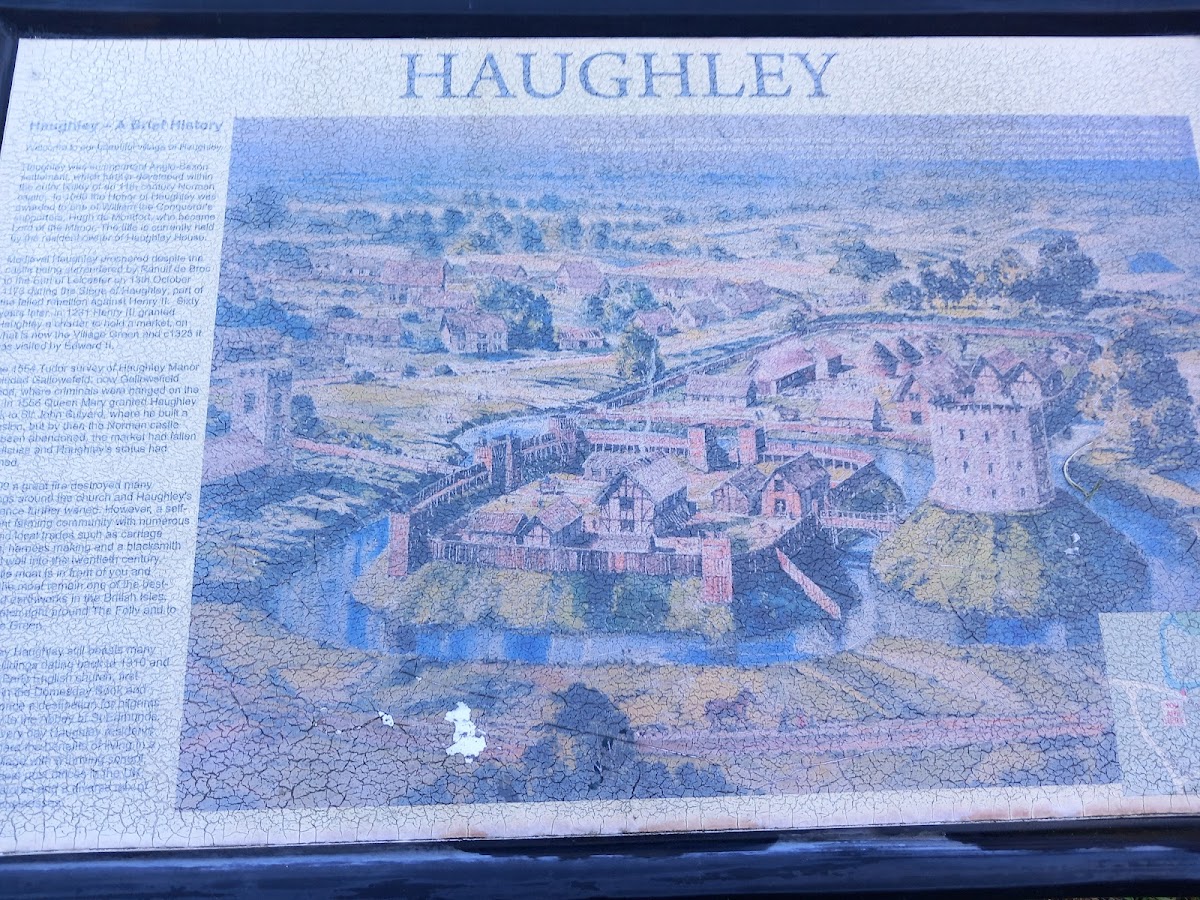
Haughley Castle survives as a large motte-and-bailey earthwork. This type of fortress combined a raised mound, or motte, with an enclosed bailey containing buildings, storage, occupation areas, and defensive activity. Both parts of the castle were protected by a deep ditch. A stream diverted from the west supplied the ditch with water, creating a wet moat around the earthworks.
The motte and defensive earthworks
The motte is unusually large, measuring approximately 210 feet, or 64 metres, across its base. Its height has been estimated at about 80 feet, or 24 metres, although the castle specialist D. J. Cathcart King considered a height of approximately 40 feet, or 12 metres, more likely. Circular foundations more than 8 feet thick remain visible on the mound. Earlier investigations attributed these foundations to a stone shell keep, a defensive enclosure built around the summit of a castle mound rather than a solid tower, although the keep’s foundations can no longer be identified with certainty.
The bailey and later buildings
The rectangular bailey measured approximately 390 by 300 feet, or 120 by 91 metres, and was entered from the west. The Inner Bailey later contained a manor house, while the Outer Bailey filled gradually with subsequent development. A further bailey may originally have surrounded the surviving earthworks and may also have enclosed the local church.
Surviving structural evidence
The removal of the remaining keep-tower fabric in 1760 altered the appearance of the summit, but the site still preserves substantial archaeological evidence. The 2011 excavation revealed extensive structural foundations together with fragments of intricately carved and dressed stone. J. C. Wall regarded Haughley’s earthworks as the most perfect of their type in Suffolk, while R. Allen Brown described the castle site as one of the most important in East Anglia.