Helmingham Hall: A Moated Tudor Manor House in Suffolk

Site at a Glance
- Rating
- 4.8
- Popularity
- Medium
- Country
- United Kingdom
- Primary era
- Early Modern
- External website
- Open
- Eras represented
- Early Modern, Modern
- Civilizations
- British, English
- Site type
- Domestic
- Remains
- Manor House
On this page9 sections
History
Origins and architectural changes
Helmingham Hall is a moated manor house in the United Kingdom, near Stowmarket in Suffolk, begun by John Tollemache in 1480 in a late medieval or Tudor style. It has remained in the Tollemache family ever since. The present house may have been built around 1510 on the site of an earlier building known as Creke Hall.
The exterior was altered between 1745 and 1760, then changed again in 1800 by John Nash, a prominent English architect of the late eighteenth and early nineteenth centuries. Further alterations followed in 1840. These successive changes modified the appearance of the house while retaining its medieval and Tudor foundations.
The Tollemache family and its collections
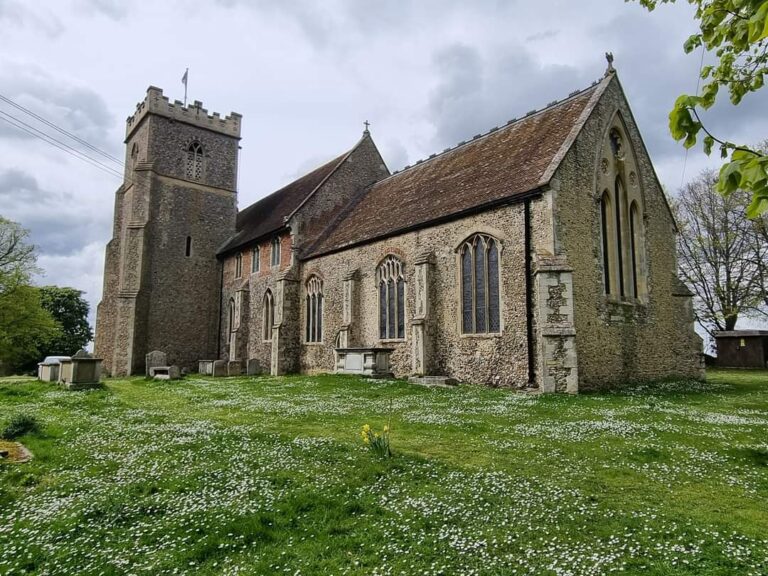
St Mary’s Church, situated at the edge of the park, has been connected with the Tollemache family since the Middle Ages. Its memorials commemorate several generations of the family, including a large tomb with a verse describing four generations of Tollemaches.
Catherine Tollemache lived at Helmingham Hall from 1581 to 1612. Household papers from her period survive, including recipes from her own time and earlier medieval recipes. The family collections also included the Tollemache lute manuscript, a written musical source containing lute music or instructions. Written by Henry Sampson, it was sold by Sotheby’s to Robert Spencer in 1965 and is now held at the Royal Academy of Music, although it retained the name “Tollemache” after its ownership changed.
Archaeological discovery and protection
An Iron Age and Roman coin hoard was found near the estate grounds on 8 September 2019. The 748 coins date to AD 47, during the Roman conquest of Britain. Sixty-three entered the collections of the British Museum and Colchester and Ipswich Museums. The remaining coins were offered at auction at Noonans Mayfair on 18 September 2024, with the proceeds divided between the finder and the current owners.
Helmingham Hall is listed Grade I on the National Heritage List for England. Grade I is the category for buildings or sites of exceptional interest. The park and formal gardens are also Grade I entries on the Register of Historic Parks and Gardens, while several estate buildings and structures have Grade II status, a category for nationally important buildings or structures of special interest.
Remains
The moated house
Helmingham Hall is arranged around a courtyard, with its late medieval or Tudor character still expressed in the plan. The original half-timbered walls, formed by a structural timber frame with infill between the timbers, are concealed by brick and tiles. A moat approximately 60 feet wide surrounds the house.
Two working drawbridges provide access across the moat. They have been raised every night since 1510. Windlasses originally operated them, but the mechanism was replaced in recent years by an electric motor. Their continued operation preserves a practical feature associated with the early history of the present house.
Estate buildings and garden structures
The estate includes a garden wall southwest of the hall, together with two urns, male and female statues, a sundial, an obelisk, tea rooms, a bridge, a game larder, and a revetment, a retaining structure that supports or protects a bank, slope, or edge. A gate lodge stands northeast of the hall. At the front are left and right lodges, joined visually by an entrance gateway with piers between them.
Formal gardens and deer park
The gardens combine semi-formal mixed planting with extensive herbaceous borders, a rose garden, a knot garden, and a parterre. A knot garden uses closely planted, interwoven patterns, while a parterre is a formal arrangement of garden beds and paths. The grounds also contain a walled garden, an allée, and an orchard. An allée is a formal, often tree-lined garden avenue. Lady Alexandra Tollemache, who works under the name Xa Tollemache, supervises the gardens.
Beyond the gardens extends a 400-acre deer park containing herds of red deer and fallow deer. The park forms part of the wider historic landscape associated with the hall and its gardens.
Musical instrument and archaeological objects
The Tollemache family collection includes one of only two English Orpharion viols. An Orpharion is a Renaissance plucked string instrument belonging to the cittern family. This instrument is dated 1580 and carries the label of John Rose, a sixteenth-century English viol-maker. It is the only one of the four surviving examples in private hands and is believed to have been made for Queen Elizabeth I, the Tudor queen who ruled England from 1558 to 1603. According to the tradition associated with the instrument, she presented it to the Tollemaches during one of her visits to Suffolk.
The estate’s archaeological material also includes the Iron Age and Roman coin hoard found in 2019. Its coins date to AD 47 and connect the grounds with the period of the Roman conquest of Britain, while the institutional holdings preserve part of the find in the British Museum and the Colchester and Ipswich Museums.
Nearby sites