Church of St Peter and St Mary: Medieval Parish Church of Stowmarket


Site at a Glance
- Rating
- 4.9
- Popularity
- Very Low
- Country
- United Kingdom
- Primary era
- Medieval
- External website
- Open
- Eras represented
- Medieval, Modern
- Civilizations
- English
- Site type
- Religious
- Remains
- Church
On this page9 sections
History
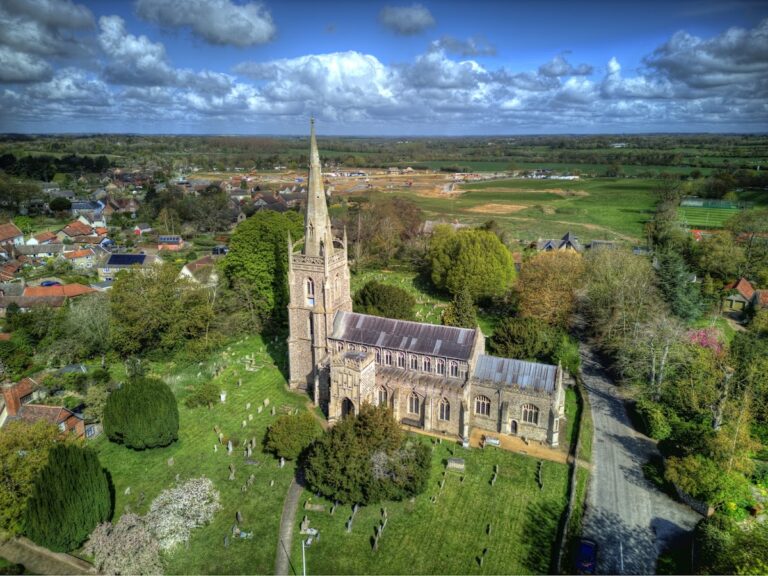
The Church of St Peter and St Mary is a fourteenth-century parish church in Stowmarket, United Kingdom, built in the Decorated Gothic style for the medieval town’s local parish. Its double dedication records the late-medieval union of the living of St Peter, an ecclesiastical benefice with its associated income and rights, and that of a separate church dedicated to St Mary.
Medieval origins
The main body of the church belongs to the fourteenth century, when it stood at the centre of Stowmarket’s medieval community. The tower was constructed later, forming part of the church’s subsequent development. The building’s history therefore reflects both the foundation of a parish church and the later consolidation of separate ecclesiastical institutions under one dedication.
Clergy, restoration, and remembrance
During the seventeenth century, Thomas Young served as vicar. He was also tutor to John Milton, the English poet and author of Paradise Lost, and was buried in the church. The building later underwent three separate Victorian renovations. Its interior was extensively restored in the mid-nineteenth century by Richard Phipson, architect to the Diocese of Norwich, an Anglican administrative jurisdiction.
The church contains memorials to Stowmarket residents who died in the First and Second World Wars, as well as numerous memorials to members of the Tyrrell family, local landowners. In November 2000, the then vicar received a nine-month prison sentence for embezzling church funds. The church remains an active Church of England parish church in the Diocese of St Edmundsbury and Ipswich, holding regular services. It has been protected as a Grade I listed building since 28 July 1950, a category used in England for buildings of exceptional architectural or historic interest.
Remains
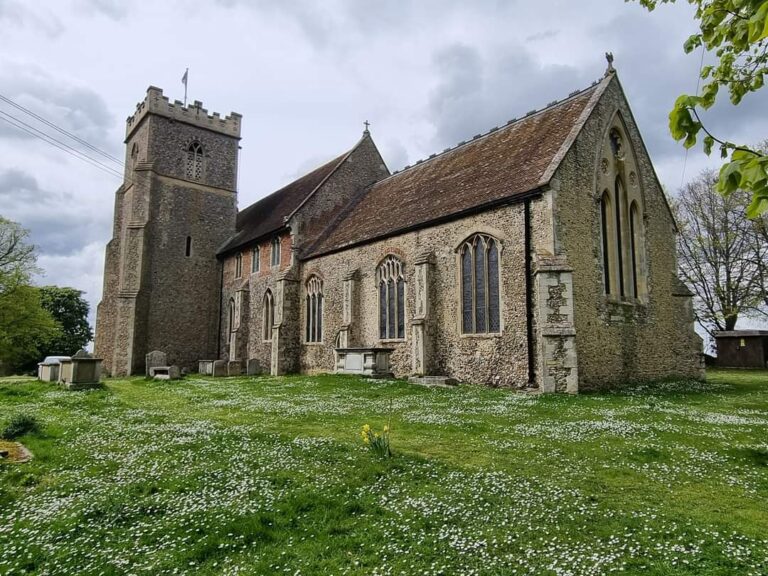
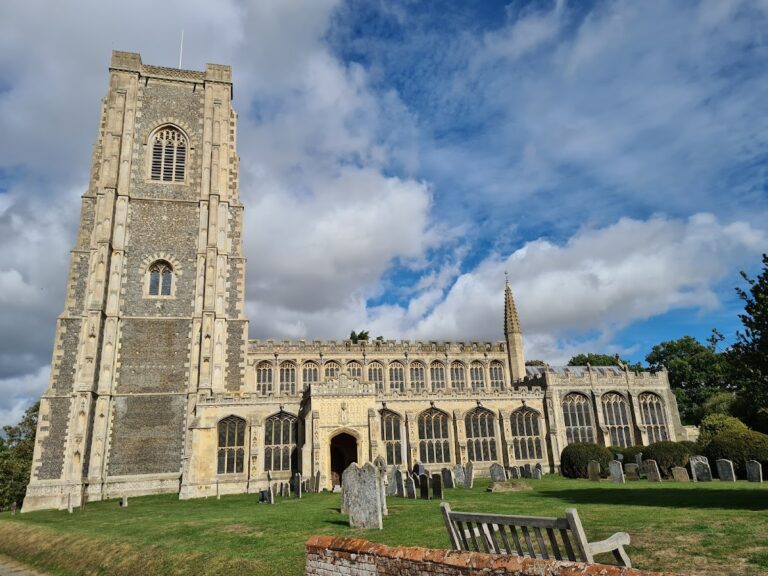
The church is built chiefly of local flint, with ashlar stone dressings, meaning finely cut and regularly shaped masonry used on architectural surfaces. Its architecture is mainly Decorated Gothic, a fourteenth-century phase of English Gothic associated with elaborate window tracery and curving ornament. The surviving building combines the medieval main body with a later tower and a sequence of replacement spires.
Church fabric, tower, and spire
Main body
Tree-ring dating places the timbers used in the spire at 1362–1363, while the main body of the church dates from the same general period. The flint walls and ashlar dressings express the local materials and Gothic construction of the medieval parish church. The interior was heavily renewed during the Victorian restoration led by Richard Phipson, leaving the present building with both medieval fabric and nineteenth-century intervention.
Tower
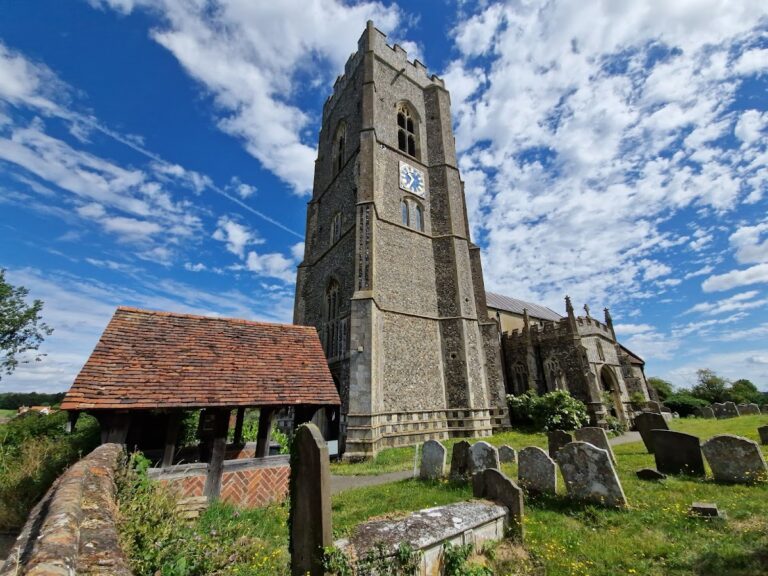
The tower was built after the main body of the church. It rises through four storeys and ends in a crenellated parapet, a battlemented upper edge formed by alternating raised sections and gaps. This later tower provides the support for the church’s spire and remains a distinct element of the building’s external form.
Spire
A medieval spire was replaced in 1674. The replacement was destroyed by the Great Storm of 1703, a severe windstorm that caused widespread damage in southern Britain, and another spire was installed in 1712. Instability led to its removal in 1975. A timber replacement was installed in 1993–1994, and, like its predecessors, it has an external gallery, a platform or walkway projecting around the outside of the spire.
Memorials
Within the church are memorials to members of the Tyrrell family, who were local landowners, together with commemorations of Stowmarket residents killed in the First and Second World Wars. These memorials connect the medieval parish building with the people and families remembered in its interior.