Protestant Town Church in Sinsheim: A Church of Shared Worship
Site at a Glance
- Rating
- 4.3
- Popularity
- Low
- Country
- Germany
- Primary era
- Modern
- External website
- Open
- Eras represented
- Early Modern, Modern
- Civilizations
- Electoral Palatinate, Grand Duchy of Baden, Holy Roman Empire
- Site type
- Religious
- Remains
- Church
On this page10 sections
History
Origins and the Reformation
The Protestant Town Church in Sinsheim, Germany, traces its origins to the twelfth century, when the Church of St James was established in the town alongside a collegiate church on Michaelsberg. A collegiate church was served by a chapter, or community, of clergy. The town church’s present form developed around 1800.
A Protestant pastor was expelled from Sinsheim in 1527, but the Reformer Ottmar Stab served there around 1540. The Reformation, a sixteenth-century movement that reshaped Western Christianity, was formally established in Sinsheim in 1553, when the Electoral Palatinate appointed the town’s first Protestant clergyman. The Electoral Palatinate was a German territory ruled by Palatine electors. A church order, setting out rules for the church community, followed in 1557, and the Reformed tradition became predominant from 1559. The town was briefly Lutheran from 1576 to 1583, then Catholic for a time during the Thirty Years’ War, a European conflict fought from 1618 to 1648.
A shared church and its rebuilding
A Lutheran congregation was re-established in 1696. The following year, after the collegiate foundation had been dissolved, the town’s only remaining church was in ruins but came into joint use by Protestant congregations and the officially readmitted Catholic congregation. Sinsheim was burned during the War of the Palatine Succession, a late-seventeenth-century conflict, in 1698, and the church suffered severe damage.
In 1707, a church division in the Palatinate assigned the choir, the altar area, to the Catholics, and the nave, the main space for the congregation, to the Reformed community. A dividing wall was added in 1712, and the nave was renewed in 1717. Damage appeared there in 1734; construction defects led to its closure in 1766. It was renewed again by 1782, while the Catholic portion was repaired by 1788.
After the Lutheran and Reformed congregations joined to form the Evangelical State Church in Baden, they continued to worship in the town church. The Catholic congregation used its portion until its Church of St James the Elder was completed in 1967.
The bells
When the dilapidated tower’s bells were removed in 1780, a large bell was later hung in the town hall tower. A smaller bell dated 1418 was sold in 1812 to the church at Eschelbach; it is now in the Kurpfälzisches Museum in Heidelberg. After the town church tower was completed, the church obtained three new bronze bells from the Barthels brothers of Frankfurt. In 1832, two larger bells from the Lutheran church were transferred to the town church, while a smaller former Lutheran bell went to the town hall. Two of the Lutheran bells had been cast by Lucas Speck in Heidelberg in 1805. The smallest Barthels bell cracked in 1863 and was recast the following year by Georg Hamm in Kaiserslautern.
During the First World War, the three largest bells were taken for armaments, leaving the Hamm bell and the small Speck bell. In 1923, the Speck bell was replaced by a second-hand bell cast in 1725 by Konrad Scheel in Kolberg, and two cast-steel bells were added. During the Second World War, the two older bronze bells were requisitioned. The steel bells left behind were later sold for scrap.
A small baptismal bell dated 1441 survived both world wars. It was not registered during the First World War and was considered important to preserve during the Second.
Remains
Church layout
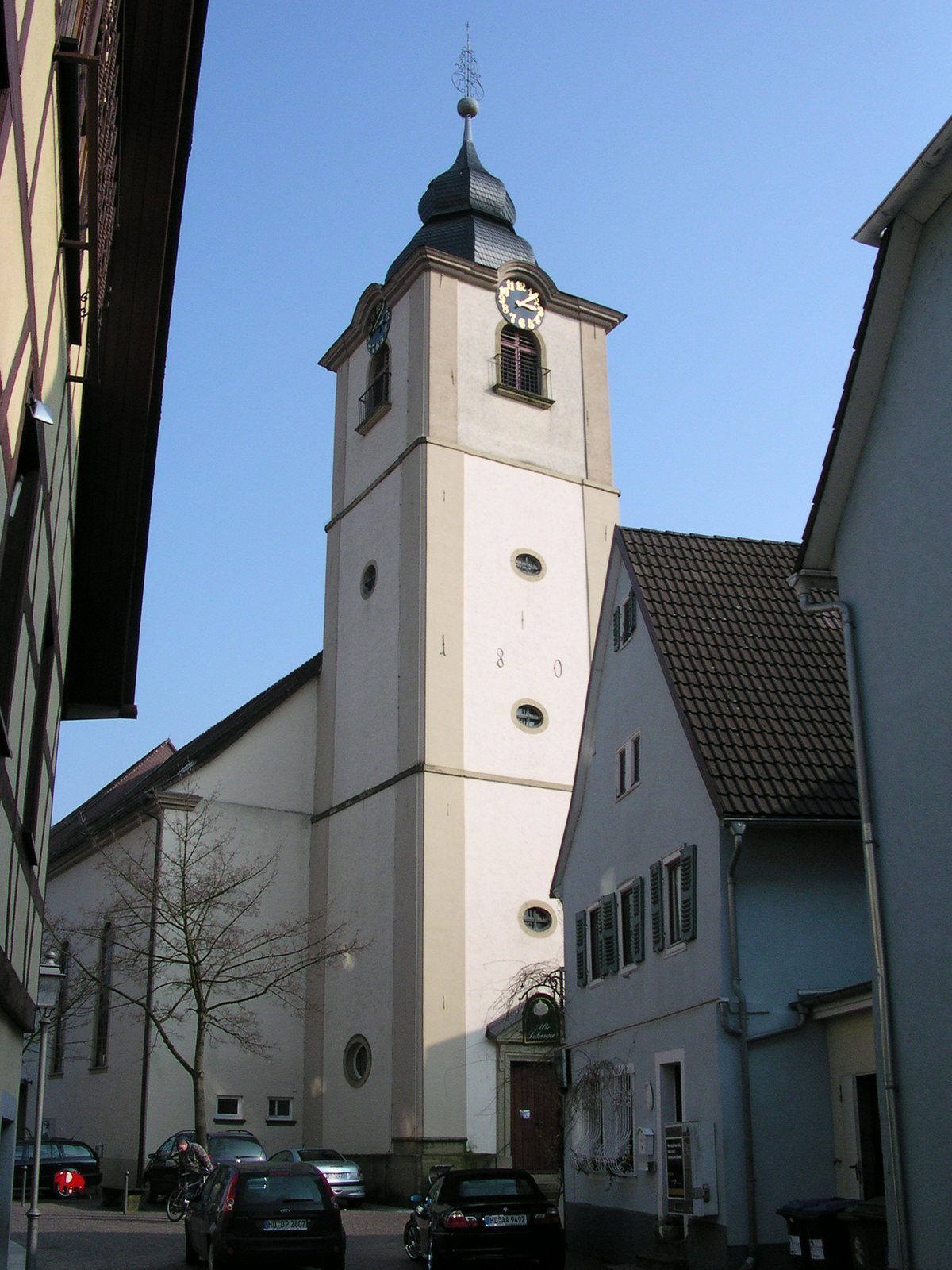
The church’s principal parts are its choir, nave, and tower. The building took its present form around 1800, and the tower was completed in 1806. These elements preserve the division between the altar area and the main congregational space that shaped the church’s use.
Organ
G. F. Steinmeyer & Co. built the organ in 1968. It has 39 stops, which control sets of pipes, arranged across three manuals, or keyboards, and a pedal played with the feet. Some stops from the earlier organ, built by E. F. Walcker & Cie. in 1928, were reused.
Bells
The four-bell peal
The tower holds a bronze peal, a set of bells sounded together, cast in 1958 by Friedrich Wilhelm Schilling in Heidelberg. The Christ Bell sounds C (c’), measures 154.7 centimetres across, and weighs 2,173 kilograms. The Mary Bell sounds E-flat (es’), measures 128.4 centimetres, and weighs 1,391 kilograms. The Joseph Bell sounds F (f’), measures 115.5 centimetres, and weighs 1,039 kilograms. The Prayer Bell sounds A-flat (as’), measures 104.8 centimetres, and weighs 775 kilograms.
The baptismal bell
The separate baptismal bell from 1441 sounds D-flat (des”), measures 39 centimetres across, and weighs 47 kilograms. Its inscription reads: "ihesus + maria + ano + m + cccc + xli."