Marienstatt Abbey: A Cistercian Monastery and Pilgrimage Site in Germany
Site at a Glance
- Popularity
- High
- Country
- Germany
- Primary era
- Medieval
- Eras represented
- Medieval, Early Modern, Modern
- Civilizations
- German, Holy Roman Empire
- Site type
- Religious
- Remains
- Monastery
On this page24 sections
History
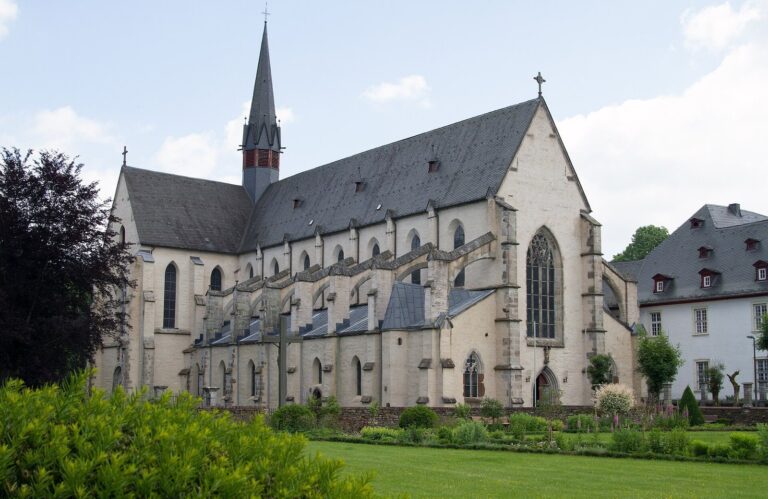
Marienstatt Abbey is a Cistercian monastery and pilgrimage site in the Nister valley at Streithausen, Germany. Founded in 1212, it belongs to a Catholic monastic order that began at Cîteaux, and its church is an early Gothic basilica. The community’s institutional lineage ran through Heisterbach and Himmerod to Cîteaux; Himmerod had been founded from Clairvaux in 1134.
Foundation and relocation
The abbey was first established at Neunkhausen through a gift from the regional nobles Eberhard of Aremberg and Adelheid von Molsberg. Building probably began in 1212 or 1213. In 1215, the archbishop of Trier confirmed the foundation, and the founding community left Heisterbach for Neunkhausen under Abbot Hermann. By then, the principal monastic buildings were likely in place.
Disputes over the original gift and the poor farming conditions at Neunkhausen led Hermann to seek a new site. In 1222, Count Henry III of Sayn and his wife, Mechthild of Landsberg, granted the monks the Nistria estate in the Nister valley and income from wine at Metternich, near Koblenz. The abbey also retained authority over the parish of Kirburg. A tradition later recorded in the Marienstatt Panels of 1324 relates that Mary appeared to Hermann in a dream and showed him a hawthorn flowering in winter. The community’s name means “place of Mary,” and a flowering hawthorn branch became its emblem. The first church at the new site was consecrated on 27 December 1227 under Abbot Conrad, and the monks settled there permanently.
The relocation moved the abbey from the Diocese of Trier to the Archdiocese of Cologne, weakening Trier’s position in the area while expanding Cologne’s eastern territory. The church was enlarged from 1243, consecrated again in 1324 under Abbot Wigand of Greifenstein, and subject to further building work into about 1425.
Privileges, estates and pilgrimage
Pope Honorius III issued a protection privilege in 1219 and further privileges in 1225–27. In 1225 he confirmed the abbey’s possessions in the Nister valley, exempted it from material claims by bishops, and reinforced the legal position of its abbot and prior. Later popes, including Alexander IV and John XXI, confirmed its privileges. In 1276, John XXI also exempted the abbey from secular taxes.
Marienstatt built up property and rights well beyond its valley. From 1272 it held rights and land in Dorchheim, where it established a separate estate administration. Its holdings there exceeded 200 Morgen, a traditional land measure that varied in size, and included patronage of St Nicholas’s Chapel. The abbey also acquired or managed estates around Engers, Gönnersdorf and Feldkirchen, and enjoyed customs exemption in the Neuwied basin. Gifts, leases, exchanges and sales reshaped those holdings over time.
Public access to services in the church was permitted in 1476. The octave of Corpus Christi, the eighth day after the Catholic feast, became the main pilgrimage day in 1485. A fair was already linked to the church’s consecration feast; in 1479, Count Gerhard of Sayn granted the abbey its toll revenue. This period of building and pilgrimage was interrupted by plague in 1490, when the monks briefly left, and by disputes with the counts over territorial authority.
Reformation and wartime damage
From 1561, the Counts of Sayn introduced the Reformation, a movement that established Protestant churches and brought changes within Western Christianity, in their lands. They also took the abbey’s authority over Kirburg and the Nister valley. The dispute continued until a settlement in 1582 recognized Marienstatt’s independence from the counts’ claims.
On 3 October 1633, during the Thirty Years’ War, a major European conflict fought from 1618 to 1648, Swedish forces declared the abbey crown property, expelled the monks and plundered the complex. After the troops withdrew, the community returned in a precarious condition. By the mid-1630s only a small group remained; nine monks sent from Heisterbach helped prevent the abbey’s closure.
After the war, the community recovered and undertook extensive construction. Most of the present monastic buildings, though not the church, date from this period. In 1659, Michaelstein Abbey in the Harz was placed under Marienstatt, and Abbot Johannes Pflüger received pontifical insignia, liturgical symbols such as a mitre that an abbot could be authorized to use. Under Abbot Benedikt Bach, the church received Baroque furnishings and the abbey and its farmyards saw extensive rebuilding. From 1735 to 1751, Abbot Petrus Emons replaced older monastic buildings with Baroque structures; a matching gatehouse followed in 1754. Bottenbroich Priory came under Marienstatt in 1777.
During the wars of the First Coalition, European alliances formed against revolutionary France in the 1790s, the abbey served as a military hospital in 1794–95 and 1796–97. A cemetery was established for soldiers, and French troops plundered the complex several times. The monks temporarily left during this period.
Suppression and the return of monastic life
Secularization suppressed the abbey on 19 October 1802 and transferred it to Count William of Nassau-Weilburg. The last monks left in 1803, although Catholic services continued in the church. A workshop making iron goods operated in former abbey buildings from 1806 to 1811, and a wool-weaving and fulling business ran from 1809 until about 1815. After the buildings stood empty, an English-German mining company bought them with plans to use them as offices. Nassau repurchased the deteriorated complex in 1842, but a proposed workhouse was never established.
On 18 May 1864, the duchy sold Marienstatt to Peter Josef Blum, Bishop of Limburg, who founded an institution for neglected boys. Spiritan fathers initially ran it, but the Kulturkampf, a nineteenth-century conflict between the Prussian state and the Catholic Church, led to the order’s expulsion in 1873. Diocesan priests then took charge, sometimes assisted by the Poor Handmaids of Jesus Christ. The institution moved to Marienhausen in 1889.
Monks from Wettingen-Mehrerau bought and resettled Marienstatt in 1888 under Dominikus Willi. The abbey has since belonged to the Mehrerau Congregation, an association of Cistercian monasteries. Willi later became Bishop of Limburg. A new library was built in 1909, and an Oblate school, which prepared young people for the religious order, opened in 1910. The abbey’s former mill and water channel were also put back into operation after the monks returned.
Twentieth century and continuing use
During the First World War, the gatehouse served as a convalescent home for soldiers. In 1922 Marienstatt helped resettle its former mother abbey, Himmerod, and Hardehausen Abbey. The church received the honorary title of minor basilica in 1927. Under the Nazi regime, Marienstatt narrowly avoided suppression, while its Oblate school was closed.
During the Second World War, the abbey served as a hospital and housed a children’s home from Dormagen, an old people’s home from Frankfurt, and the theological college of Sankt Georgen. Eight monks died as a result of wartime hostilities. After the war the school reopened and grew into a secondary school, becoming a gymnasium in 1963. A boarding facility was built between 1958 and 1962, expanded with a single-room wing in the late 1960s, and closed in 1982.
In 2010, former pupil Arno Benner spoke publicly about humiliating treatment and an oppressive atmosphere at the former boarding school. Two books published in 2024, drawing on former pupils’ recollections, described allegations of oppression, psychological intimidation, mistreatment and harsh discipline between 1947 and 1954.
The church underwent restoration in 1941–47 and again in 2000–07. In 2015, Marienstatt parish was merged into the larger parish of Maria Himmelfahrt Hachenburg. The abbey remains an independent Cistercian community in the Diocese of Limburg. Monks continue public choral prayer in the church, which also serves Catholics from nearby villages. The pilgrimage season runs from 1 May to the feast of the Nativity of Mary on 8 September, with the octave of Corpus Christi as its principal pilgrimage day.
Remains
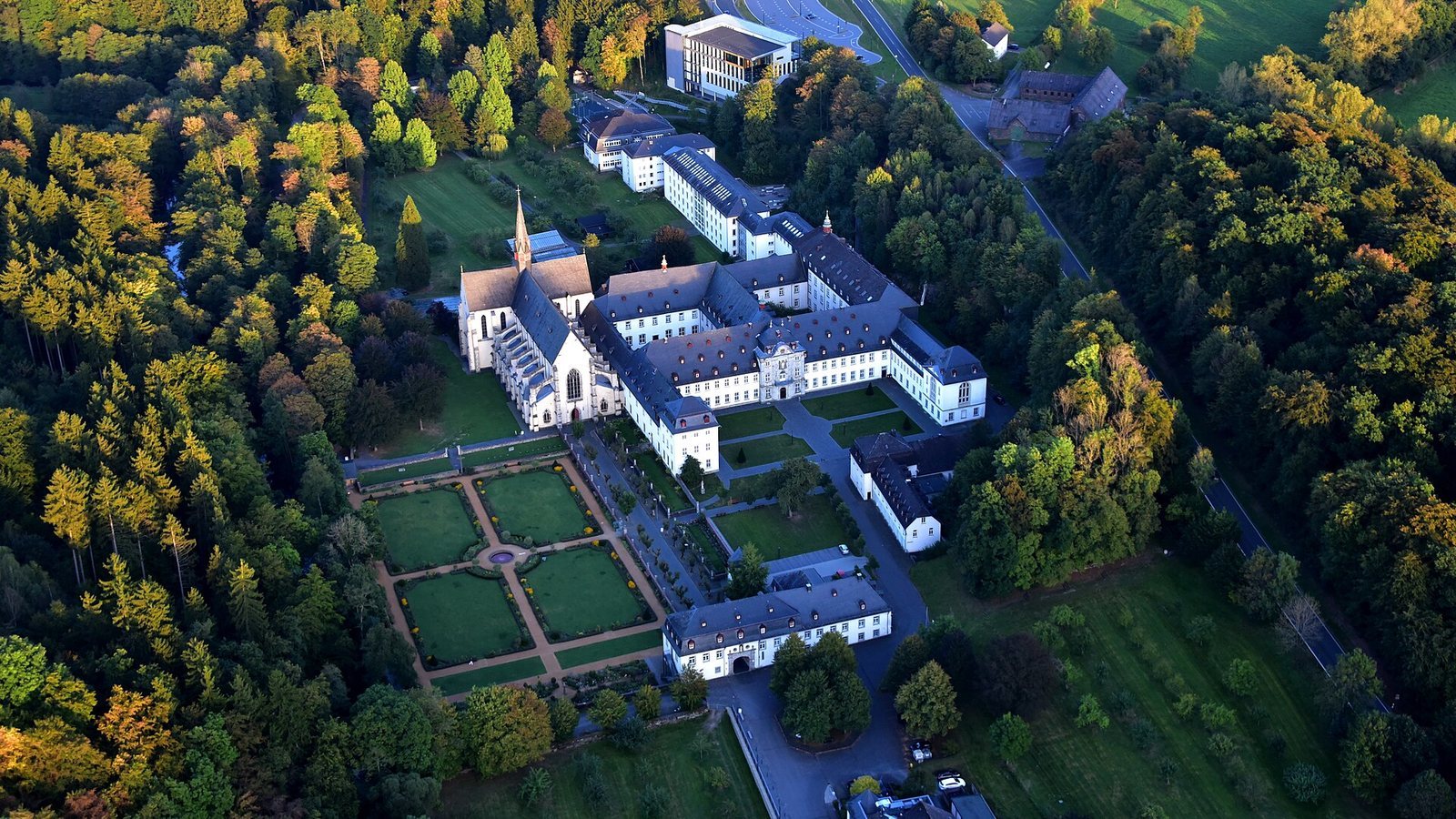
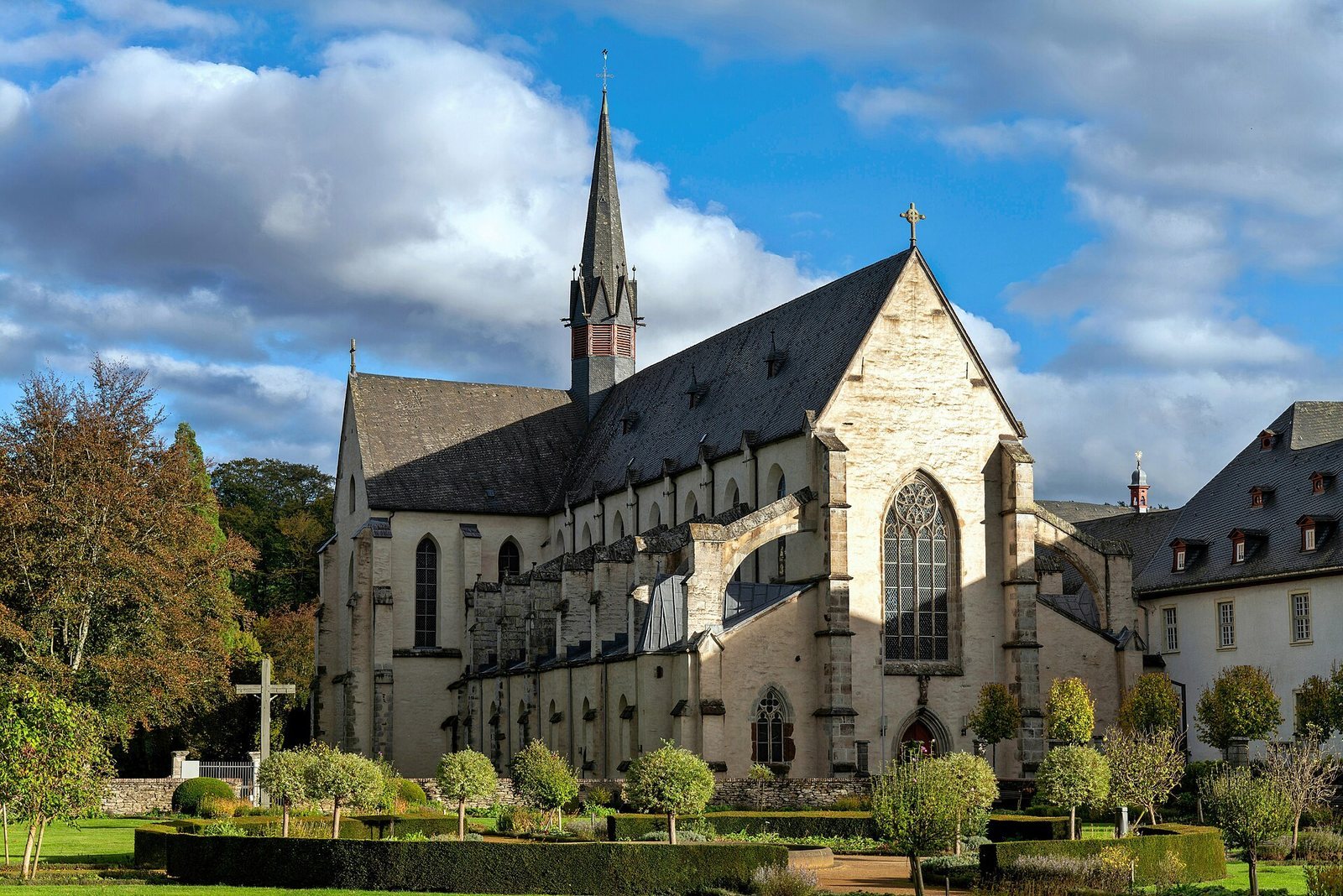
The abbey occupies a valley beside the Nister. Its grounds bring together an early Gothic basilica, monastic buildings, a school, library, brewery, guesthouse, chapels, gardens, a bridge and a water-powered mill system. The buildings reflect successive periods of use and construction, while several historic furnishings and devotional features remain part of the complex.
The church
Plan and structure
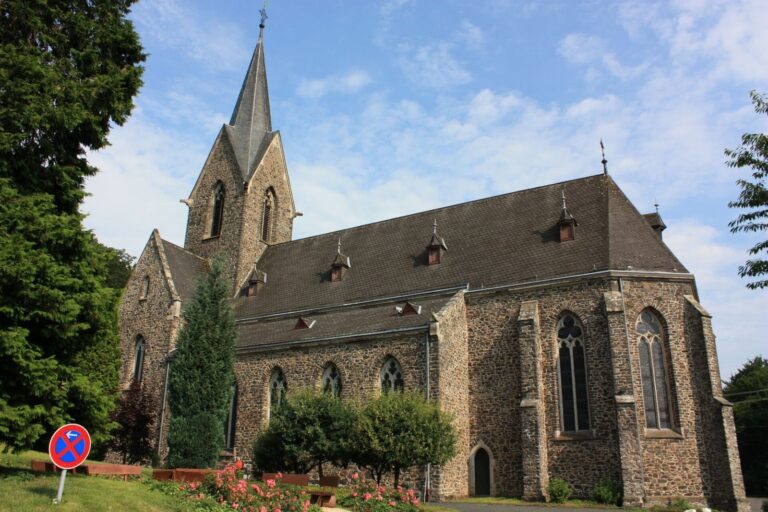
The early Gothic church is a three-aisled basilica, with a central space flanked by two side aisles, and has a transept, the crosswise arm of a church. Its design draws on Heisterbach Abbey and French art. A small bell turret rises over the crossing and holds four bells. The church was remodelled in a Neo-Gothic style between 1879 and 1891, a nineteenth-century revival of Gothic forms, and some furnishings were removed. During restoration work in 1941, the organ then in use and its gallery were demolished.
Medieval furnishings and tombs
The choir stalls, dating to about 1300, remain in use and are among Germany’s oldest. The high altar is a winged altarpiece, with hinged panels, made about 1350. Approximately five metres wide and 2.3 metres high, it bears figures of Christ, Mary, Saint Ursula and her companions, and the twelve apostles. A Pietà, a sculpture of Mary holding the dead Christ, was installed in 1425 and dates to around that time.
A tomb for Gerhard of Sayn and Elisabeth of Sierck was made between 1487 and 1493. The church also holds a tomb for Johann Pithan, a canon, or cleric attached to a cathedral or collegiate church, who died in 1516. His tomb was transferred from Niederwerth monastery.
Baroque and later furnishings
Baroque furnishings include three side altars made in 1717–18 and dedicated to the Trinity, Saint Barbara and Saint Anthony. The church also has three marble altars in its south aisle, a confessional, an iron grille, a holy-water basin and a clock dated 1750. A new choir altar by Leon Zogmayer was installed in 2009.
Organs
The church has had a succession of organs. A sixteenth-century instrument stood in a gallery attached to the north wall, while a large late-eighteenth-century organ occupied a gallery in front of the west window. In 1854, Daniel Raßmann replaced the latter with an instrument of 16 stops, selectable sets of pipes, played from two manuals and a pedalboard, reusing some material from the earlier organ. A 45-stop choir organ was in use from 1912 and later moved to the parish hall during restoration.
In 1950, Anton Feith built another organ using material from the choir instrument; it was sold to St Peter’s parish in Cologne-Neuehrenfeld in 1964. A small rented organ served the church in the intervening years. The present organ, built by Rieger in 1969–70, was enlarged in 2006–07 and gained three further stops in 2015. It has four manuals and a pedalboard, 67 stops and more than 5,000 pipes. It incorporates a Spanish Trumpet, a reed stop designed to sound like a trumpet, dating to 1732. The organ is the largest in the Westerwald, and its Spanish Trumpet is described as the only authentic example outside Spain.
Monastic buildings and collections
Buildings and gatehouse
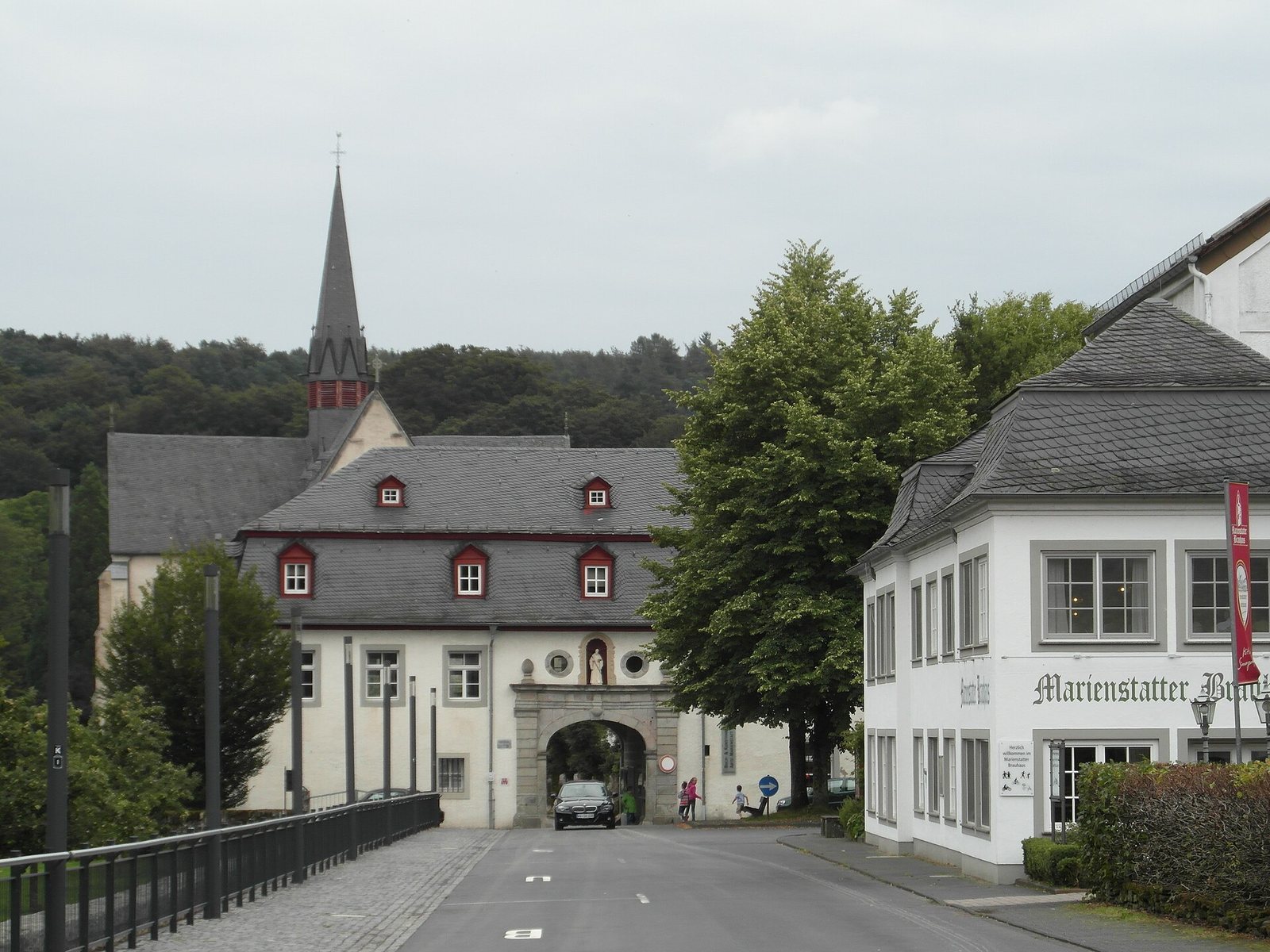
Most of the monastic buildings visible today belong to the postwar rebuilding of the abbey after the Thirty Years’ War. They include Baroque structures built in place of older quarters and a matching gatehouse. The west side of the abbey has a richly decorated central projection made of trachyte, a volcanic stone. The church and the abbot’s wing belong to the state of Rhineland-Palatinate; the other monastic buildings belong to the abbey.
Library
The library is now housed in the main school building and has occupied two other locations on the grounds. Its collection contains about 112,700 books, including about 21,500 historic antiquarian holdings protected since 2017. The collection also includes apostle figures in the Hadamar Baroque style, a regional form of Baroque art, dating to the seventeenth and eighteenth centuries. Ten of the figures had been conserved and restored by 2025.
Chapels and cemetery
Three chapels stand on the grounds: the Marienkapelle, Kriegerkapelle and Annakapelle. The Annakapelle is inside the buildings and can hold about 200 people. A separate cemetery serves the deceased monks of the abbey.
Gardens and devotional features
Gardens and avenue
The Baroque garden, with a fountain, flowers and other plants, was reconstructed in 2010–11. A natural-stone monastery wall borders the garden and supports wild and uncommon plants; a separate medicinal-plant garden is used for growing herbs. A lawn and Baroque-style garden occupy the area to the right of the basilica avenue, whose trees are part of the abbey’s conservation work. A hawthorn cutting associated with the foundation tradition grows between the monastic buildings and the avenue, near a statue of Joseph.
Great Way of the Cross
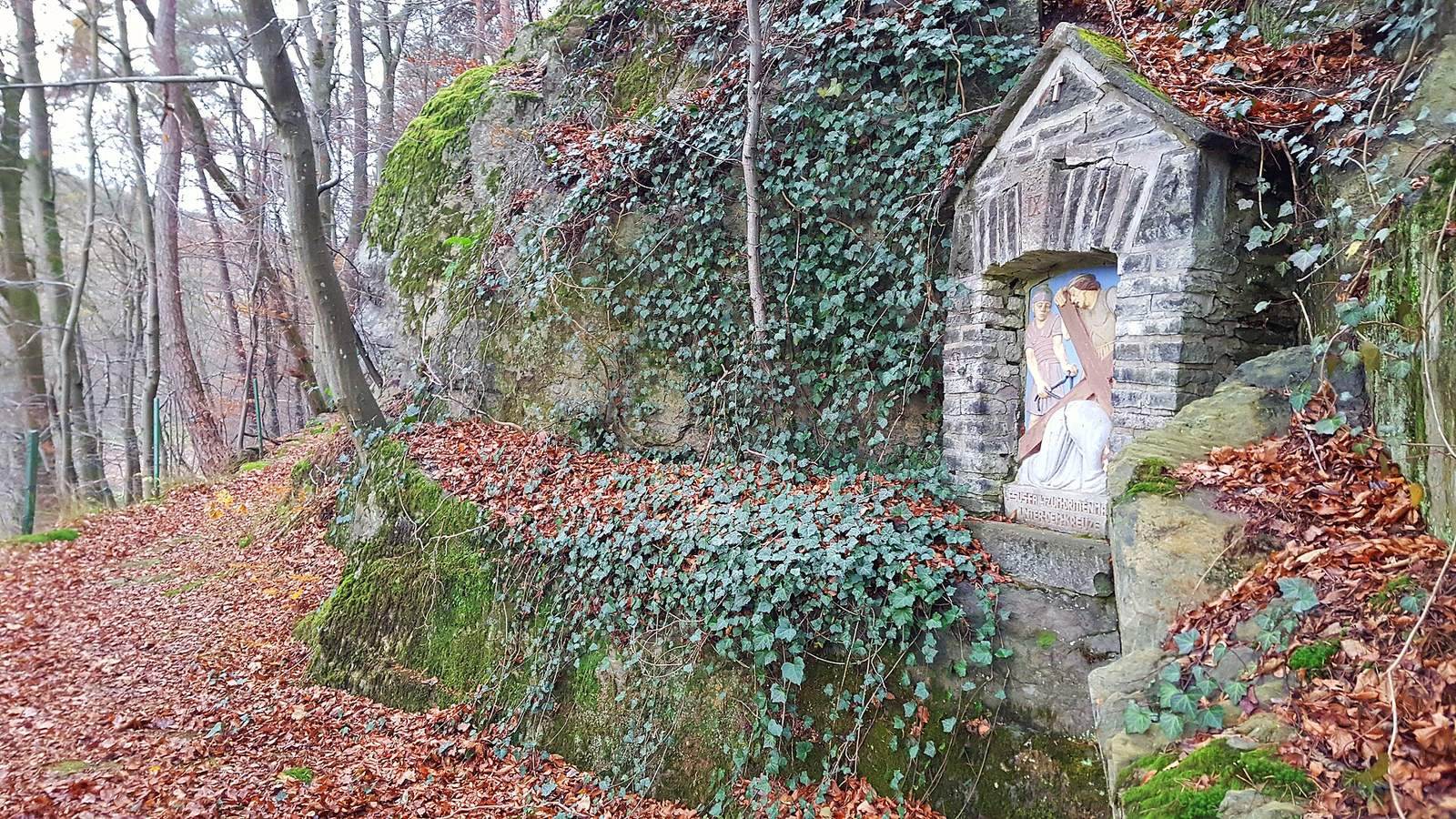
The Great Way of the Cross was erected shortly after the Second World War. At its ninth station, pressure from earth and rock and penetrating moisture caused serious cracks. Restoration work addressing the damage began in 2018. At the twelfth station, an altar supports a monumental cross; the altar has also been restored.
Old Brick Meadow
The Old Brick Meadow lies above the brewery. Its name probably recalls bricks fired there for a pilgrims’ hostel, from which the later brewery developed. A stele by Walter Jansen was installed in the garden in 2024. It depicts Robert of Molesme, Alberic of Cîteaux, Stephen Harding and Bernard of Clairvaux, early leaders in the formation and development of the Cistercian order.
Bridge, mill and soldiers’ cemetery
Nister bridge
The historic bridge across the Nister is built of rubble stone and was first recorded in 1478. It was renewed between 1721 and 1734 and once carried traffic on the Cologne–Leipzig route. It is now used by pedestrians and cyclists.
Mill and water system
The mill system diverts water from the Nister along an artificial channel. Its weir lies about one kilometre southeast of the turbine house. A 120-metre tunnel shortened the channel and increased its gradient; the turbine house contains the power-generation equipment. A photovoltaic installation was added to its roof in 2000, and the turbine and generator were replaced in 2002. The system also uses Nister water for heat pumps. A solar thermal installation on the school library roof, added in 2004, provides heat for domestic water.
Soldiers’ cemetery
The separate cemetery established when the abbey served as a military hospital during the wars against revolutionary France contains the graves of 636 soldiers.