Evangelical A. C. Temple of the Holy Trinity: A Lutheran Church in Prešov
Site at a Glance
- Popularity
- Low
- Country
- Slovakia
- Primary era
- Early Modern
- Eras represented
- Early Modern, Modern
- Civilizations
- Austrian Empire, Habsburg, Hungarian
- Site type
- Religious
- Remains
- Church
On this page13 sections
History
A Catholic predecessor and a Protestant city
The Evangelical A. C. Temple of the Holy Trinity is a Lutheran church in Prešov, Slovakia, built by the city’s Protestant community between 1642 and 1647 in the late Renaissance, the later phase of a European cultural period. A small Catholic church dedicated to Saint Ladislaus, a medieval king of Hungary later venerated as a saint, had stood on the site from the fifteenth century. It served Prešov’s Hungarian community and had probably disappeared by the mid-sixteenth century.
Prešov embraced Protestant ideas associated with Martin Luther early. In 1531, the Catholic priests Anton Transylvanius and Bartolomeus Bogner and their congregations adopted the Reformed confession. The city soon became uniformly Protestant, and no other denomination had a church there for the next 140 years. Congregations worshipped in German, Slovak, and Hungarian communities. The German congregation used the present Saint Nicholas Church, while the Slovak congregation used the present Greek Catholic Cathedral of Saint John the Baptist. Hungarian Protestants first built a smaller church elsewhere in 1565, then replaced it with a larger church on the former Saint Ladislaus site when their first building proved inadequate.
Construction and repeated transfers
Local Protestants built the present church with substantial support from Daniel Lengfelner, who served as Prešov’s mayor during 1642–1648 and 1653–1656. Protestant pastor Jakub Jakobeus blessed the foundation stone in 1642, but construction finished after his death. The church was completed on 15 June 1647 and consecrated the following day.
Control of the church changed repeatedly during conflicts between Protestant communities and Catholic authorities. After the suppression of the Wesselényi conspiracy, a seventeenth-century anti-Habsburg plot, the church was taken from the Evangelicals in 1671 and given to the Jesuits, members of the Catholic Society of Jesus. It returned to the Evangelicals in 1682 during an anti-Habsburg uprising led by Emeric Thököly, but came under Jesuit administration again in 1687. Francis II Rákóczi’s later anti-Habsburg uprising brought another return in 1705. After that revolt was suppressed, Queen Eleonora Magdalena ordered the Evangelicals on 25 June 1711 to surrender the church and build another outside the city. The Jesuits again took charge.
Evangelical ownership and congregational life
In 1773, after the Jesuit order was suppressed, the church became state property. The Evangelicals bought it from the municipal authorities in 1784 for 6,000 florins, a historical currency unit. The purchase took place at auction on 24 November, and church supervisor Žigmund Toporcer took possession. Slovak and German congregations worshipped together there; the German congregation later became German-Hungarian. At the time, the two congregations had 2,606 members, including 1,553 Slovaks.
Fire, restoration, and church institutions
A city fire on 5 July 1788 destroyed the church’s roof and tower. The building underwent repairs in 1850, when the main portal was repaired, and again in 1867. Pastors L. Liptai and Lajos Draskóczy oversaw a thorough renovation in 1905. A major fire on 13 May 1913 damaged the interior fittings and organ, destroyed the altar painting, and left smoke stains on the paintings. The church was restored in 1914, with the work formally received at a service on 6 December. The painting’s loss prompted speculation that it had been stolen and that the fire had concealed the theft, but this remained conjecture.
After Czechoslovakia was established in 1918, Slovak Evangelicals separated from the Hungarian church organization. Prešov became the seat of the Eastern District, a regional unit of the Evangelical Church of the Augsburg Confession in Slovakia, in 1930. This Lutheran tradition follows the Augsburg Confession, a foundational statement of Lutheran belief. The church served as the district’s principal church until 1945 and again from 1994. It belongs to the Šariš-Zemplín seniorate, another regional church unit. A major restoration took place from 1980 to 1982. The church was declared a Slovak national cultural monument on 17 April 1963.
Remains
Building and spatial arrangement
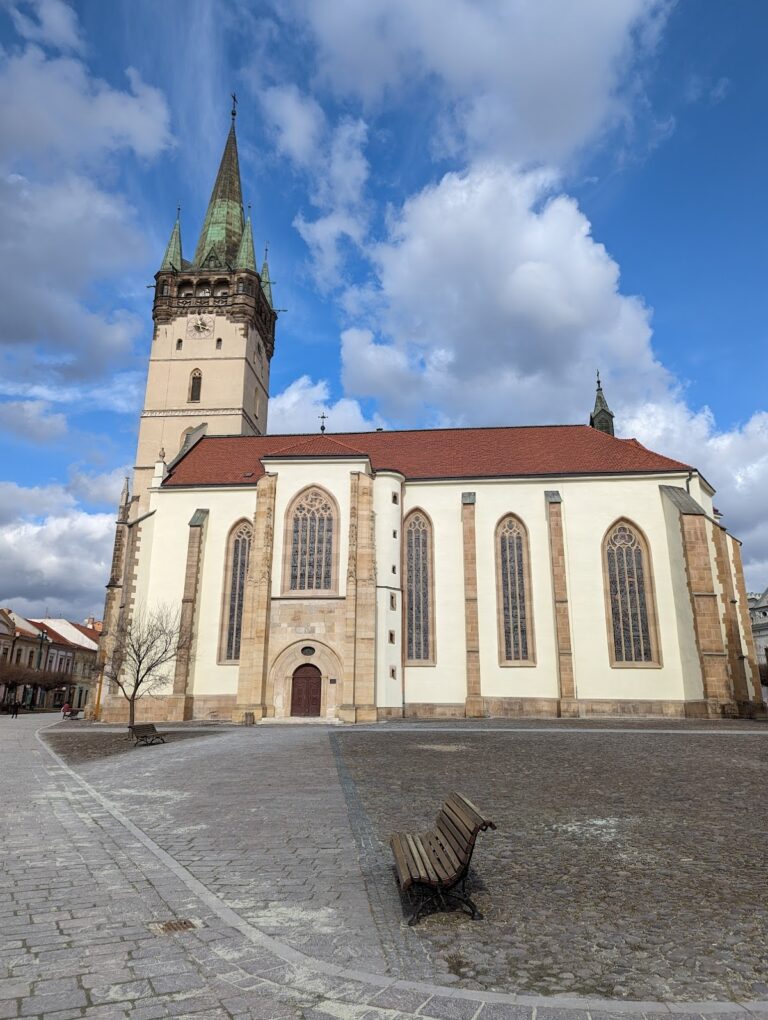
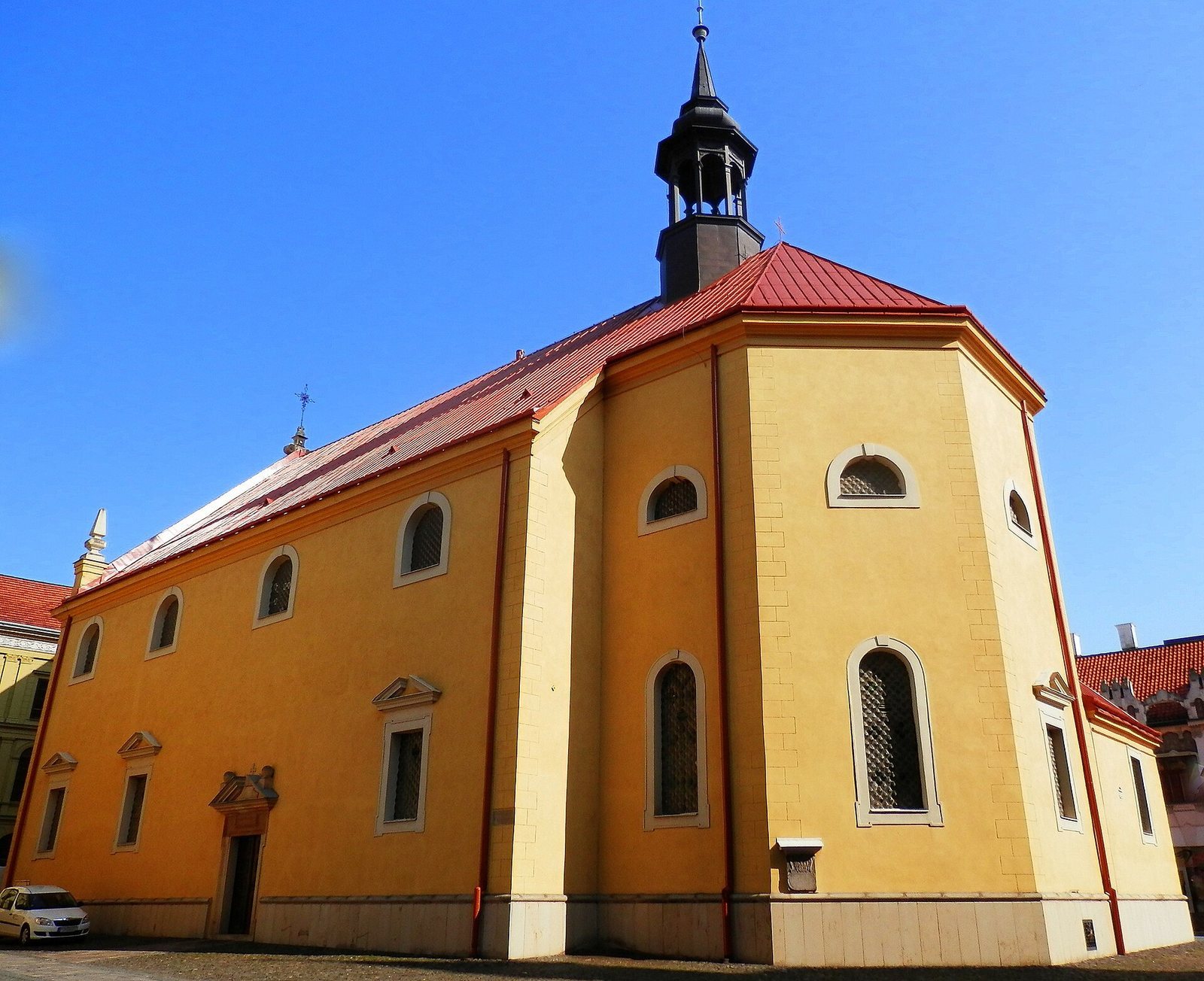
The church is a large masonry building aligned north–south. Its plan has a single nave, or main body, ending in a three-sided form, with raised galleries along both sides. The north gallery holds the organ. The building is 36 m long; its width is given as 16 m (13 m). Its restrained interior uses painted effects to represent marble ornament.
Exterior and entrances
A small turret rises from the roof ridge and is topped by a star. The principal entrance is on the north side, facing the college, and a second entrance is on the west, beside a former church school. Above the main portal, a Latin inscription records the church’s foundation and completion, identifies the royal free city of Prešov, a self-governing town under the Hungarian crown, as its funder, and names Mayor Daniel Lengfelner and overseers Adam Czimmermann and Daniel Schneider.
Sacristy and memorial plaque
The sacristy, a room where clergy prepare for services and keep liturgical objects, is attached to the east side of the chancel, the area around the altar. It lies to the left of the altar and is entered beside the pulpit. Its sixteenth-century Renaissance door retains its original ironwork and key. A plaque beside the pulpit commemorates Evangelical pastor Matej Bahyl, who served the congregation from 1734 to 1746. It gives his dates as 24 February 1706 and 24 December 1761 and quotes Revelation 3:10.
Crypt
A crypt, or underground burial chamber, lies beneath the pulpit in the basement area before the altar. The Jesuits adapted it and enlarged it in 1754. Its burials include Jesuit superior Juraj Postek and František Perger, who led the construction of Calvary, a devotional site representing Jesus’s Passion. Evangelicals closed the crypt to prevent further burials and avoid disturbing those they regarded as religious opponents.
Altar and paintings
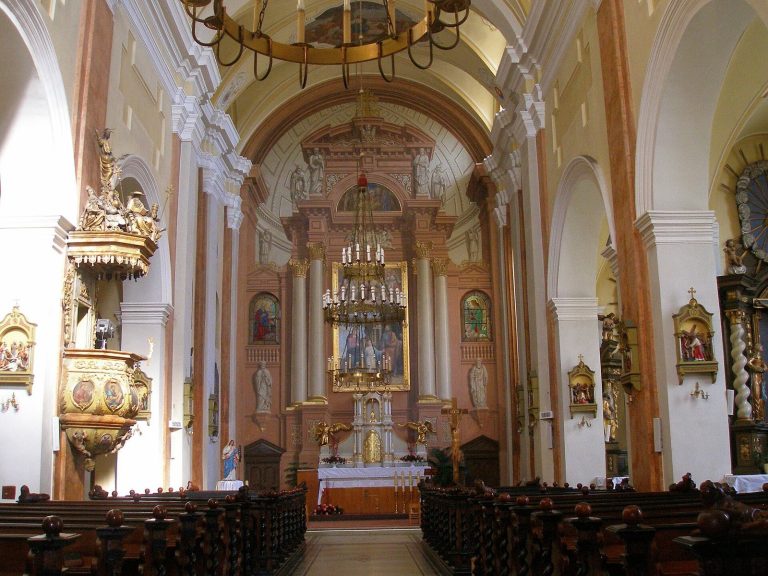
The wooden altar, made in 1865 in the Classicist style, which draws on forms associated with classical antiquity, was crafted by Ján Maršálek to designs by Béla Gerster and Frey. Jesuits had removed an earlier altar in 1673. The central painting shows Jesus and the Samaritan woman, an episode from John 4:1–30. Karol Brocký painted the original in 1845–1846 at the request of his friend, Evangelical pastor Móric Kolbenheyer. It travelled from London to Prešov by way of Hamburg, Vienna, and Sopron, and its arched upper section was fitted to the altar.
The 1913 fire destroyed Brocký’s painting. After the altar was repaired in 1914, a canvas bearing a black cross temporarily replaced it. Mikuláš Jordán and Ernest Rákoši began a replacement in 1922, working from a photograph and using an older copy by Košice artist Vojtech Klimkovič as a colour guide. The painting was installed in the altar frame in 1924, when senior Matej Slabej consecrated the altar. A medallion above it depicts a lamb on a black book with golden rays: the lamb represents Christ’s innocence, and the book and rays his teaching. A white cross crowns the altar.
Organ and gallery
Built between 1642 and 1647, the organ stands in the north gallery and contains 1,530 pipes of different sizes. Its decorated gallery rail places Christ at the centre, with Peter holding keys, Mark beside a lion, and Matthew beside a human figure on one side; John with an eagle, Luke with an ox, and Paul with a sword appear on the other. A sculpture of King David playing a harp crowns the organ, with Prešov’s 1558 coat of arms in front of him. Four angels adorn the case: the upper pair hold trumpets and palm leaves, while the lower pair play violins. Vine patterns, five winged angel heads, and two columns topped by herms, supports ending in carved heads or busts, complete the decoration.
In 1787 the organ was repaired, regilded, and given Baroque ornament, an elaborate European artistic style, under the direction of Prešov senator Samuel Steller. Jozef Borovetzki completed the work in April. Franz Gatt cleaned and repaired the instrument in 1813, and Jozef Reiszmayer carried out further work in 1862–1864. Repairs following the 1913 fire included adding an electric motor. The organ was thoroughly cleaned in 1947 and 1980–1981, then underwent major reconstruction and tuning in 1997.
Jesuit alterations
During Jesuit administration, a covered, roofed passage was built in 1716 to connect the college with the church’s north gallery, and a wall enclosed the church and college as a residence. Evangelicals removed the passage and wall in 1867 while rebuilding the college. The Jesuits had also replaced the galleries’ original wooden railings with masonry railings in 1728.